OpenClaude
Open-source, model-agnostic terminal coding agent
In short
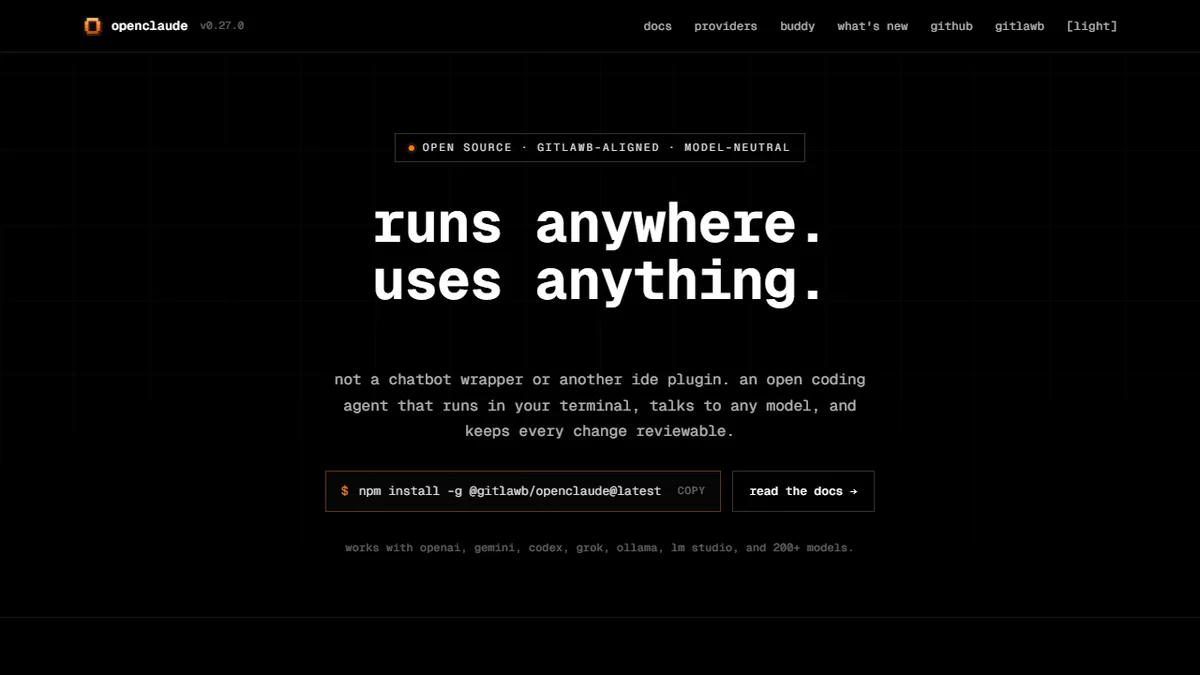
OpenClaude is a model-agnostic, open-source CLI tool that automates coding tasks like file editing and shell execution. It is best for developers seeking a Claude Code-style workflow without vendor lock-in, supporting both cloud APIs and local models.
Developers and small teams who want a Claude Code-style terminal agent without vendor lock-in — especially those routing to local Ollama/LM Studio models or mixing cheap and premium providers per task.
Non-technical users, teams that need a GUI or IDE integration, and organisations that want a single-vendor supported product with SLAs rather than a self-managed open-source CLI.
OpenClaude is an open-source, terminal-based coding agent distributed through npm as `@gitlawb/openclaude`. It runs locally on Node.js 22+ and drives development tasks — reading and editing files, executing shell commands, searching with grep and glob, calling MCP servers, and streaming diffs — while keeping every action reviewable. Where most coding agents lock you to a single vendor, OpenClaude is deliberately model-agnostic: it advertises support for OpenAI, Gemini, Grok, Codex, Ollama, LM Studio, GitHub Models, DeepSeek and roughly 200 additional models across hosted and self-hosted providers, so teams can point it at whatever backend fits their budget, latency, or data-residency needs. Typical workflows include interactive coding sessions where the agent proposes changes as visible diffs you approve or reject, non-interactive scripted runs that emit JSON for CI pipelines and pre-commit hooks, and long refactors that lean on session management to resume, branch, or rewind prior turns. Repository-scoped configuration profiles let a monorepo, a Rust crate, and a Next.js app each carry their own model, tool allowlist, and prompt tuning without polluting a global config. Because it ships as a plain CLI, it slots into tmux, VS Code terminals, and remote SSH sessions the same way, and self-hosters can pair it with a local Ollama or LM Studio instance to keep code and prompts entirely on-prem. A small pixel-art 'buddy' companion adds some personality without burning tokens. It is best understood as a Claude Code / Aider-style workflow that is intentionally not tied to Anthropic's models or hosted service.
A pragmatic answer to 'I like the Claude Code workflow but I do not want to be tied to one vendor.' The 200+ model claim is really 'whatever the OpenAI-compatible or Ollama API can reach', which is exactly the right abstraction for a CLI agent. Rough edges around docs and defaults, but the session model and scriptable JSON mode are genuinely useful.
— The AI Tool Bible editorial team
Pros
- ✅ Model-agnostic: openai, gemini, grok, ollama, lm studio, github models, deepseek and 200+ backends
- ✅ Fully open source and installable via a single npm command
- ✅ First-class support for local models via Ollama and LM Studio for private / offline coding
- ✅ Real developer toolset baked in: bash, file edit, grep, glob, and MCP server calls
- ✅ Session resume, branching, and rewind make long refactors and exploratory work practical
- ✅ Non-interactive JSON mode makes it scriptable inside CI, pre-commit hooks, and cron jobs
- ✅ Per-repository config profiles keep monorepo and polyglot setups clean
Cons
- ⚠️ Terminal-only — no IDE panel, GUI, or web dashboard
- ⚠️ Quality depends heavily on which backend model you configure; no opinionated default
- ⚠️ Requires Node.js 22+, which some enterprise environments still lag on
- ⚠️ Documentation and community are small compared to Claude Code, Aider, or Cursor
- ⚠️ The 'OpenClaude' name invites confusion with Anthropic's Claude, though it is unaffiliated
- ⚠️ No hosted offering — every user manages their own API keys, rate limits, and billing
Use cases
Frequently asked
- Is OpenClaude free to use?
- Yes, the software is free and open source. You only pay for the underlying model API you configure, or it costs $0 if you use local models via Ollama or LM Studio.
- Which AI models does OpenClaude support?
- It is model-agnostic and supports OpenAI, Gemini, Grok, Codex, Ollama, LM Studio, GitHub Models, DeepSeek, and approximately 200 other hosted or self-hosted providers.
- Can OpenClaude run locally without an internet connection?
- Yes, it can be paired with local instances of Ollama or LM Studio to keep code and prompts entirely on-premises for offline coding.
- Does OpenClaude integrate with IDEs or GUIs?
- No, it is a terminal-only CLI tool. It does not offer IDE panels, GUIs, or web dashboards, but it works within tmux, VS Code terminals, and SSH sessions.
- What are the system requirements for OpenClaude?
- It runs locally on Node.js 22+ and is distributed through npm as @gitlawb/openclaude.
Explore related
Compare with similar tools
All in Coding →Cursor
FeaturedAI-first VS Code fork — chat, edit, and agentic coding in one IDE.
GitHub Copilot
FeaturedThe original AI pair programmer, now with chat and agents.
Replit Agent
FeaturedBuild & deploy a full app from a single prompt.
Warp
The agentic development environment, from the terminal up
Cline
Open-source agentic coding assistant that plans, edits, and runs code inside your IDE
Aider
Terminal-based AI pair programmer that writes commits.