OpenArt
All-in-one AI canvas that bundles a dozen top image, video, and audio models behind a single subscription.
In short
OpenArt bundles top AI image, video, and audio models into one subscription. It offers a unified canvas for consistent characters and short-form content creation.
Pick OpenArt if you want one subscription that covers the current SOTA image and video models with a consistent-character pipeline for short-form content.
Skip it if you need self-hosting, open weights, or low-level node-graph control over a single diffusion model.
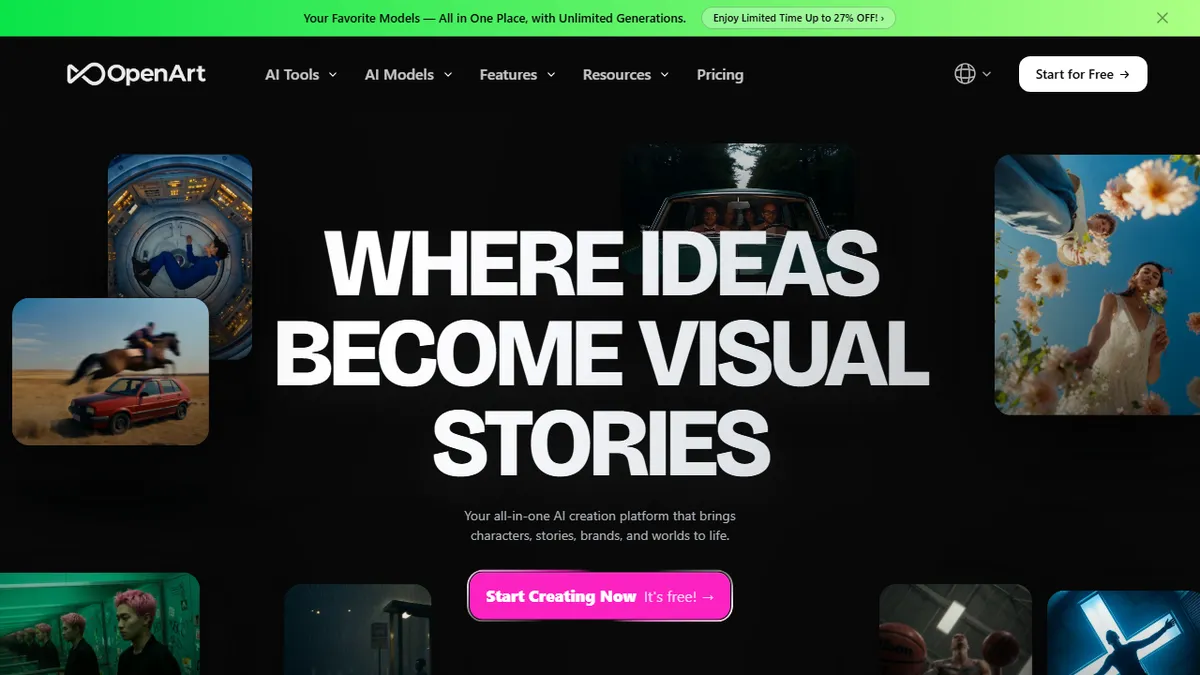
OpenArt is a consumer-facing AI creation platform that aggregates the leading image, video, audio, and 3D generation models into one workspace. Instead of juggling separate subscriptions for Sora, Veo, Kling, Seedance, GPT Image, Nano Banana, and Hailuo, you pay OpenArt once and call them from a unified canvas that also handles editing, upscaling to 4K, background swapping, and outpainting.
It is aimed squarely at solo creators, brand teams, and short-form video producers who want a single tool to draft TikTok/Instagram/YouTube assets. The differentiators are character consistency across scenes, multi-shot 'story' videos with synced dialogue and music, and a deep audio stack (30+ language voiceovers, voice cloning, sound effects). Pricing is freemium with daily credit allowances on the free tier and paid plans that unlock premium models and higher resolutions.
It is not the right pick if you want fine-grained, ComfyUI-style control over a single open model, or self-hosting. OpenArt's value is breadth and convenience: the model roster is updated quickly when new SOTA models drop, and the canvas glues them together with consistent characters, story arcs, and editing tools that the underlying providers don't ship on their own.
OpenArt has quietly become one of the best 'meta-clients' for generative media — the kind of place a freelancer can ship a full ad spot without leaving the tab. The aggregator model means you're never stranded on yesterday's SOTA, but you are paying a markup on credits, and the magic is in the canvas glue, not any proprietary model.
— The AI Tool Bible editorial team
Pros
- ✅ Aggregates Sora 2, Veo 3, Kling 3.0, Seedance, GPT Image and more under one bill
- ✅ Strong character consistency across scenes and videos
- ✅ Built-in editing canvas: outpaint, erase, upscale to 4K, background swap
- ✅ Integrated audio: voiceovers in 30+ languages, voice cloning, music, SFX
- ✅ Free tier with daily credits, no card required to try
Cons
- ⚠️ Credit-based pricing makes heavy video work expensive fast
- ⚠️ Less low-level control than ComfyUI or A1111 power-user setups
- ⚠️ Closed platform — no self-hosting and no model weights
- ⚠️ Quality depends on which third-party model is routed to your job
Use cases
Frequently asked
- How much does OpenArt cost?
- OpenArt uses a freemium model. Paid plans include Starter at $14, Plus at $34, Pro at $56, and Wonder at $240. The free tier provides daily credit allowances, while paid plans unlock premium models and higher resolutions.
- Which AI models are available in OpenArt?
- OpenArt aggregates leading models including Sora 2, Veo 3, Kling 3.0, Seedance, GPT Image 2, Hailuo, and Nano Banana. It supports image, video, audio, and 3D generation within a single workspace.
- Is OpenArt suitable for self-hosting or open weights?
- No. OpenArt is not the right pick if you need self-hosting, open weights, or low-level node-graph control over a single diffusion model. Its value lies in breadth and convenience for consumer-facing creation.
- What features help with character consistency?
- OpenArt offers a consistent-character pipeline for short-form content. It supports multi-shot 'story' videos with synced dialogue and music, allowing creators to maintain character consistency across scenes without juggling separate subscriptions.
- Does OpenArt support audio generation?
- Yes. It includes a deep audio stack with 30+ language voiceovers, voice cloning, and sound effects. This allows users to create assets with synced dialogue and music directly within the unified canvas.
Explore related
Compare with similar tools
All in Image Generation →Midjourney
FeaturedThe gold standard for aesthetic AI image generation.
Flux
FeaturedBlack Forest Labs' open-weights image model — rivals Midjourney quality.
Stable Diffusion
Open-source image generation — run anywhere, fine-tune anything.
Nano Banana (Gemini Image)
Google DeepMind's Gemini-powered image generation and conversational editing model family
DALL·E 3
OpenAI's image model — strong on prompt adherence and text-in-image.
Canva Magic Studio
Canva's all-in-one AI creative suite for design, image, video, copy, and presentations