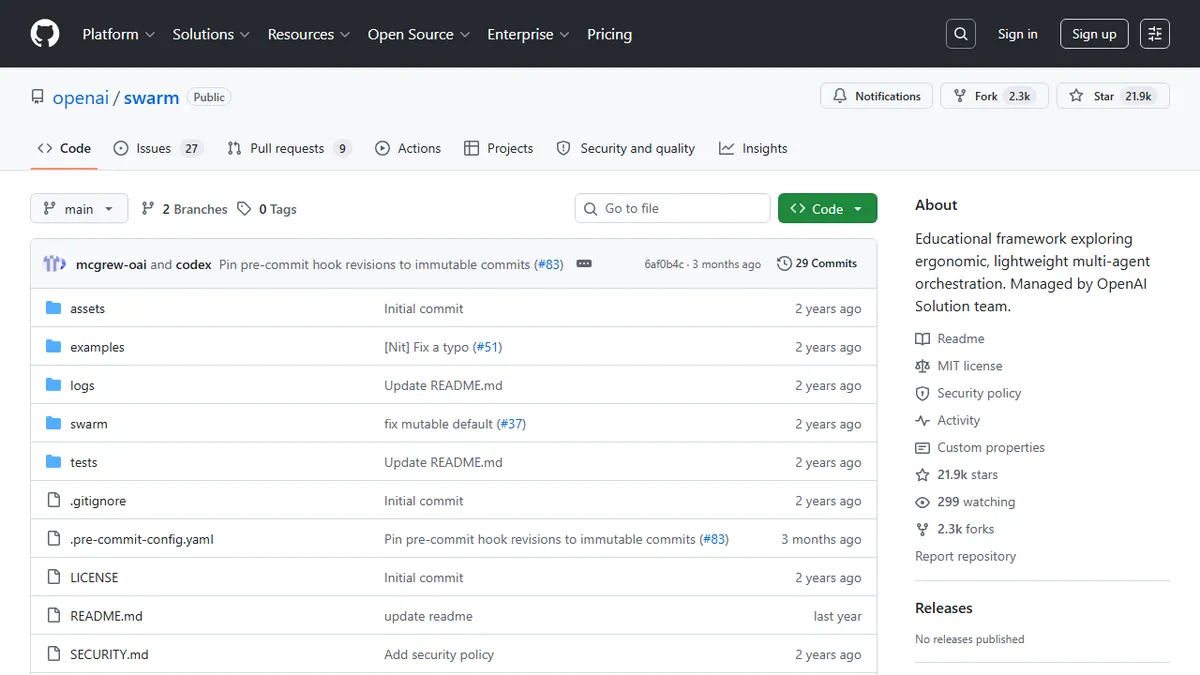

OpenAI Swarm
✓ Editorially verifiedLightweight multi-agent orchestration in Python.
In short
OpenAI Swarm is a free, educational Python framework for multi-agent handoffs. It is ideal for learning patterns and prototyping, but explicitly not for production use.
Pick Swarm when you want to learn multi-agent patterns in minimal code or build a quick experiment.
Skip it for anything production — OpenAI explicitly positions it as educational.
Swarm is OpenAI's experimental framework for multi-agent handoffs in Python — minimal, readable, and a good way to learn the patterns of multi-agent design before committing to a production framework. The codebase fits in your head, which is rare in this category.
It's explicitly positioned by OpenAI as educational rather than production-grade. There's no observability layer, no deployment story, and no committment to ongoing maintenance. The handoff pattern (agents passing control to each other) is well-illustrated and easy to reason about, which is exactly the point.
For learning multi-agent patterns, for short-lived experiments, and for one-off internal tools where production-grade isn't needed, Swarm is the easiest way in. For anything that needs to run reliably under SLA, graduate to LangGraph or CrewAI before deploying.
Swarm is the rare framework that's better as a teaching tool than as a product. Read the source, build something small, then move to LangGraph or CrewAI for anything serious.
— The AI Tool Bible editorial team
Pros
- ✅ Minimal, readable code
- ✅ Great for learning patterns
- ✅ Free and open
- ✅ Handoff pattern is well-illustrated
Cons
- ⚠️ Not production-grade by design
- ⚠️ Limited tooling/observability
Use cases
Frequently asked
- Is OpenAI Swarm free to use?
- Yes, Swarm is free and open-source. It is designed for educational purposes and quick experiments, allowing you to build multi-agent patterns without any cost or licensing fees.
- Can I use Swarm for production applications?
- No, OpenAI explicitly positions Swarm as educational rather than production-grade. It lacks observability, deployment stories, and maintenance commitments. For production needs, you should graduate to frameworks like LangGraph or CrewAI.
- What is the learning curve for Swarm?
- The learning curve is minimal because the codebase is small, readable, and fits in your head. It is designed to be the easiest way to learn multi-agent design patterns and handoffs in Python.
- Which AI models does Swarm support?
- Swarm is designed for OpenAI models but is extensible. It allows you to experiment with multi-agent handoffs using the models you have access to, though it is primarily built around the OpenAI ecosystem.
- What are the best use cases for Swarm?
- Swarm is best for education, prototyping, and short-lived experiments. It is ideal for one-off internal tools where production-grade reliability is not required, helping you understand multi-agent patterns before committing to heavier frameworks.
Explore related
Compare with similar tools
All in Agents →LangGraph
FeaturedStateful, graph-based agent orchestration from LangChain.
CrewAI
FeaturedPython framework for multi-agent orchestration.
Ernie Bot
Baidu's Mandarin-first ChatGPT rival, powered by the ERNIE model family
Moveworks
The enterprise AI assistant that searches, answers, and takes action across your business systems
AWS Bedrock
Build and scale generative AI applications with foundation models
Claude Agent SDK
Anthropic's official SDK for building autonomous Claude agents.