OpenAI Agents SDK (Python)
A lightweight Python framework for building multi-agent LLM applications with handoffs, guardrails, and built-in tracing.
In short
This lightweight Python SDK enables production-ready multi-agent systems with built-in handoffs, guardrails, and tracing. It is best for Python teams using the OpenAI Responses API who want structured orchestration without heavy frameworks.
Python teams building production agent systems on the OpenAI Responses API who want handoffs, guardrails, tool-calling, and tracing without adopting a heavy orchestration framework.
Teams that primarily target non-OpenAI models, need a non-Python runtime, or want an off-the-shelf UI and workflow builder rather than a code-first SDK.
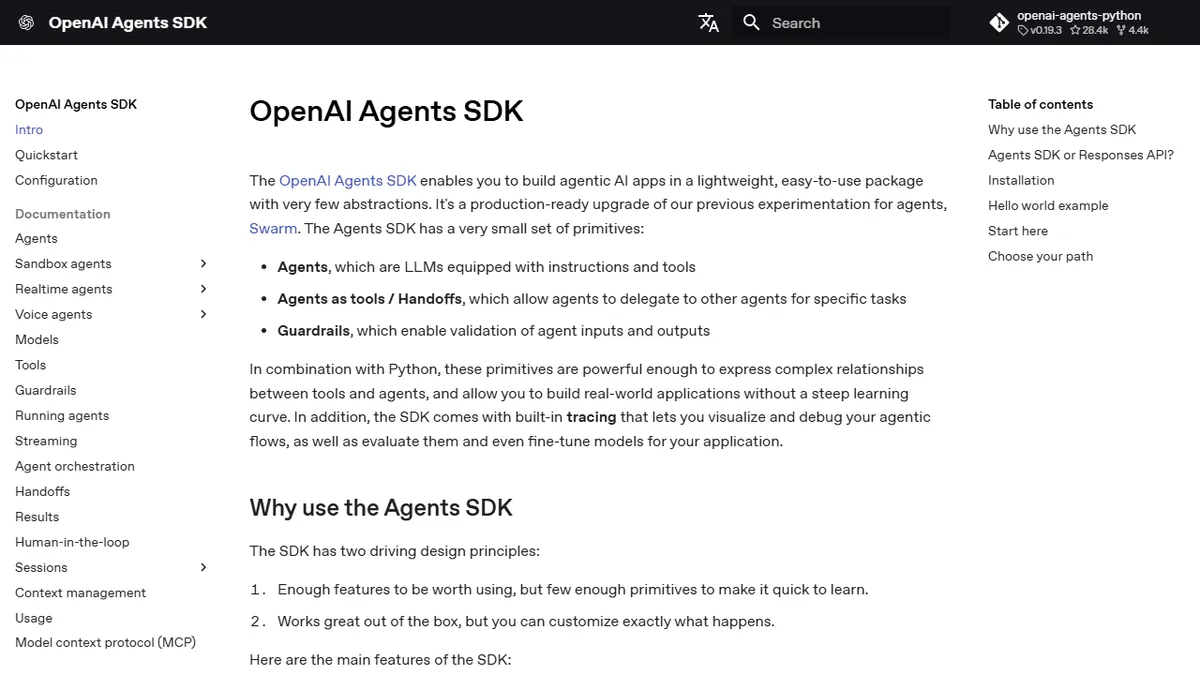
OpenAI Agents SDK is a Python framework for building production agentic applications on top of LLMs — chiefly OpenAI's, but the runtime is provider-pluggable. It is the successor to OpenAI's earlier Swarm experiment and is deliberately small: a handful of primitives (Agent, Runner, Session, Handoff, Guardrail, function tools, tracing) instead of the deep class hierarchies that make larger frameworks hard to reason about. An Agent is an LLM with instructions, a set of tools, and optional structured output. The Runner drives the model-tool loop until the agent decides it is done; Sessions give you persistent conversational memory; Handoffs let one agent transfer control to another specialist agent; Guardrails run classifier-style checks in parallel to short-circuit unsafe input or output. Python functions become tools automatically via type hints and docstrings, and everything is traced by default so you can inspect each model call, tool invocation, and handoff in the OpenAI trace viewer. The SDK also ships first-class support for realtime voice agents (gpt-realtime for low-latency speech-to-speech) and 'sandbox' agents that run inside isolated workspaces for code execution or long-lived task state. It is a natural fit for teams already committed to the OpenAI Responses API who want structured orchestration without adopting a heavy framework like LangGraph or CrewAI, and it is opinionated enough to get a coherent multi-agent system running in a few dozen lines.
This is the framework I reach for when I want an agent system that a colleague can read in one sitting. The handoff primitive is the honest win over LangChain-era designs, and default tracing removes the usual 'why did the agent do that' debugging tax. The trade-off is real: leave the OpenAI ecosystem and half the polish evaporates.
— The AI Tool Bible editorial team
Pros
- ✅ Very small surface area — a handful of primitives means the whole SDK fits in your head in an afternoon
- ✅ First-class handoffs and guardrails make multi-agent and safety patterns idiomatic instead of bolt-on
- ✅ Automatic function-to-tool conversion from Python type hints and docstrings, with structured Pydantic outputs
- ✅ Built-in tracing viewer surfaces every model call, tool call, and handoff without extra instrumentation
- ✅ Realtime voice agent support (gpt-realtime) is unusually mature for an agent framework
- ✅ Provider-pluggable — you can point it at non-OpenAI models via the LiteLLM integration or a custom model provider
- ✅ Open source under MIT, actively maintained by OpenAI itself, so it tracks new Responses API features quickly
Cons
- ⚠️ Strongly Python-first — the JS/TS sibling exists but lags in features, and there is no other-language support
- ⚠️ Optimised for the OpenAI Responses API; using it with Anthropic, Gemini, or local models works but loses some ergonomics (built-in tools, tracing fidelity)
- ⚠️ Tracing dashboard is hosted by OpenAI, which some regulated teams cannot use without extra work
- ⚠️ Fewer high-level building blocks than LangGraph/CrewAI — you write more of the orchestration and state logic yourself
- ⚠️ Documentation assumes fluency in async Python and the Responses API; not a great first agent framework for beginners
Use cases
Frequently asked
- Is the OpenAI Agents SDK free to use?
- Yes, the SDK is free and open source under the MIT license. You only pay for the underlying model provider costs, such as OpenAI API pricing.
- What are the core components of the SDK?
- The framework uses a small set of primitives including Agent, Runner, Session, Handoff, Guardrail, function tools, and tracing to manage the model-tool loop.
- Can I use models other than OpenAI's with this SDK?
- Yes, the runtime is provider-pluggable. You can point it at non-OpenAI models via LiteLLM integration or a custom model provider, though some ergonomics may be reduced.
- Does the SDK support voice agents?
- Yes, it ships with first-class support for realtime voice agents using gpt-realtime for low-latency speech-to-speech applications.
- Is this SDK suitable for beginners?
- It is not ideal for beginners, as the documentation assumes fluency in async Python and the OpenAI Responses API.
Explore related
Compare with similar tools
All in Agents →LangGraph
FeaturedStateful, graph-based agent orchestration from LangChain.
CrewAI
FeaturedPython framework for multi-agent orchestration.
Ernie Bot
Baidu's Mandarin-first ChatGPT rival, powered by the ERNIE model family
Moveworks
The enterprise AI assistant that searches, answers, and takes action across your business systems
AWS Bedrock
Build and scale generative AI applications with foundation models
Claude Agent SDK
Anthropic's official SDK for building autonomous Claude agents.