Oh My OpenAgent
Open-source multi-agent orchestration framework that coordinates specialized AI coders across planning, execution, and verification.
In short
Oh My OpenAgent is a free, open-source multi-agent framework for autonomous coding. It coordinates specialized AI agents across planning, execution, and verification using your own API keys.
Pick Oh My OpenAgent if you want a configurable, model-agnostic multi-agent harness layered on OpenCode or Codex CLI for autonomous coding runs.
Skip it if you want a hosted, point-and-click coding agent or a single-model assistant without CLI setup and multi-provider API keys.
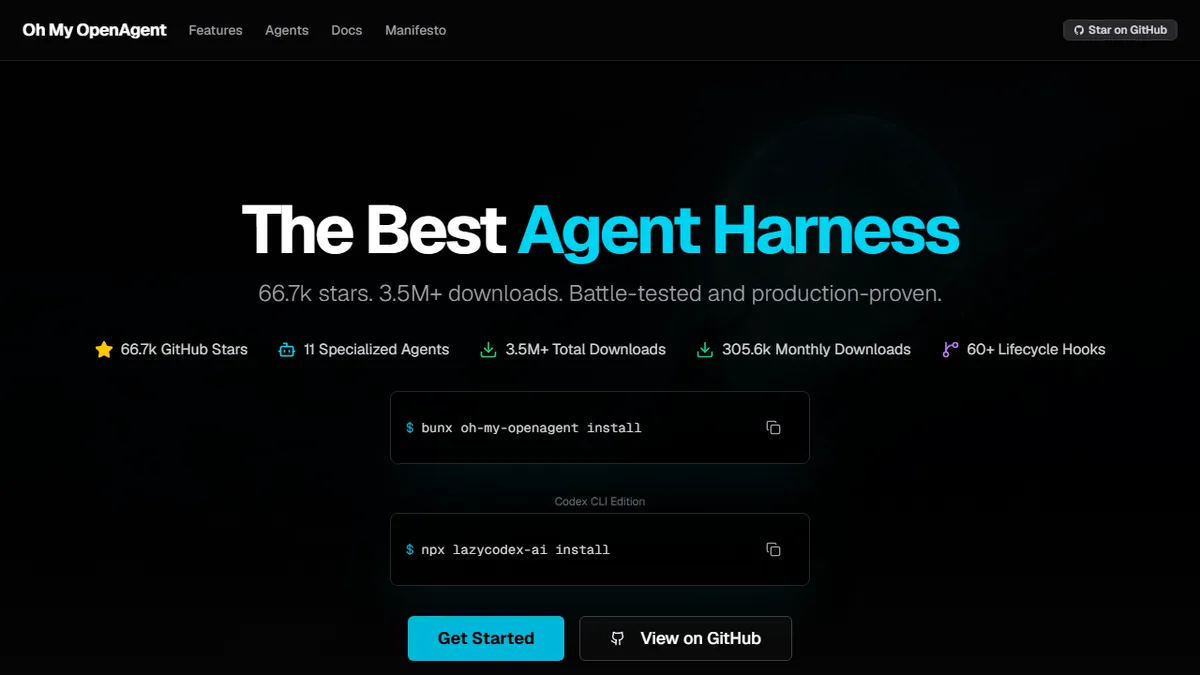
Oh My OpenAgent (omo) is an open-source agent harness for software development that splits work across 11 specialized agents and routes each task to the model best suited for it. It ships in two editions, a full OpenCode build and a lighter Codex CLI build, and exposes a Team Mode that runs up to 8 agents in parallel, with session continuity via a 'boulder.json' resume file and 60+ lifecycle hooks for customization.
It is aimed at developers who want more structure than a single chat-style coding agent and don't mind wiring a config-heavy harness around their existing CLI. The signature 'Ultra Work' (ulw) mode kicks off autonomous multi-step runs that separate planning from execution and then independently verify the result. Pricing isn't published on the site because the framework itself is free under the SUL-1.0 license; you pay only the underlying model providers.
Under the hood it brokers between Claude Opus 4.7 Max for orchestration, plus Sonnet 4.6, multiple GPT 5.5 variants, Gemini 3.1 Pro, and others depending on the task category. There's no hosted SaaS or REST API — it's a local framework you install on top of OpenCode or Codex CLI, so usability depends on how comfortable you are managing model keys and CLI tooling.
A serious attempt at a real orchestration layer rather than another chat wrapper — the plan/execute/verify split and per-category model routing are the right ideas. It's CLI-first and assumes you'll bring keys for Claude, GPT, and Gemini, so it's squarely for developers, not casual users.
— The AI Tool Bible editorial team
Pros
- ✅ Routes tasks to model best suited per category instead of one-size-fits-all
- ✅ Parallel Team Mode runs up to 8 agents at once
- ✅ Plan/execute/verify separation reduces single-agent drift
- ✅ Open source under SUL-1.0 with extensive hook system
- ✅ Session resumption via boulder.json keeps long runs recoverable
Cons
- ⚠️ No hosted product — local CLI install with config overhead
- ⚠️ Requires paid API keys from multiple model providers to use fully
- ⚠️ Documentation and ecosystem still young compared to mainstream agents
Use cases
Frequently asked
- How much does Oh My OpenAgent cost?
- The framework is free and open-source under the SUL-1.0 license. You only pay for the underlying model providers by bringing your own API keys. There is no hosted SaaS or subscription fee for the tool itself.
- Which AI models does it support?
- It is model-agnostic, supporting Claude Opus 4.7, Sonnet 4.6, GPT 5.5 variants, and Gemini 3.1 Pro. It routes tasks to the best-suited model, using Claude Opus 4.7 Max specifically for orchestration.
- Is it difficult to set up?
- It requires CLI setup and managing multiple provider API keys. It is a local framework installed on top of OpenCode or Codex CLI, so it is not a point-and-click solution. It suits developers comfortable with config-heavy harnesses.
- Can it run multiple agents at once?
- Yes, it features a Team Mode that runs up to 8 agents in parallel. It splits work across 11 specialized agents, allowing for parallel execution and independent verification of results during autonomous runs.
- Does it offer a hosted version?
- No, there is no hosted SaaS or REST API. It is a local framework you install on your machine. You must manage the CLI tooling and model keys yourself, as it is not a cloud-based service.
Explore related
Compare with similar tools
All in Agents →LangGraph
FeaturedStateful, graph-based agent orchestration from LangChain.
CrewAI
FeaturedPython framework for multi-agent orchestration.
Ernie Bot
Baidu's Mandarin-first ChatGPT rival, powered by the ERNIE model family
Moveworks
The enterprise AI assistant that searches, answers, and takes action across your business systems
AWS Bedrock
Build and scale generative AI applications with foundation models
Claude Agent SDK
Anthropic's official SDK for building autonomous Claude agents.