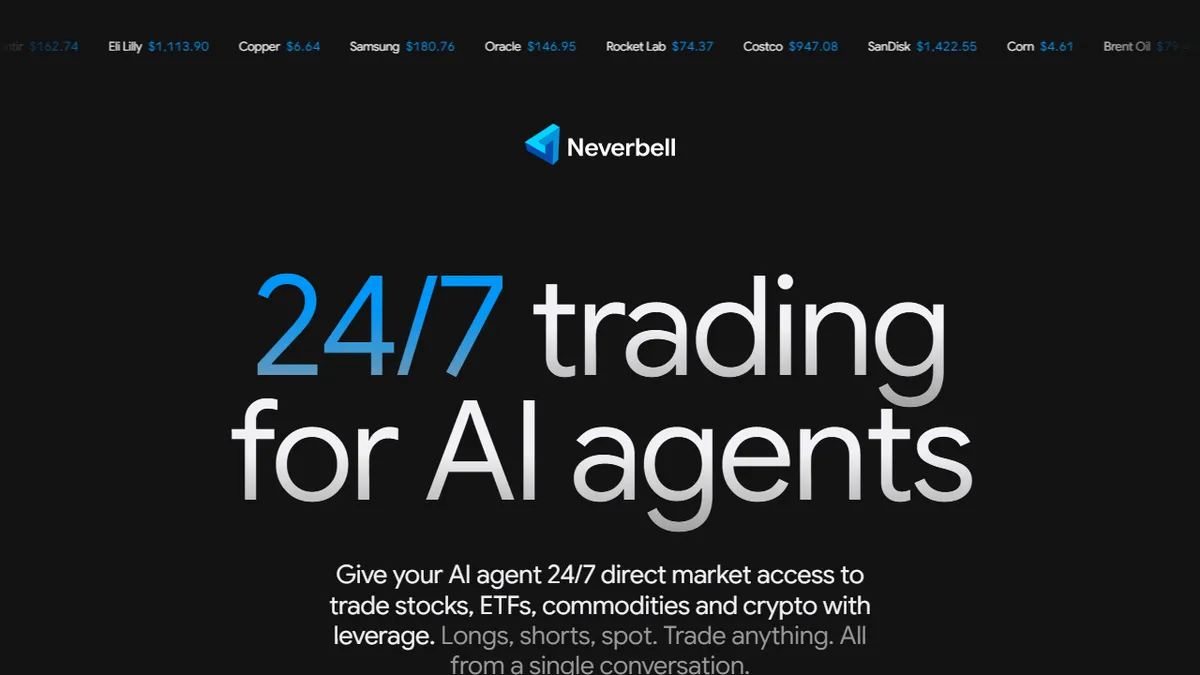
Neverbell
Market access skill that lets AI agents monitor and trade real markets
Technical retail traders and quant tinkerers who already run LLM-driven agents and want a governed way to let those agents place real trades across multiple asset classes.
Passive investors, users seeking financial advice, or anyone uncomfortable with the risk of an autonomous agent placing leveraged trades on their behalf.
Neverbell is a market-access skill designed for AI agents, giving them the ability to monitor global markets and execute trades on behalf of a human operator. Rather than being a standalone robo-advisor or a self-contained trading bot, it functions as a connector layer that plugs into agent frameworks like Claude Code, OpenClaw, and Hermes, exposing brokerage-style capabilities (long, short, spot, and leveraged positions across stocks, ETFs, commodities, and crypto) through natural-language instructions. The agent interprets the operator's intent, consults news feeds and sentiment signals if wired in, and then routes orders through Neverbell's infrastructure subject to user-defined guardrails: position caps, instrument allowlists, confirmation prompts before execution, and per-trade risk limits. Typical workflows include letting an always-on agent watch pre-market catalysts and open a scaled entry when a set of conditions triggers, running a scripted rebalance across a portfolio without touching a broker UI, or asking an agent conversationally to hedge exposure ahead of an earnings print. Because it targets operators who are already comfortable in agent-based or terminal workflows, it treats the LLM as the decision surface and Neverbell as the execution rail, with the user responsible for the strategy and its outcomes. Currently in early access, new users receive $1,000 in test funds to experiment with agent-driven trading before committing capital.
Neverbell is one of the more interesting attempts to give agent frameworks a real execution rail rather than just a data feed. It sensibly leans on user-defined guardrails and confirmation steps, but the value depends entirely on how disciplined the operator's prompts and limits are - the tool cheerfully executes what the agent decides. Worth trialing with the test funds before wiring it into anything that touches real money.
— The AI Tool Bible editorial team
Pros
- ✅ Purpose-built to give existing AI agents (Claude Code, OpenClaw, Hermes) real market execution rather than just paper analysis
- ✅ Broad instrument coverage across stocks, ETFs, commodities, and crypto with long, short, and leveraged positions
- ✅ User-defined permission controls and confirmation steps keep the human in the loop by default
- ✅ Natural-language instruction handling removes the need to script broker APIs directly
- ✅ 24/7 monitoring fits crypto and after-hours workflows
- ✅ Free $1,000 in test funds during early access lets you validate an agent strategy before risking real capital
Cons
- ⚠️ Early access with no public pricing tiers means production cost is unpredictable
- ⚠️ Autonomous trade execution introduces real financial risk if guardrails are misconfigured
- ⚠️ Assumes fluency with agent frameworks and terminals, so non-technical retail investors will struggle
- ⚠️ Public documentation on API surface, supported jurisdictions, and regulated broker relationships is thin
- ⚠️ No claim of being a fiduciary or robo-advisor - all strategy and loss falls on the operator
Use cases
Explore related
Compare with similar tools
All in Agents →LangGraph
FeaturedStateful, graph-based agent orchestration from LangChain.
CrewAI
FeaturedPython framework for multi-agent orchestration.
Ernie Bot
Baidu's Mandarin-first ChatGPT rival, powered by the ERNIE model family
Moveworks
The enterprise AI assistant that searches, answers, and takes action across your business systems
AWS Bedrock
Build and scale generative AI applications with foundation models
Claude Agent SDK
Anthropic's official SDK for building autonomous Claude agents.