Netdata
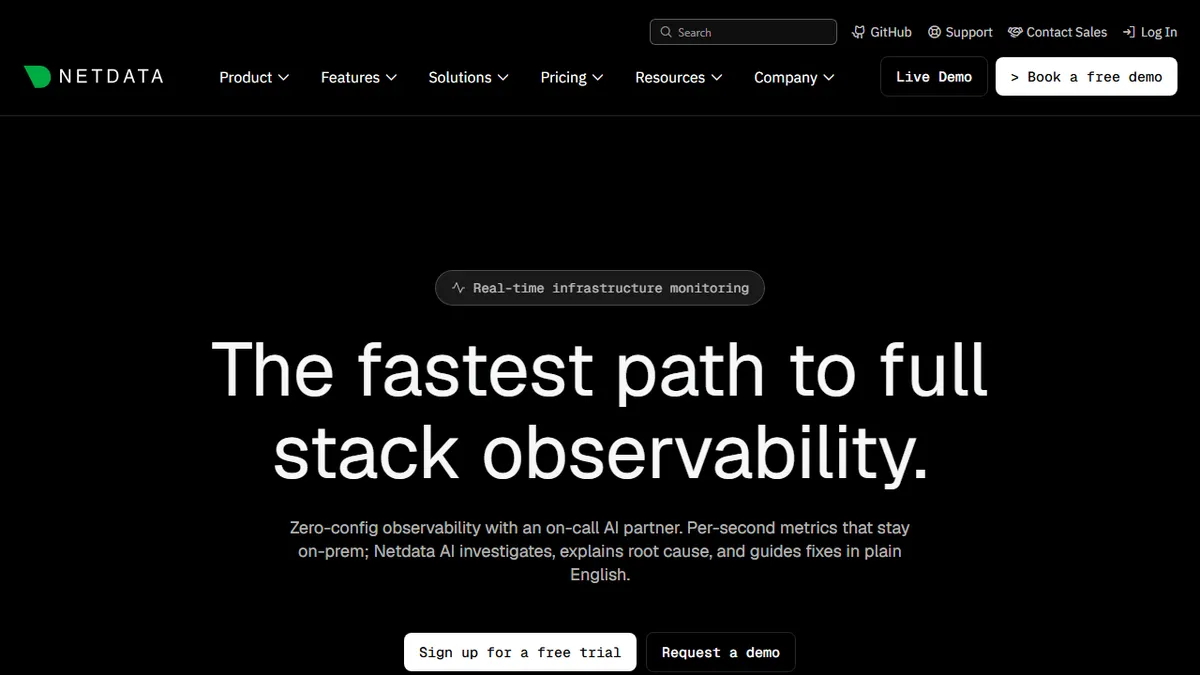
Not yet source-checkedReal-time infrastructure observability with embedded AI anomaly detection and an AI co-engineer for root-cause analysis.
Machine-drafted from the vendor's site · not yet source-checkedProfile updated Link checked Pricing captured How we rate
In short
Netdata offers zero-config, per-second infrastructure monitoring with edge-native ML anomaly detection. It includes an AI Co-Engineer for root-cause analysis and MCP support for AI assistants.
SRE, DevOps and platform teams that want zero-config, per-second monitoring with edge-native ML anomaly detection and an MCP endpoint that AI assistants can drive during incidents.
Teams looking for a general-purpose AI assistant, content generator, or vector-DB/RAG stack — Netdata is an observability product with AI features, not an AI-first tool.
Netdata is an open-source (GPLv3+) infrastructure monitoring and observability platform that has grown a substantial AI layer on top of its per-second metrics engine. The agent auto-discovers services across 800+ integrations with essentially zero configuration, then runs unsupervised machine-learning models on every collected metric at the edge to score anomalies in real time. Where it earns a place in an AI-tools directory is the newer troubleshooting stack: an 'AI Co-Engineer' that walks an on-call engineer through incident triage, automated blast-radius detection that correlates anomalies across nodes to point at a likely root cause, and 'Ask Nedi', a documentation- and source-code-trained assistant for support questions. Netdata also ships a Model Context Protocol (MCP) server, so Claude, ChatGPT, Cursor and other MCP-aware clients can query live infrastructure state, list anomalies, and reason over logs and metrics as tool calls. The typical workflow is: drop the lightweight agent (~5% CPU, 150MB RAM) onto every host, connect nodes to Netdata Cloud or self-host the parent, let the ML baselines learn normal behavior for a few days, then use the anomaly advisor and AI Co-Engineer during incidents instead of hand-writing PromQL. It is aimed at SREs, DevOps and platform teams that want observability with AI assistance without paying per-GB ingest fees or shipping raw telemetry to a vendor. Data retention stays on-premises by default, which is unusual among AI-augmented monitoring products.
Netdata is one of the few monitoring stacks where the AI layer feels like real product rather than a bolted-on chat widget: anomaly rates per metric are surprisingly usable, and the MCP server is a legitimate reason to point Claude or Cursor at your fleet. It belongs in an AI directory mostly as an example of 'AI-augmented observability' — pick it for the monitoring, enjoy the AI as leverage on top.
— The AI Tool Bible editorial team
Pros
- ✅ Genuinely open source (GPLv3+) with a large contributor base and self-hostable parent nodes
- ✅ Per-metric unsupervised ML runs at the edge, so every chart has an anomaly rate without you configuring anything
- ✅ MCP server lets Claude/ChatGPT/Cursor query live infra state as tool calls
- ✅ AI Co-Engineer and Ask Nedi produce useful triage guidance instead of just dumping dashboards
- ✅ Node-based pricing avoids the per-GB ingest surprises typical of Datadog/New Relic
- ✅ 800+ pre-built collectors mean minimal config to get real coverage
- ✅ Data retention stays on-prem by default, which is easier to sell to compliance
Cons
- ⚠️ Fundamentally an observability platform with AI layered on top, not a general-purpose AI product
- ⚠️ Anomaly scores are noisy on bursty workloads until baselines have trained for several days
- ⚠️ AI Co-Engineer and Ask Nedi quality depend on Netdata Cloud connectivity and are less capable in fully air-gapped self-hosted setups
- ⚠️ Query language and dashboard idioms are Netdata-specific; teams already on Prometheus/Grafana face migration friction
- ⚠️ Business tier pricing is quote-based above the small Homelab plan, so budgeting requires a sales conversation
Pricing (captured )
| Tier | Monthly | Annual | Key features |
|---|---|---|---|
| Homelab | — | $90/yr |
|
Prices change; we show the grid as captured on Nov 15, 2026. Check current pricing on the vendor's site →
Facts
- API available
- Yes
- Free trial
- Yes
- Open source
- Yes
- Model used
- In-house unsupervised ML models for per-metric anomaly detection; AI Co-Engineer and Ask Nedi built on third-party LLMs (unspecified) with MCP integration for external assistants
- Hacker News
- 17 stories · top 13 points · last Jul 8, 2026 · checked Nov 17, 2026
- Earliest Wayback capture
- 2019-05-22 (earliest archived capture of the site, not a launch date)
Where this tool sits
Use cases
Frequently asked
- How much does Netdata cost?
- Netdata uses a freemium model. The Community edition is free. Business costs $4.50 per node per month. Enterprise pricing requires contacting sales. This avoids per-GB ingest fees common in other monitoring tools.
- Is Netdata a general-purpose AI assistant?
- No. Netdata is an observability product with AI features, not an AI-first tool. It is not a general-purpose assistant, content generator, or vector-DB/RAG stack. It focuses on infrastructure monitoring and incident triage.
- How does the AI Co-Engineer work?
- The AI Co-Engineer walks on-call engineers through incident triage. It uses automated blast-radius detection to correlate anomalies across nodes and point at likely root causes. It is built on third-party LLMs with MCP integration.
- Can I use Netdata with Claude or Cursor?
- Yes. Netdata ships a Model Context Protocol (MCP) server. This allows MCP-aware clients like Claude, ChatGPT, and Cursor to query live infrastructure state, list anomalies, and reason over logs and metrics as tool calls.
- What are the system requirements for the Netdata agent?
- The lightweight agent uses approximately 5% CPU and 150MB RAM. It auto-discovers services across 800+ integrations with essentially zero configuration. Data retention stays on-premises by default, which is unusual among AI-augmented monitoring products.