
Moonbeam
GPT-4-powered long-form writing assistant for essays, blogs, and technical guides.
In short
Moonbeam is an AI tool designed for long-form writing, guiding users from notes to finished drafts using a Wizard workflow. It is best for content creators and students who need structured assistance for essays, blogs, and technical guides rather than short snippets.
Pick Moonbeam if you write long-form content (1k+ words) and want a guided outline-to-draft workflow with style controls rather than an open chat window.
Skip it if you need an API, programmatic access, or a general-purpose assistant for code, short copy, or non-writing tasks.
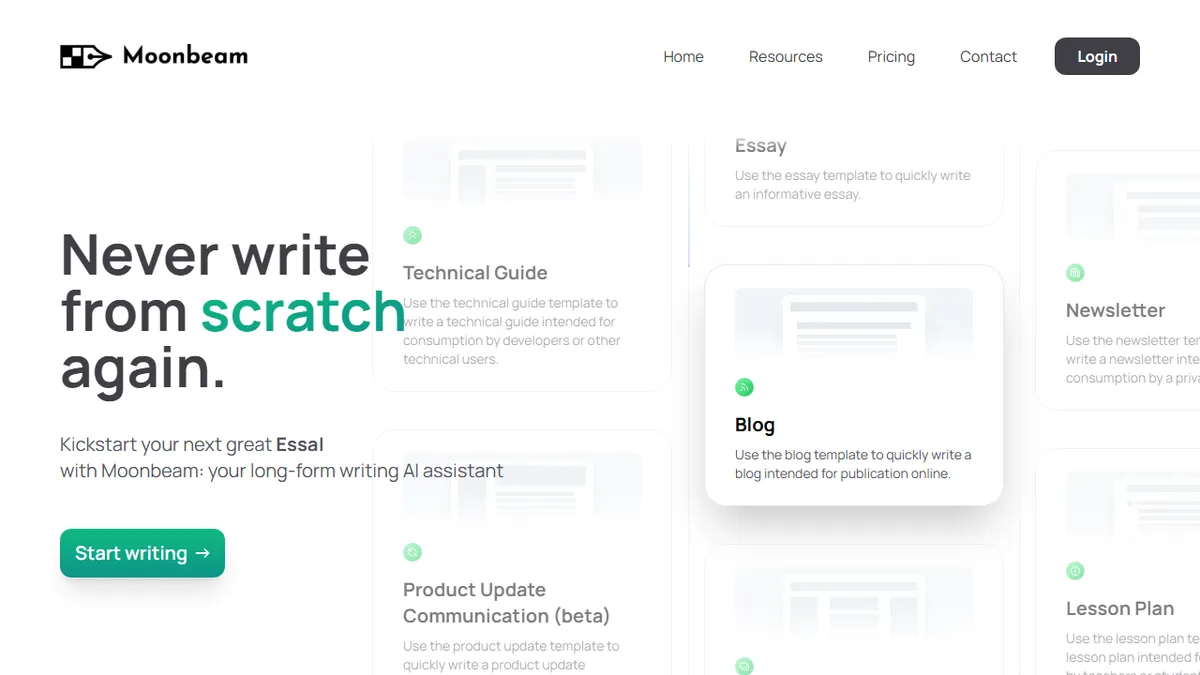
Moonbeam is an AI long-form writing tool built specifically for essays, articles, blogs, newsletters, and technical guides rather than the short snippets most generators excel at. Its flagship workflow is the Wizard, which walks you from rough notes to an outline to a finished draft, while Luna AI generates first drafts from a single prompt and the GPT-4-backed Smart Chat handles inline refinement, expansion, and feedback inside the editor.
Where Moonbeam differentiates itself is structure: instead of a blank chat window, it leans on 13+ templates (blog post, technical guide, newsletter, essay, etc.), a Content Cluster generator that spins 10+ ideas from one keyword, and a Custom Style Generator that lets you write in the voice of named authors or personalities. It's aimed at content creators, students, freelancers, and marketers who want a structured drafting environment rather than a Notion-style scratchpad. Pricing is freemium with a Pro tier and a 30-day money-back guarantee.
Collaboration mode mirrors Google Docs for team editing, and a Chrome extension extends the assistant into the browser. There's no public API and integrations are limited beyond that, so this is a standalone writing app, not an embeddable layer for an existing stack.
Moonbeam is one of the few AI writing tools that actually takes long-form structure seriously, with a Wizard that scaffolds drafts and templates tailored to articles rather than tweets. The reliance on GPT-4 means quality tracks OpenAI's roadmap rather than anything proprietary, but the editorial workflow is what you're paying for here.
— The AI Tool Bible editorial team
Pros
- ✅ Structured long-form workflow (notes -> outline -> draft) instead of blank-page chat
- ✅ Templates tuned for blogs, essays, newsletters, and technical guides
- ✅ Custom Style Generator mimics named voices for tone control
- ✅ Real-time Google Docs-style collaboration and Chrome extension
Cons
- ⚠️ No public API or deep integrations beyond Chrome
- ⚠️ GPT-4 wrapper rather than proprietary model
- ⚠️ Pricing details for Pro tier aren't fully transparent on the page
Use cases
Frequently asked
- What types of content is Moonbeam designed to help write?
- Moonbeam is built specifically for long-form content such as essays, articles, blogs, newsletters, and technical guides. It uses templates and a Wizard workflow to structure these longer pieces.
- How does Moonbeam's workflow differ from standard AI chat tools?
- Instead of a blank chat window, Moonbeam uses a structured approach with a Wizard that moves from rough notes to an outline to a draft. It also includes 13+ templates and a Content Cluster generator for ideation.
- Does Moonbeam support team collaboration?
- Yes, Moonbeam features a collaboration mode that mirrors Google Docs for team editing. It also offers a Chrome extension to extend the assistant into the browser.
- Is there a public API available for Moonbeam?
- No, Moonbeam does not have a public API. It is a standalone writing app with limited integrations beyond the Chrome extension, making it unsuitable for programmatic access.
- What is the pricing structure for Moonbeam?
- Moonbeam operates on a freemium model. The Pro tier costs $49 per month, and the Team tier is $99 per month per seat. A 30-day money-back guarantee is included.
Explore related
Compare with similar tools
All in Writing →Claude
FeaturedAnthropic's flagship assistant for long-form writing, analysis, and coding.
GPT-4o
FeaturedOpenAI's multimodal flagship behind ChatGPT.
Gemini Advanced
Google's flagship — strong at math, long context, and Workspace integration.
Llama 3
Meta's open-weights LLM family that put serious frontier-adjacent models in everyone's hands.
Qwen
Alibaba's open-weight foundation model family covering chat, vision, image generation, translation, and safety classification.
Jan
Open-source desktop ChatGPT alternative that runs local LLMs and routes to cloud providers from one app.