ModelBias
100 models, 100 prompts, 30,000 answers — an interactive look at AI defaults
Alignment researchers, prompt engineers, and AI-curious readers who want a concrete, comparable look at how default LLM outputs cluster across providers.
Teams needing a rigorous benchmark, live evaluation harness, or API to score their own prompts — this is a static exploratory dataset, not an eval platform.
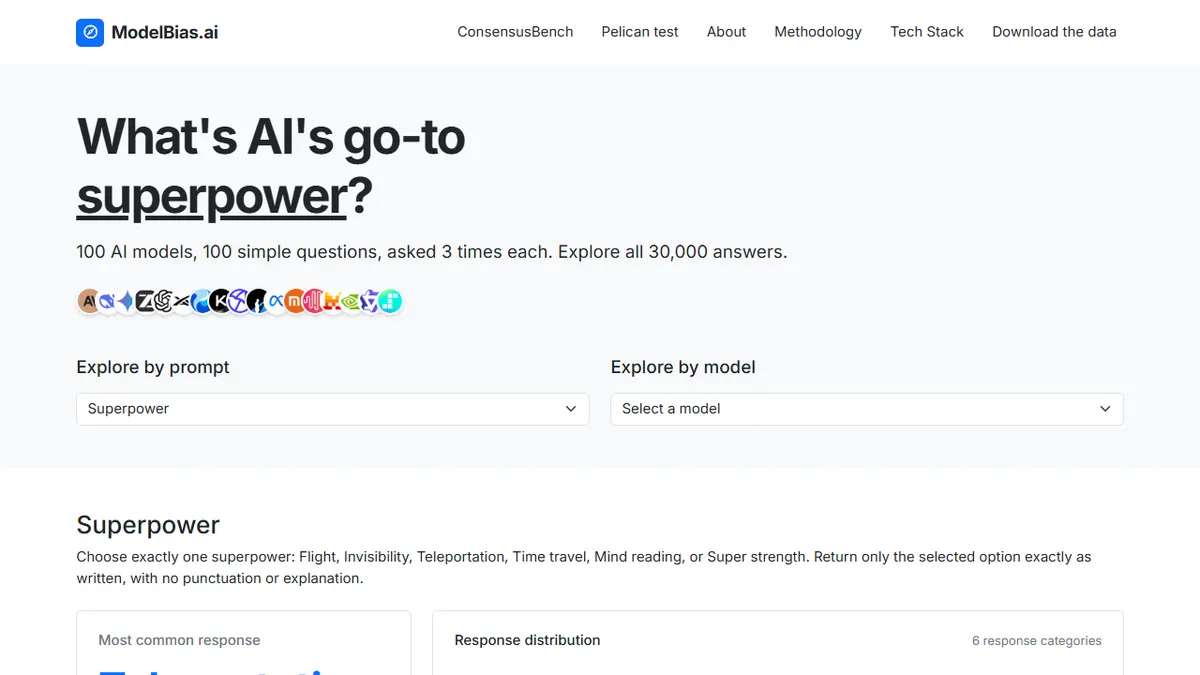
ModelBias.ai is an open research experiment by Tormund Gerhardsen that surfaces the default preferences of large language models when given minimal context. The project ran 100 simple, opinion-shaped prompts (superpower of choice, favourite holiday destination, capitalism vs. socialism, privacy vs. safety, best programming language, and dozens more) against 100 models from 17 major providers — Anthropic, OpenAI, Google, DeepSeek, Meta, xAI, Mistral, Qwen and others — asking each question three times per model through OpenRouter with the provider's default sampling parameters. The result is a browsable corpus of roughly 30,000 answers with a filterable UI: pick a prompt to see the aggregate distribution across the fleet, or pick a model to inspect its personal leanings.
A key methodological choice is provider-balancing: aggregates weight each provider equally rather than counting individual model variants, so a company that ships many checkpoints doesn't dominate the headline percentages. The methodology and about pages document the run parameters, and the complete raw output — including original text responses, not just the extracted category — is published on GitHub under a permissive licence so researchers can re-classify, re-analyse, or extend the dataset.
Typical use is exploratory rather than production: alignment researchers use it to spot suspicious cross-model consensus (e.g. ~80% of models pick 'teleportation' as their preferred superpower), prompt engineers use it to sanity-check that a supposedly neutral prompt is nudging the model, and journalists or educators use it as a concrete illustration of how homogenised RLHF outputs can be. It is explicitly positioned as an entertainment-first experiment, not a peer-reviewed benchmark, but the underlying data is real and reusable.
A small, honest, and unusually fun artifact of the alignment era. It won't replace a real eval suite, but the provider-balanced view and the willingness to publish raw outputs make it a useful reference the next time someone insists LLMs are all wildly different — the data shows they mostly aren't.
— The AI Tool Bible editorial team
Pros
- ✅ Genuinely open — full 30,000-response dataset and code on GitHub for independent re-analysis
- ✅ Broad coverage of 100 models across 17 providers, refreshed with newer releases like DeepSeek and Grok
- ✅ Provider-balanced aggregation prevents any single vendor from skewing headline numbers
- ✅ Clean interactive UI to slice results by prompt or by model with immediate visual distribution charts
- ✅ Transparent methodology page documenting sampling, defaults, and the OpenRouter pipeline
- ✅ Free to use, no login, no cookies, Plausible-only analytics
Cons
- ⚠️ Explicitly not a scientific study — small prompt set, three trials each, and default temperatures limit statistical rigor
- ⚠️ Only tests short, opinion-style prompts; nothing on reasoning, safety refusals, or long-context behaviour
- ⚠️ No live API or programmatic query interface — you download the CSV/JSON and work with it yourself
- ⚠️ Snapshot in time — model versions and defaults shift, so results can drift silently between refreshes
- ⚠️ Category labels are extracted from free-text answers, so edge cases and ambiguous responses may be misbucketed
Use cases
Explore related
Compare with similar tools
All in Evaluation →Braintrust
FeaturedEval, monitor, and improve AI products end-to-end.
LangSmith
LangChain's eval + observability platform.
Weights & Biases
The ML experiment tracker, now with LLM eval features.
Helicone
Open-source LLM observability — one-line proxy install.
Arize AI
Enterprise observability and evaluation platform for LLM agents and generative AI applications.
Giskard
Continuous AI red teaming platform that stress-tests LLM agents for vulnerabilities before they hit production.