Mastra
✓ Editorially verifiedOpen-source TypeScript framework for building, deploying, and observing AI agents and workflows.
In short
Mastra is a TypeScript-first framework for creating production AI agents, multi-step workflows, and copilots. It is best for TypeScript engineers who want typed primitives, built-in observability, and MCP support without using Python.
Pick Mastra if you're a TypeScript team building agents or multi-step AI workflows and want typed primitives, observability, and MCP support out of the box.
Skip it if your stack is Python-first or you need the mature plugin ecosystem of LangChain/LlamaIndex today.
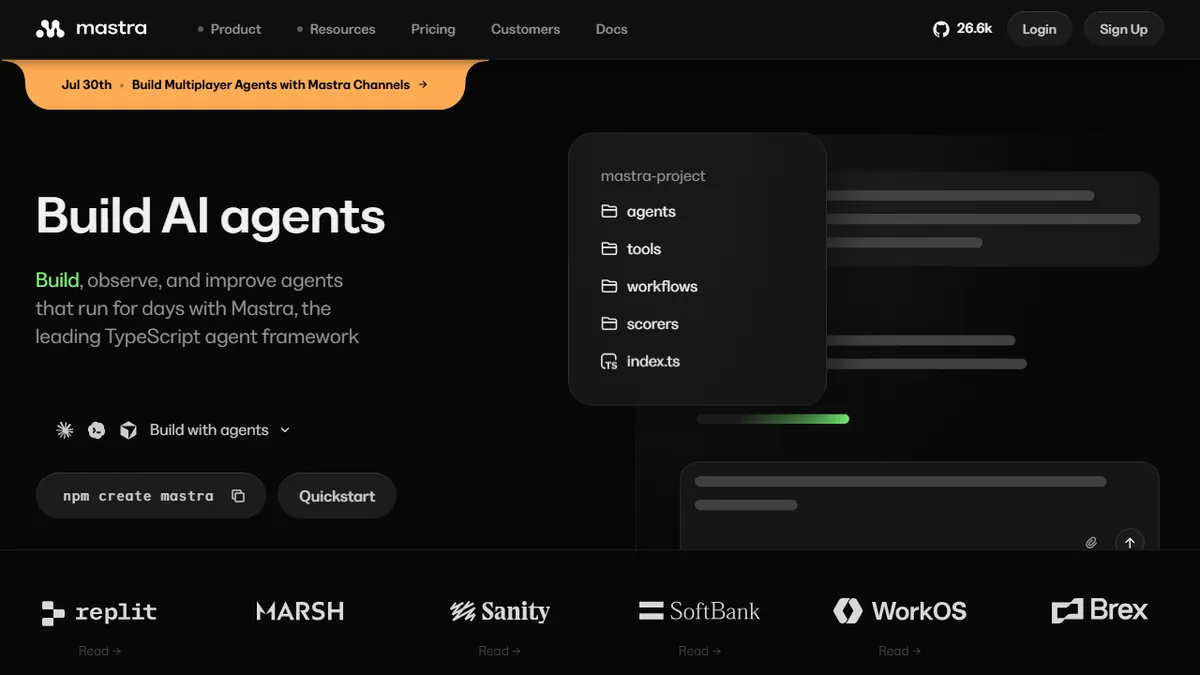
Mastra is a TypeScript-first framework for building production AI agents, multi-step workflows, and copilots. It bundles typed agent primitives, a graph-based workflow engine, conversation and semantic memory, evals/traces/metrics for observability, and a model router that talks to 90+ LLM providers behind one interface. You scaffold a project with `npm create mastra` and ship to Vercel, Netlify, Cloudflare, or a plain Node server.
The pitch is aimed at TypeScript engineers who don't want to drop into Python LangChain/LangGraph land to build serious agentic systems. Core is Apache 2.0 and free to use with no seat or usage tiers; an Enterprise tier adds source-available extensions for larger orgs. Mastra also authors MCP (Model Context Protocol) servers, so its tools and data sources plug into Claude Desktop, Cursor, and any MCP-aware client.
It slots neatly into existing Next.js / React stacks rather than asking you to adopt a new runtime, and the built-in evals + tracing meaningfully reduce the "how do I know my agent is working" problem that plagues most home-grown agent stacks.
Mastra is the most credible TypeScript-native answer to LangGraph we've seen, and the bundled evals and tracing are a real differentiator over rolling your own agent loop. The Apache 2.0 core plus MCP-first posture make it a safe long-term bet for serious Next.js teams.
— The AI Tool Bible editorial team
Pros
- ✅ TypeScript-native, fits cleanly into Next.js/Node stacks
- ✅ Apache 2.0 core with no seat or usage limits
- ✅ Built-in evals, traces, and metrics for agent observability
- ✅ Model router across 90+ LLM providers
- ✅ First-class MCP server support
Cons
- ⚠️ TypeScript only; Python shops will look elsewhere
- ⚠️ Younger ecosystem than LangChain/LlamaIndex
- ⚠️ Enterprise features are source-available, not OSS
Use cases
Frequently asked
- What programming language does Mastra support?
- Mastra is a TypeScript-first framework designed for TypeScript engineers. It is not suitable for Python-first stacks.
- How does Mastra handle different LLM providers?
- It includes a model router that connects to over 90 LLM providers behind a single interface.
- What observability features are included in Mastra?
- The framework bundles evals, traces, and metrics to help monitor agent performance and ensure reliability.
- Is Mastra compatible with existing web stacks?
- Yes, it slots into existing Next.js and React stacks and can be deployed to Vercel, Netlify, Cloudflare, or a plain Node server.
- Does Mastra support the Model Context Protocol?
- Yes, Mastra authors MCP servers, allowing its tools and data sources to plug into Claude Desktop, Cursor, and other MCP-aware clients.
Explore related
Compare with similar tools
All in Agents →LangGraph
FeaturedStateful, graph-based agent orchestration from LangChain.
CrewAI
FeaturedPython framework for multi-agent orchestration.
Ernie Bot
Baidu's Mandarin-first ChatGPT rival, powered by the ERNIE model family
Moveworks
The enterprise AI assistant that searches, answers, and takes action across your business systems
AWS Bedrock
Build and scale generative AI applications with foundation models
Claude Agent SDK
Anthropic's official SDK for building autonomous Claude agents.