
Magic.dev
✓ Editorially verifiedFrontier code models with ultra-long context aimed at automating software engineering
In short
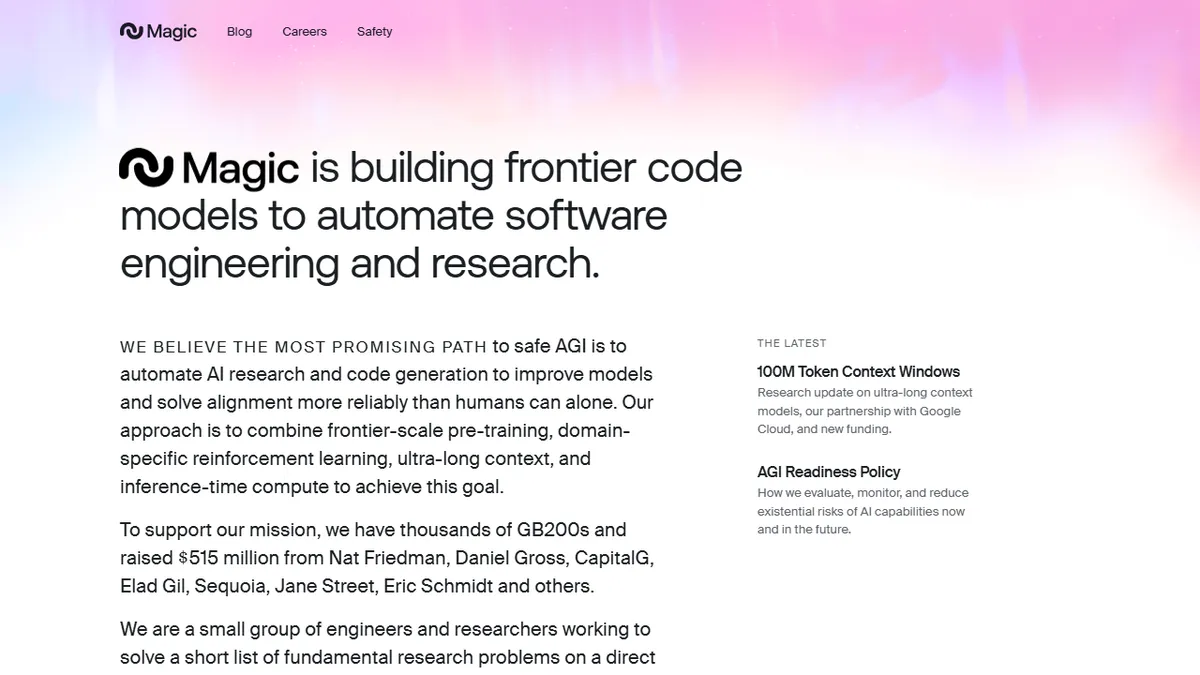
Magic.dev develops proprietary foundation models designed to automate software engineering end-to-end using an ultra-long context window. It targets research labs and enterprises seeking whole-repo reasoning capabilities rather than individual developer tools. Access is currently limited to research partnerships and enterprise engagements.
Research labs, enterprise engineering orgs, and investors tracking frontier code-model progress and willing to engage through direct partnership rather than a self-serve product.
Individual developers or small teams who need a working IDE assistant this quarter — there is no shipping product, API, or free trial to adopt.
Magic.dev is a San Francisco research lab building frontier-scale code models with the stated ambition of automating software engineering end-to-end. Rather than shipping a consumer IDE plugin, Magic trains proprietary foundation models specialised for code synthesis, reasoning over huge codebases, and long-horizon engineering tasks. The team's headline technical claim is an ultra-long context window (they have publicly discussed a 100M token 'LTM' model), which in principle lets a single inference session load an entire monorepo, its documentation, past PRs, and reviewer comments, then reason across all of it without RAG stitching. That is a materially different design point from Copilot-style assistants that lean on retrieval and short prompts.
The intended user is not the individual developer looking for autocomplete today. Magic is currently a research-forward organisation whose outputs are their models and the eventual agentic products built on them; the site is heavy on hiring, capabilities research, and infrastructure (they run thousands of GB200 GPUs and have partnered with Google Cloud), and light on self-serve product access. In 2024 they announced $465M+ in fresh capital led by names including Nat Friedman, Daniel Gross, and CapitalG, bringing total funding above $500M, which puts them in the same funding tier as other frontier labs. Typical workflows envisioned are 'assign a large engineering task to a model that has the entire codebase in context' — refactors, migrations, spec-driven feature implementation, autonomous PR generation, and long-running debugging — as opposed to line-by-line completion. Because there is no public API, no free tier, and no shipping IDE integration at the time of writing, evaluation is currently limited to partners and hires; treat Magic as a bet on where coding models are going rather than a tool you can pick up this afternoon.
Magic is one of the more interesting bets in the coding-model space because it is not trying to be a Copilot clone — the 100M-token context pitch, if it holds up in practice, is a genuinely different capability. But as of this writing it remains a research organisation with no product you can buy, so we file it under 'watch closely, cannot yet recommend'.
— The AI Tool Bible editorial team
Pros
- ✅ Ambitious ultra-long context research (100M-token class) that could obviate retrieval for whole-codebase reasoning
- ✅ Heavyweight funding and compute (thousands of GB200 GPUs) backing sustained frontier training runs
- ✅ Focused solely on code and software engineering, not a general-purpose chatbot spread thin across use cases
- ✅ Backed by credible technical investors (Nat Friedman, Daniel Gross, Sequoia, CapitalG) and Google Cloud infrastructure partnership
- ✅ Research direction targets autonomous engineering agents rather than narrow autocomplete, which is the direction the market is moving
Cons
- ⚠️ No public API, no self-serve product, and no published pricing — you cannot try it today
- ⚠️ Very little third-party benchmarking or independent evaluation of the long-context claims
- ⚠️ Site is heavier on mission statements and hiring than shipping product documentation
- ⚠️ Small team relative to incumbents (OpenAI, Anthropic, Google) it must compete with on model quality
- ⚠️ Enterprise-only access model means no community, no plugin ecosystem, no learning-in-public momentum
Use cases
Frequently asked
- Is Magic.dev available as a self-serve product or API?
- No, there is no public API, free tier, or self-serve product available. Access is restricted to research partnerships and enterprise engagements.
- What is the context window size of Magic.dev's models?
- Magic has publicly discussed a 100M token 'LTM' model designed to load entire monorepos, documentation, and past PRs in a single inference session.
- Who is the intended user for Magic.dev?
- The tool is aimed at research labs, enterprise engineering orgs, and investors. It is not designed for individual developers or small teams needing immediate IDE assistance.
Explore related
Compare with similar tools
All in Coding →Cursor
FeaturedAI-first VS Code fork — chat, edit, and agentic coding in one IDE.
GitHub Copilot
FeaturedThe original AI pair programmer, now with chat and agents.
Replit Agent
FeaturedBuild & deploy a full app from a single prompt.
Warp
The agentic development environment, from the terminal up
Cline
Open-source agentic coding assistant that plans, edits, and runs code inside your IDE
Aider
Terminal-based AI pair programmer that writes commits.