
Lovable
✓ Editorially verifiedChat-driven app builder that turns natural-language prompts into deployable full-stack web apps.
In short
Lovable allows users to describe applications in plain English to generate working full-stack web apps. It is best suited for founders, PMs, and designers needing rapid prototypes or MVPs. The platform supports live iteration, template usage, and immediate deployment.
Pick Lovable if you're a founder, PM, or designer who needs a deployable web-app prototype from a prompt rather than from a Figma-to-code pipeline.
Skip it if you're shipping a complex production codebase where you need full control over architecture, dependencies, and long-term maintainability.
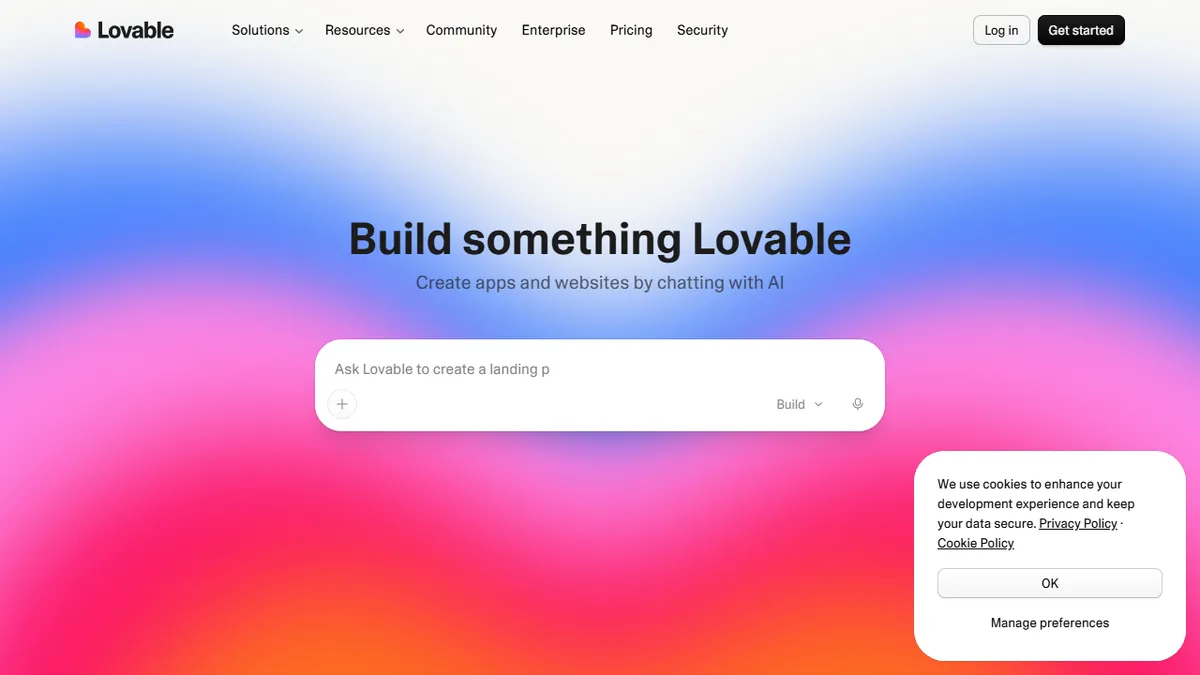
Lovable is an AI app builder that lets non-engineers (and engineers in a hurry) describe an application in plain English and get a working full-stack web app back. You can iterate by chatting, attach screenshots or docs as references, preview the result live, and deploy in one click. The platform leans heavily on templates spanning e-commerce, SaaS dashboards, portfolios, and blogs, and exposes integration connectors plus an MCP server for hooking the generated apps into outside services.
It sits in the same competitive lane as Bolt, v0, and Replit Agent, but Lovable has been one of the breakout consumer-facing entrants, with millions of projects built and a heavy lean toward founders, PMs, designers, and students rather than career developers. Pricing is freemium, with a free tier and paid plans on a dedicated pricing page, plus student discounts and a founders program. The underlying model stack isn't disclosed on the homepage, but output is typically a React/Vite or Next-style codebase you can export.
The ecosystem includes connectors, an MCP server, and a growing template marketplace. Expect rough edges on anything beyond a CRUD-shaped app, and treat its output as a strong scaffold rather than a finished production codebase.
Lovable is the closest thing to a true 'describe-an-app-get-an-app' tool that actually deploys. It's brilliant for prototypes, landing pages, and lightweight SaaS scaffolds, but the generated code still wants a human pass before it sees real users. Treat it as a senior intern, not a senior engineer.
— The AI Tool Bible editorial team
Pros
- ✅ Extremely fast 0-to-working-prototype loop for non-developers
- ✅ One-click deployment and live preview built in
- ✅ Template library covers most common app shapes
- ✅ MCP server and connectors for real integrations
- ✅ Generous free tier to evaluate before paying
Cons
- ⚠️ Generated code quality degrades on complex, non-CRUD apps
- ⚠️ Underlying model and limits not transparent on the homepage
- ⚠️ Output usually needs cleanup before serious production use
- ⚠️ Credit-based usage can get expensive on heavy iteration
Use cases
Frequently asked
- Who is Lovable designed for?
- Lovable is primarily for non-engineers, including founders, product managers, designers, and students, who need to build web apps without extensive coding knowledge. It is also useful for engineers who need to prototype quickly.
- What kind of applications can I build with Lovable?
- You can build full-stack web apps such as e-commerce sites, SaaS dashboards, portfolios, blogs, landing pages, and internal tools. The platform provides templates for these common app shapes.
- How does the pricing model work?
- Lovable uses a freemium model with a free tier and paid Pro and Business plans. It also offers student discounts and a founders program, though specific prices are listed on a dedicated pricing page.
- Can I integrate external services with apps built on Lovable?
- Yes, the platform exposes integration connectors and an MCP server that allow generated apps to hook into outside services.
- Is the generated code ready for production use?
- The output is typically a React/Vite or Next-style codebase that serves as a strong scaffold. However, it may require cleanup and human review before serious production use, especially for complex, non-CRUD applications.
Explore related
Compare with similar tools
All in Coding →Cursor
FeaturedAI-first VS Code fork — chat, edit, and agentic coding in one IDE.
GitHub Copilot
FeaturedThe original AI pair programmer, now with chat and agents.
Replit Agent
FeaturedBuild & deploy a full app from a single prompt.
Warp
The agentic development environment, from the terminal up
Cline
Open-source agentic coding assistant that plans, edits, and runs code inside your IDE
Aider
Terminal-based AI pair programmer that writes commits.