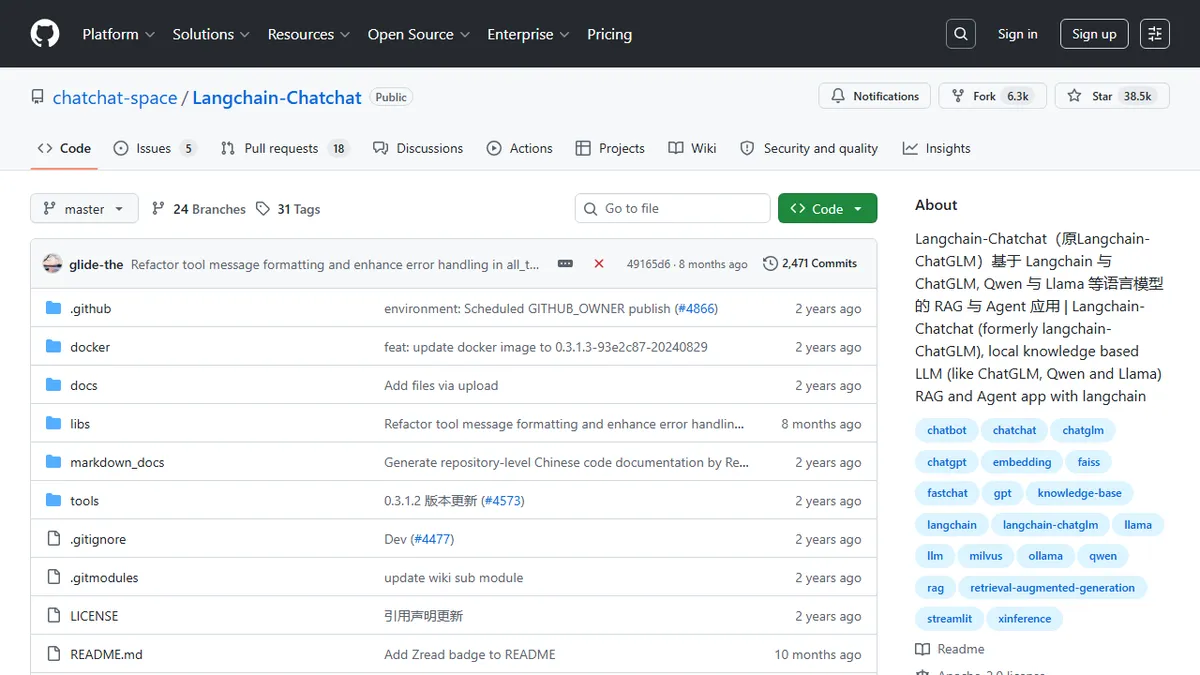

Langchain-Chatchat
Self-hostable RAG and agent framework that wires LangChain to any local open-source LLM and a knowledge base.
In short
Langchain-Chatchat is a free, open-source RAG framework for running local LLMs like Llama 3 or Qwen2 against private knowledge bases.
Pick Langchain-Chatchat if you need an open-source, on-prem RAG and agent scaffold that can drive local Qwen, GLM or Llama models against a private knowledge base.
Skip it if you want a hosted, turnkey RAG product or a polished consumer chatbot without managing Python, GPUs and a vector store yourself.
Langchain-Chatchat is an open-source RAG and agent application platform built on top of LangChain, designed to run fully offline against local LLMs. It bundles document ingestion, vectorization, retrieval, a FastAPI service and a Streamlit web UI so a team can stand up a private knowledge-base chatbot without piping documents through a third party. Out of the box it speaks to Xinference, Ollama, LocalAI, FastChat and One API, and works with GLM-4, Qwen2, Llama 3 and other open-weight models, plus BGE-class embedding models.
It is squarely aimed at developers and infrastructure teams who want a Chinese-and-English RAG stack they can air-gap on their own GPUs, not at end users buying a hosted SaaS. The project is Apache-2.0 and free; the only cost is your own compute (and any optional cloud LLM calls if you wire those up). With ~38k GitHub stars it is one of the most popular Chinese-language LangChain wrappers, and v0.3.x added a meaningful agent layer with tools for SQL chat, arXiv lookup, Wolfram, and text-to-image.
Caveats: this is an integration framework rather than a polished product, so expect to read code, manage Python and CUDA dependencies, and pick your own vector DB (FAISS, Milvus and others are supported). Documentation skews Chinese-first, and release cadence has slowed compared to the project's peak, so treat it as a strong scaffolding starter rather than a turnkey enterprise RAG appliance.
A pragmatic LangChain wrapper that solved the 'private GPT over my own docs' problem early and still holds up as a reference architecture. We would use it as a starting template rather than a finished product, and we would budget time for the Python and CUDA plumbing before any of the agent magic appears.
— The AI Tool Bible editorial team
Pros
- ✅ Fully offline, self-hosted RAG stack with Apache-2.0 license
- ✅ Framework-agnostic: plugs into Xinference, Ollama, LocalAI, FastChat, One API
- ✅ Ships both Streamlit UI and FastAPI service with OpenAI-compatible endpoints
- ✅ Built-in agent tools (SQL chat, arXiv, Wolfram, text-to-image)
- ✅ Large community (~38k stars) and broad model coverage
Cons
- ⚠️ Dependency and GPU setup is non-trivial; not a one-click install
- ⚠️ Documentation is Chinese-first; English coverage lags
- ⚠️ Release cadence has slowed since the v0.3 peak
- ⚠️ You still pick and operate your own vector DB and model server
Use cases
Frequently asked
- Is Langchain-Chatchat free to use?
- Yes, it is free and open-source under the Apache-2.0 license. The only costs are your own infrastructure, such as GPUs for self-hosting, or optional cloud LLM calls if you choose to wire them up.
- Which local LLMs does it support?
- It supports multi-model setups including GLM-4, Qwen2, and Llama 3. It connects to these models via Xinference, Ollama, LocalAI, FastChat, or One API, and uses BGE-class embedding models for vectorization.
- Is it suitable for non-technical users?
- No, it is aimed at developers and infrastructure teams. You must manage Python, CUDA dependencies, and your own vector store. It is an integration framework, not a polished, turnkey consumer product.
- Can it run completely offline?
- Yes, it is designed to run fully offline against local LLMs. This allows teams to stand up private knowledge-base chatbots without piping documents through third-party services, making it ideal for air-gapped environments.
- What agent capabilities does it offer?
- Version 0.3.x added an agent layer with tools for SQL chat, arXiv lookup, Wolfram, and text-to-image. It functions as a scaffold for building local LLM agents alongside standard RAG retrieval.
- What are the main drawbacks?
- Documentation is Chinese-first, and release cadence has slowed. It requires reading code and managing dependencies. It is best treated as a strong scaffolding starter rather than a turnkey enterprise RAG appliance.
Explore related
Compare with similar tools
All in RAG →Pinecone
FeaturedManaged vector database for production-scale similarity search.
LlamaIndex
FeaturedData framework for connecting LLMs to your data.
Elasticsearch Vector Search
Hybrid vector + keyword search in the enterprise-grade Elasticsearch engine
Snowflake Cortex
Generative AI and RAG built into the Snowflake data cloud
DataStax Astra DB
Serverless vector and document database for production RAG and AI agents
MongoDB Atlas Vector Search
Vector search built into the operational database you're already using.