
Katonic AI
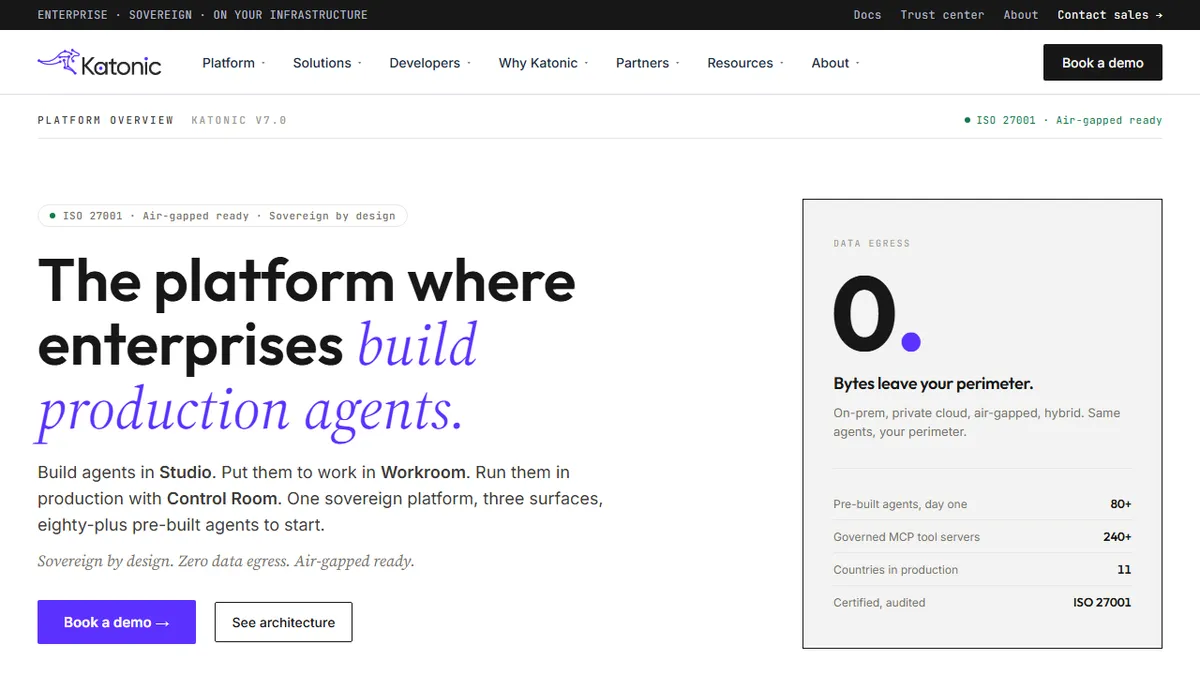
Sovereign enterprise platform for building, deploying, and governing AI agents on your own infrastructure.
In short
Katonic AI is a sovereign enterprise platform for building and governing AI agents on your own infrastructure, featuring 80+ pre-built agents and multi-model support.
Pick Katonic AI if you are a regulated enterprise that needs to run agents on your own GPUs with guardrails, governance, and no data leaving your perimeter.
Skip it if you are an individual builder or small team who just wants to wire up a few agents in the cloud without a procurement cycle.
Katonic AI is a full-stack enterprise platform for building and operating AI agents on customer-controlled infrastructure, including on-premise, private cloud, and air-gapped environments. It ships with around eighty pre-built production agents (covering procurement, retail, finance, and other verticals) and offers five build paths: a step-by-step guided builder, a plain-English AI builder, a visual workflow designer, a code SDK, and a 'bring your own agent' option for frameworks like LangChain or LlamaIndex.
The platform is aimed squarely at regulated enterprises that need zero data egress, GPU governance, and policy control rather than at indie developers. Its Control Room handles NVIDIA KAI GPU scheduling, routes to 2,600+ models through an AI gateway, applies NVIDIA NeMo guardrails (with eight configurable guardrail types), and tracks cost per agent and per GPU. Pricing is quote-based with no public tier; Katonic markets a 'predictable cost model' versus pay-per-use, but you must contact sales for a number.
It competes with the likes of Dataiku, DataRobot, and the agent layers of the hyperscalers. Strengths are sovereignty and breadth of pre-built agents; weaknesses are opaque pricing and the heavy lift typical of any on-prem MLOps stack.
Katonic is one of the few credible 'sovereign' agent platforms aimed at banks, telcos, and government buyers who cannot send prompts to a US SaaS. The pre-built agent library and NeMo-based guardrails are the real draw; the opacity around pricing and the on-prem footprint mean it is firmly an enterprise procurement, not a weekend trial.
— The AI Tool Bible editorial team
Pros
- ✅ Runs fully on-prem or air-gapped with zero data egress
- ✅ Ships ~80 pre-built agents with source code on day one
- ✅ NVIDIA NeMo guardrails plus GPU scheduling and per-agent cost tracking
- ✅ Five build paths from no-code wizard to full SDK and BYOA
Cons
- ⚠️ No public pricing; requires a sales conversation
- ⚠️ Heavy enterprise stack with real deployment overhead
- ⚠️ Overkill for individuals or small teams just prototyping agents
Use cases
Frequently asked
- How much does Katonic AI cost?
- Pricing is quote-based with no public tiers. You must contact sales for a specific number. Katonic markets a 'predictable cost model' versus pay-per-use, but exact costs are not publicly documented.
- Who is Katonic AI best suited for?
- It is best for regulated enterprises needing to run agents on their own GPUs with guardrails and no data leaving their perimeter. It is not recommended for individual builders or small teams wanting simple cloud setups.
- What infrastructure does Katonic AI support?
- The platform operates on customer-controlled infrastructure, including on-premise, private cloud, and air-gapped environments. It handles NVIDIA KAI GPU scheduling and ensures zero data egress for sovereignty requirements.
- How can I build agents with Katonic AI?
- There are five build paths: a step-by-step guided builder, a plain-English AI builder, a visual workflow designer, a code SDK, and a 'bring your own agent' option for frameworks like LangChain or LlamaIndex.
- What models and guardrails are available?
- It routes to 2,600+ models via an AI Gateway and applies NVIDIA NeMo guardrails with eight configurable types. The Control Room tracks cost per agent and per GPU for governance.
Explore related
Compare with similar tools
All in Agents →LangGraph
FeaturedStateful, graph-based agent orchestration from LangChain.
CrewAI
FeaturedPython framework for multi-agent orchestration.
Ernie Bot
Baidu's Mandarin-first ChatGPT rival, powered by the ERNIE model family
Moveworks
The enterprise AI assistant that searches, answers, and takes action across your business systems
AWS Bedrock
Build and scale generative AI applications with foundation models
Claude Agent SDK
Anthropic's official SDK for building autonomous Claude agents.