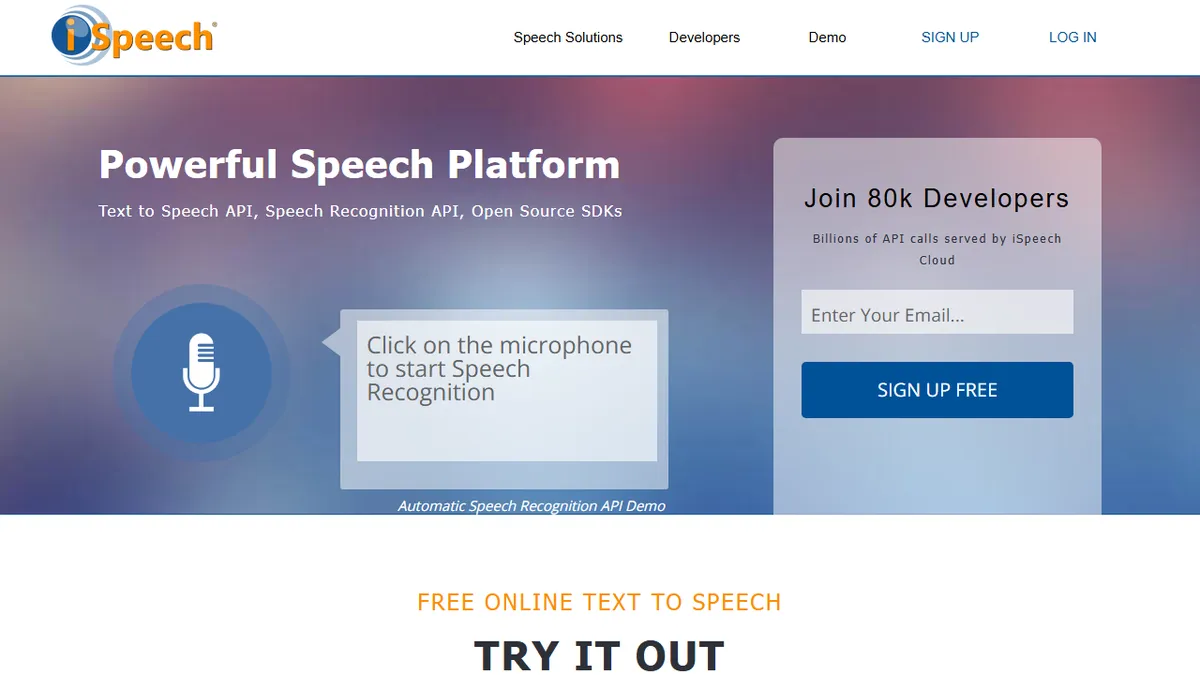
iSpeech
Veteran cloud TTS and speech recognition API with broad SDK and language coverage.
In short
iSpeech is a veteran cloud API for TTS and ASR with broad language support and SDKs. It offers stable command-grammar recognition and lip-sync data, though voices are less realistic than modern neural options.
Pick iSpeech if you need a stable cross-platform TTS+ASR API with command-grammar recognition and lip-sync data.
Skip it if you want state-of-the-art neural voice realism or modern voice cloning.
iSpeech is a long-running cloud speech platform offering both Text-to-Speech (TTS) and Automated Speech Recognition (ASR) through a unified HTTP API. The service ships 40+ voices across English, Spanish, French, German, Portuguese, Italian, Japanese, Korean, Chinese, Arabic, Russian and Scandinavian languages, with tunable speed/pitch/bitrate, SSML and MathML markup, word-timing position markers, and viseme data for lip-sync animation. ASR supports both freeform dictation and constrained command-grammar recognition.
It is squarely aimed at developers embedding voice into apps rather than end users. SDKs cover the usual mobile targets (iOS, Android, BlackBerry) plus server/desktop bindings for .NET, Java, PHP, JavaScript, Ruby, Python and Perl. Mobile SDKs are free for non-revenue apps that follow iSpeech's branding rules; otherwise pricing is metered between roughly $0.0001 and $0.05 per word (TTS) or transaction (ASR), with volume discounts. There is no modern self-serve dashboard pricing page in the style of newer rivals, and the site itself feels dated.
iSpeech predates the current neural-TTS wave and its voice quality is closer to classic concatenative/parametric systems than to ElevenLabs or Azure Neural voices. It is a reasonable pick if you need a stable, multi-platform API with command-grammar ASR and don't require state-of-the-art naturalness, but anyone shopping primarily on voice realism should benchmark it against newer providers first.
iSpeech is the dependable, slightly old-school option in a category now dominated by neural-voice startups. Its real edge is the combo of TTS plus command-grammar ASR plus viseme data across a dozen SDKs, which still suits IVR, telephony and game/avatar work. For pure voiceover quality, look elsewhere.
— The AI Tool Bible editorial team
Pros
- ✅ Single API covers both TTS and ASR with broad language support
- ✅ SDKs for nearly every major mobile and server platform
- ✅ Supports SSML, MathML, word timings and visemes for animation
- ✅ Free mobile SDK tier for non-commercial apps
Cons
- ⚠️ Voice quality lags modern neural TTS providers like ElevenLabs or Azure
- ⚠️ Dated site and developer experience
- ⚠️ Pricing requires contact/quote for serious volume
Use cases
Frequently asked
- How much does iSpeech cost?
- Mobile SDKs are free for non-revenue apps following branding rules. Otherwise, pricing is metered between $0.0001 and $0.05 per word or transaction, with volume discounts available. There is no modern self-serve dashboard pricing page.
- Which languages and voices does iSpeech support?
- The service ships 40+ voices across English, Spanish, French, German, Portuguese, Italian, Japanese, Korean, Chinese, Arabic, Russian, and Scandinavian languages. It supports tunable speed, pitch, bitrate, SSML, MathML, and viseme data for lip-sync animation.
- Is iSpeech suitable for modern voice realism?
- No. iSpeech predates the neural-TTS wave, offering classic concatenative or parametric voice quality. It is not recommended if you prioritize state-of-the-art neural voice realism or modern voice cloning capabilities.
- What development platforms and SDKs are available?
- SDKs cover iOS, Android, and BlackBerry for mobile. Server and desktop bindings are available for .NET, Java, PHP, JavaScript, Ruby, Python, and Perl. The platform is aimed at developers embedding voice into apps.
- Does iSpeech support speech recognition features?
- Yes, ASR supports both freeform dictation and constrained command-grammar recognition. It is a reasonable pick if you need a stable, multi-platform API with command-grammar ASR and do not require the highest naturalness.
Explore related
Compare with similar tools
All in Audio →ElevenLabs
FeaturedThe gold standard for AI voice cloning and TTS.
Suno
FeaturedText-to-song AI — full vocal tracks from a prompt.
Udio
Suno's main rival for AI-generated full songs.
AssemblyAI
Speech-to-text API with diarisation, summarisation, and topic detection.
Chorus by ZoomInfo
Enterprise conversation intelligence bundled with ZoomInfo's B2B data graph
Whisper
OpenAI's open-source speech-to-text — the de-facto baseline.