
Hypotenuse AI
AI-powered Product Experience Management for ecommerce catalogs at scale.
In short
Hypotenuse AI is a Product Experience Management platform that uses generative AI to automate large-scale ecommerce catalog operations. It is best suited for mid-market and enterprise teams needing to enrich, describe, and tag thousands of SKUs simultaneously via deep PIM integrations.
Pick Hypotenuse AI if you run a mid-market or enterprise ecommerce catalog and need to enrich, describe, and tag thousands of SKUs at once.
Skip it if you're a freelance writer, blogger, or small Shopify store looking for a cheap general-purpose AI copy tool.
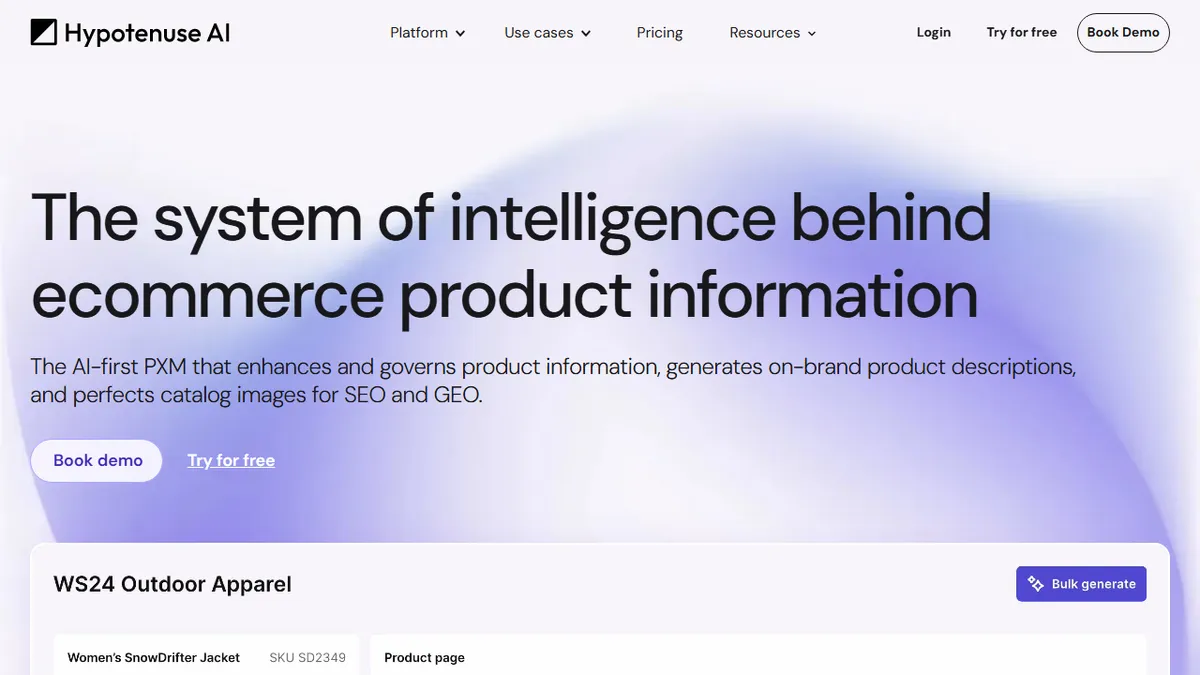
Hypotenuse AI is a Product Experience Management (PXM) platform that automates ecommerce product data workflows using generative AI. It bulk-generates SEO-optimized product descriptions in your brand voice, enriches missing attributes by mining UPC databases and the open web, extracts attributes from product images, applies consistent taxonomy and tags, and enhances product photography. A built-in performance layer tracks rankings across Google, Amazon, and Walmart.
The target customer is squarely enterprise and mid-market ecommerce teams running large catalogs, not solo bloggers or freelance copywriters. Hypotenuse leans on case studies from Fortune 500 brands like Crunchyroll, Sam Edelman, and MediaMarkt, and integrates directly with the PIM/commerce stack those teams already use: Shopify, Salesforce Commerce Cloud, Akeneo, Salsify, NetSuite, plus Amazon, Walmart, and Target marketplaces. Pricing is gated behind a sales conversation, though a free trial is exposed on the homepage.
There is a public API for custom integrations, which makes it viable as a content layer inside a larger merchandising pipeline rather than a standalone writing app. Expect enterprise-style onboarding and brand-voice training rather than instant self-serve.
Hypotenuse has quietly become one of the more credible AI tools in ecommerce PXM, with real Fortune 500 logos backing the claims. It's not a ChatGPT-for-writers; it's catalog infrastructure. Worth a demo if your bottleneck is SKU content velocity, otherwise it's the wrong shape of tool.
— The AI Tool Bible editorial team
Pros
- ✅ Purpose-built for large ecommerce catalogs, not generic blog copy
- ✅ Deep PIM/commerce integrations (Shopify, Akeneo, Salsify, SFCC)
- ✅ Combines copy, image enhancement, tagging, and rank tracking in one platform
- ✅ Public API enables embedding into existing merchandising pipelines
- ✅ Real enterprise references (Sam Edelman, MediaMarkt, Crunchyroll)
Cons
- ⚠️ No transparent pricing; clearly aimed at enterprise budgets
- ⚠️ Overkill for single-store Shopify operators or solo sellers
- ⚠️ Narrowly scoped to product content, not general-purpose writing
Use cases
Frequently asked
- Who is Hypotenuse AI designed for?
- It targets enterprise and mid-market ecommerce teams managing large catalogs. It is not intended for solo bloggers, freelance writers, or small Shopify stores seeking general-purpose copy tools.
- What core features does the platform offer?
- The tool bulk-generates SEO-optimized product descriptions in brand voice, enriches missing attributes from UPC databases and the web, extracts data from images, applies taxonomy, enhances photography, and tracks rankings on Google, Amazon, and Walmart.
- Which platforms does Hypotenuse AI integrate with?
- It integrates directly with Shopify, Salesforce Commerce Cloud, Akeneo, Salsify, NetSuite, and marketplaces including Amazon, Walmart, and Target. A public API is also available for custom merchandising pipelines.
- How is pricing structured?
- Pricing is gated behind a sales conversation with no transparent rates listed. A free trial is available on the homepage for prospective customers to evaluate the platform.
Explore related
Compare with similar tools
All in Writing →Claude
FeaturedAnthropic's flagship assistant for long-form writing, analysis, and coding.
GPT-4o
FeaturedOpenAI's multimodal flagship behind ChatGPT.
Gemini Advanced
Google's flagship — strong at math, long context, and Workspace integration.
Llama 3
Meta's open-weights LLM family that put serious frontier-adjacent models in everyone's hands.
Qwen
Alibaba's open-weight foundation model family covering chat, vision, image generation, translation, and safety classification.
Jan
Open-source desktop ChatGPT alternative that runs local LLMs and routes to cloud providers from one app.