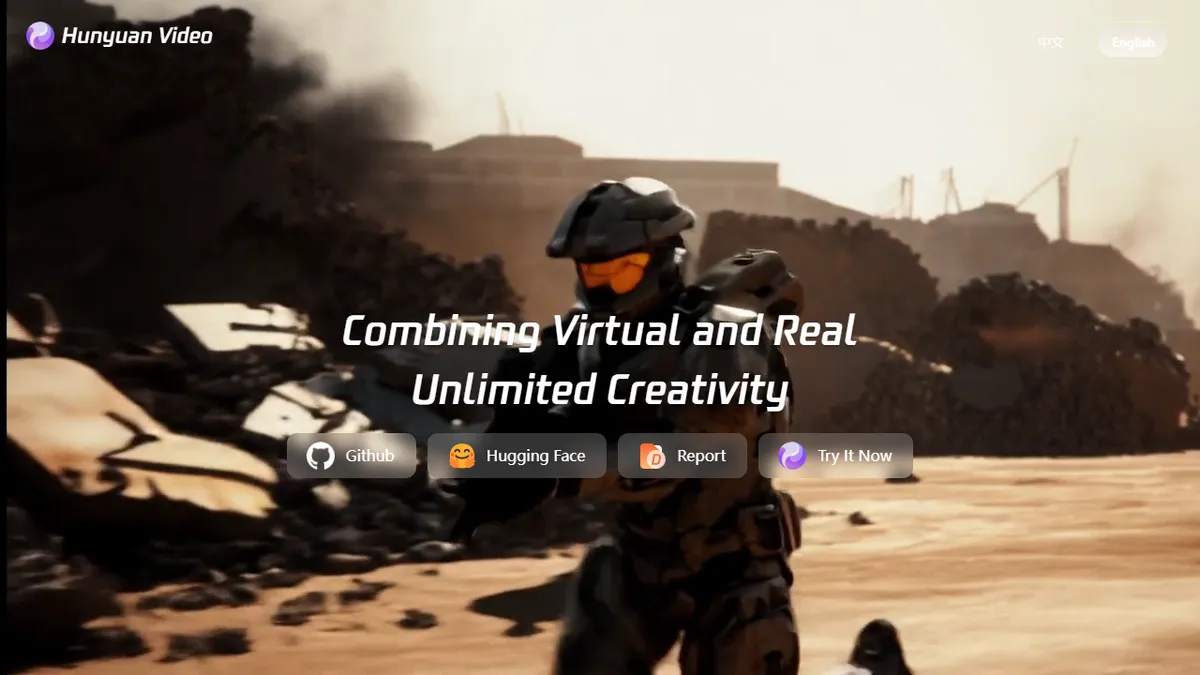
Hunyuan Video
✓ Editorially verifiedTencent's open-source, 13B-parameter text-to-video foundation model.
In short
Hunyuan Video is a frontier-tier, open-source text-to-video foundation model by Tencent. It is best for researchers and VFX teams needing self-hosted, fine-tunable video generation without per-second SaaS costs.
Generative video researchers, VFX and pre-viz teams, and studios that want frontier-tier open weights they can fine-tune, self-host, and pipeline into ComfyUI without paying per second.
Casual creators without a high-end GPU, or teams that need long-form (30s+) single-take clips, tight character consistency across shots, or a polished western SaaS UX with billing.
Hunyuan Video is Tencent's open-source text-to-video foundation model, released in late 2024 as one of the largest publicly available video generation systems at roughly 13B parameters. It uses a diffusion transformer backbone with a 'dual-stream to single-stream' hybrid design, a causal 3D VAE that compresses video into a compact latent space, and a multimodal LLM as its text encoder in place of the CLIP/T5 encoders used by most competitors. The result is notably strong prompt adherence, cinematic motion, and physical plausibility that benchmark-close to closed models like Runway Gen-3 and Kling. Standard output is 129 frames (roughly 5 seconds) at up to 1280x720, with support for 9:16, 16:9, 4:3, 3:4 and 1:1 aspect ratios and a built-in 'Normal' and 'Master' prompt-rewriting mode that reshapes user prompts into the format the model was trained on. The repository ships with an image-to-video variant, a LoRA training pipeline, ComfyUI nodes, Docker images, a Gradio UI, and Diffusers integration, and the weights are mirrored on Hugging Face. Tencent also runs a hosted consumer product and exposes generation through Tencent Cloud's API. It is aimed at researchers, generative-AI studios, VFX and pre-viz teams, and independent creators who need frontier-tier video quality without a per-second SaaS bill and are willing to run an 80GB-class GPU (or rent one). Common workflows include text-to-video shorts, image-to-video animation of stills and product shots, LoRA fine-tunes on branded characters or styles, and using it as the generation backend inside ComfyUI pipelines.
The most credible open-source answer to Runway and Kling to date. If you have the GPUs, Hunyuan Video is genuinely the one to build on right now - the MLLM text encoder makes it feel closer to Sora-class prompt handling than any other open model, and the ComfyUI/LoRA ecosystem is moving fast. Just don't underestimate the hardware bill or the ~5-second clip ceiling.
— The AI Tool Bible editorial team
Pros
- ✅ Open weights under a permissive research/commercial license (with regional restrictions), unusual for a frontier-tier video model
- ✅ Strong motion coherence and prompt adherence, competitive with Runway Gen-3 and Kling in public evaluations
- ✅ Multimodal LLM text encoder handles longer, more descriptive prompts better than CLIP/T5-based peers
- ✅ First-class ComfyUI and Diffusers integration, plus official Docker and Gradio interfaces
- ✅ Supports image-to-video, LoRA fine-tuning, and multiple aspect ratios out of the box
- ✅ Free to self-host if you own the hardware, with no per-second generation cost
Cons
- ⚠️ Requires a 60-80GB GPU (H100/A100) for 720p generation; consumer cards need aggressive quantization or offloading
- ⚠️ Standard clip length is only ~5 seconds (129 frames) per generation; longer scenes need stitching
- ⚠️ Hosted Tencent product is primarily targeted at mainland China users and can be awkward to sign up for from abroad
- ⚠️ License carves out large-user commercial deployment and some regional uses; read the terms before shipping
- ⚠️ Ecosystem is younger than Runway/Pika, so tooling for shot planning, cameras, and character consistency is thinner
Use cases
Frequently asked
- What are the hardware requirements for running Hunyuan Video?
- The model requires a 60-80GB GPU, such as an H100 or A100, for 720p generation. Consumer cards may require aggressive quantization or offloading to run the model.
- How long are the video clips generated by Hunyuan Video?
- Standard output is 129 frames, which is roughly 5 seconds long. Longer scenes require stitching multiple generations together, as single-take clips over 30 seconds are not supported.
- Is Hunyuan Video free to use?
- Open-source weights are free to download and self-host. Tencent's hosted product is free to use with account gating in mainland China, while API access via Tencent Cloud uses pay-per-generation pricing.
- What unique technical features does Hunyuan Video have?
- It uses a diffusion transformer backbone with a causal 3D VAE and a multimodal LLM as its text encoder. This design supports strong prompt adherence and handles longer, descriptive prompts better than CLIP/T5-based competitors.
- Does Hunyuan Video support image-to-video generation?
- Yes, the repository includes an image-to-video variant. It also supports LoRA training pipelines, ComfyUI nodes, and multiple aspect ratios including 9:16 and 16:9.
Explore related
Compare with similar tools
All in Video →Runway
FeaturedPro-grade AI video editor and Gen-4 generation.
Sora
FeaturedOpenAI's flagship text-to-video model.
Luma Dream Machine
Fast, accessible text-to-video with strong camera control.
HeyGen
Avatar video + lip-sync translation at scale.
Google Veo
Google DeepMind's flagship text-to-video model with native audio generation and cinematic camera control.
Higgsfield
AI video and image generation suite that aggregates 30+ frontier models under one workflow.