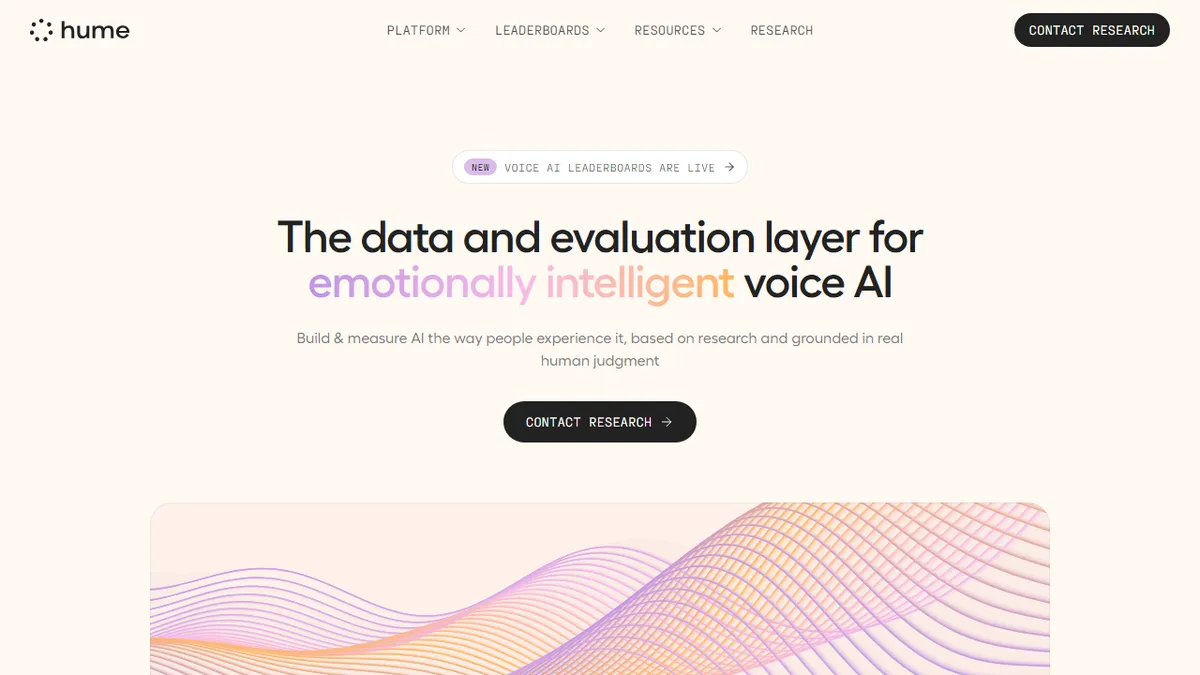

Hume AI
✓ Editorially verifiedEmotionally intelligent voice AI with expressive TTS, speech-to-speech, and human-feedback evaluation APIs.
In short
Hume AI provides a voice AI platform focused on emotional intelligence, featuring expressive TTS, speech-to-speech, and human-feedback evaluation. It is best for developers building conversational agents where natural, empathic speech is critical.
Pick Hume AI if you're building a conversational voice agent where emotional expressiveness and natural turn-taking matter more than raw voice count.
Skip it if you just need cheap bulk TTS narration or require fully open-weight models for on-prem deployment.
Hume AI is a voice AI platform focused on emotional intelligence, offering a stack of models and APIs that go beyond flat TTS into expressive, empathic speech. Its headline products are Octave (a closed-source LLM-based text-to-speech engine with voice design, cloning and conversion), EVI (a speech-to-speech conversational model with interruptibility and expressive instruction following), and TADA (an open-source streaming TTS system published on Hugging Face). It also ships a Human Feedback API with science-backed survey templates and a curated data library spanning 50+ languages, 48 emotions, and 600+ voice descriptors.
The target user is a voice AI developer or team building conversational agents, IVR systems, character voices, or accessibility tools where flat robotic output isn't acceptable. Hume's differentiator is the deep research grounding in emotional expression, which shows up in Octave's voice-design controls and EVI's real-time affect handling. Pricing isn't published on the landing page — expect a usage-based API model with a developer portal, plus a research-friendly open-source track via TADA.
Integrations are API-first through their developer portal, with SDKs for building conversational apps and evaluation workflows. Caveat: the flagship models (Octave, EVI) are proprietary, so if you need fully open weights for on-prem or fine-tuning you'll be limited to TADA. The emotional-intelligence angle is genuinely differentiated versus generic TTS competitors, but it's also narrower — if you just want a cheap voice clone, this is overkill.
Hume is the serious pick when your voice product lives or dies by how emotionally believable it sounds. The EVI speech-to-speech stack is one of the few credible answers to real-time empathic conversation, and the open TADA release is a nice hedge. Just don't expect ElevenLabs-style pricing transparency.
— The AI Tool Bible editorial team
Pros
- ✅ Emotional-expression research depth unmatched in mainstream TTS
- ✅ Speech-to-speech EVI model handles interruptions naturally
- ✅ Open-source TADA model available on Hugging Face
- ✅ Voice design and cloning built into Octave
- ✅ Human Feedback API accelerates voice-model evaluation
Cons
- ⚠️ Flagship Octave and EVI models are closed-source
- ⚠️ Pricing not published on landing page
- ⚠️ Narrower focus than general TTS providers like ElevenLabs
Use cases
Frequently asked
- What are the main models offered by Hume AI?
- Hume AI offers Octave for text-to-speech, EVI for speech-to-speech conversation, and TADA, an open-source streaming TTS system available on Hugging Face.
- Who is the target user for Hume AI?
- The platform is designed for voice AI developers and teams building conversational agents, IVR systems, character voices, or accessibility tools that require expressive speech.
- Does Hume AI offer open-source models?
- Yes, the TADA model is open-source and published on Hugging Face, while the flagship Octave and EVI models are proprietary and closed-source.
- What is the pricing structure for Hume AI?
- Hume AI uses a freemium model with tiers ranging from a free plan to a Scale plan at $200, though specific usage-based API pricing details are not published on the landing page.
Explore related
Compare with similar tools
All in Audio →ElevenLabs
FeaturedThe gold standard for AI voice cloning and TTS.
Suno
FeaturedText-to-song AI — full vocal tracks from a prompt.
Udio
Suno's main rival for AI-generated full songs.
AssemblyAI
Speech-to-text API with diarisation, summarisation, and topic detection.
Chorus by ZoomInfo
Enterprise conversation intelligence bundled with ZoomInfo's B2B data graph
Whisper
OpenAI's open-source speech-to-text — the de-facto baseline.