
Humata.ai
✓ Editorially verifiedChat-with-your-documents RAG tool with citation-backed answers across uploaded PDFs and files.
In short
Humata.ai allows users to upload PDFs and files to ask natural-language questions, receiving answers with inline citations to source pages. It is best for researchers and teams needing traceable document analysis without building a custom RAG stack.
Pick Humata.ai if you regularly drown in PDFs and need fast, citation-traceable answers without standing up your own RAG pipeline.
Skip it if you need on-prem document handling, fine-grained control over the embedding/LLM stack, or are processing regulated data you can't ship to a third party.
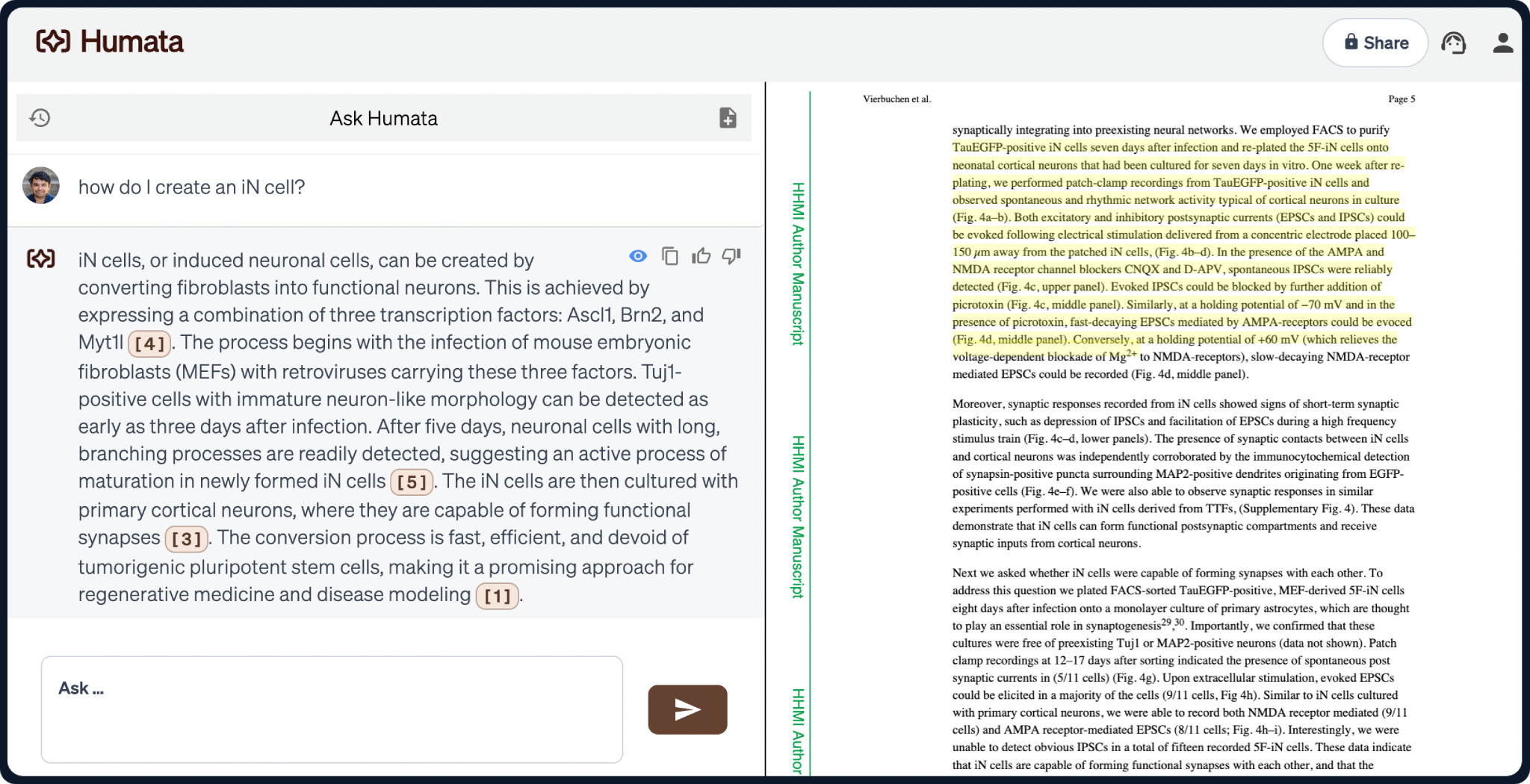
Humata.ai is a document-focused retrieval-augmented question-answering platform that lets you upload PDFs and other files, then ask natural-language questions and get answers with inline citations pointing back to the source pages. It is positioned somewhere between a Ctrl-F replacement and a research assistant, optimised for the workflow of reading dense documents you didn't write.
The sell is speed and traceability. Every answer links back to the underlying passage, which makes it more defensible than dropping PDFs into a generic chatbot. Pricing starts free (60 pages, 10 questions), then $9.99/month for the Expert plan and $49/user/month for Team with role-based access and 5,000 included pages; an enterprise tier covers SSO and bulk procurement. It is best suited to researchers, analysts, legal/compliance teams and graduate students rather than developers building their own RAG stack.
There is a public API for embedding the QA experience into your own product, plus a webpage-embed widget. It is closed-source SaaS and your data is processed in the cloud, so security-sensitive teams will want to read the encryption and retention claims carefully before uploading anything regulated.
Humata is one of the more polished entries in the chat-with-PDF category, and the citation discipline genuinely earns its keep over generic chatbots. The pricing is reasonable for individuals but the per-page caps bite quickly on real research workloads — and you're trusting a black-box model stack you can't audit.
— The AI Tool Bible editorial team
Pros
- ✅ Citations link every answer back to the exact source passage
- ✅ Cheap entry tier ($9.99/mo) suitable for individual researchers
- ✅ Public API and embeddable widget for integration into other apps
- ✅ Team plan with role-based access for collaborative workflows
Cons
- ⚠️ Closed-source SaaS — uploaded documents leave your infrastructure
- ⚠️ Per-page quotas make heavy archival workloads expensive
- ⚠️ Underlying model not disclosed, so answer quality varies silently
Use cases
Frequently asked
- How does Humata.ai ensure answer accuracy?
- Every answer includes inline citations that link back to the specific underlying passage in the uploaded document, providing traceability.
- What are the pricing options for Humata.ai?
- Pricing starts with a free tier, followed by an Expert plan at $9.99/month, a Team plan at $49 per user/month, and a custom Enterprise tier.
- Can Humata.ai be integrated into other applications?
- Yes, the platform provides a public API and a webpage-embed widget for integrating the QA experience into other products.
- Is Humata.ai suitable for handling regulated data?
- It is generally not recommended for regulated data because it is a closed-source SaaS where documents are processed in the cloud, requiring careful review of security claims.
Explore related
Compare with similar tools
All in RAG →Pinecone
FeaturedManaged vector database for production-scale similarity search.
LlamaIndex
FeaturedData framework for connecting LLMs to your data.
Elasticsearch Vector Search
Hybrid vector + keyword search in the enterprise-grade Elasticsearch engine
Snowflake Cortex
Generative AI and RAG built into the Snowflake data cloud
DataStax Astra DB
Serverless vector and document database for production RAG and AI agents
MongoDB Atlas Vector Search
Vector search built into the operational database you're already using.