HiDream
✓ Editorially verifiedOpen-source 17B image model with frontier quality, hosted on Vivago and free to self-host under MIT.
Designers, indie studios and ML teams that want frontier open-weights image quality they can self-host, fine-tune, or use commercially without the licensing and content limits of Midjourney or DALL-E.
Casual users who just want a polished, opinionated one-click generator with strong safety rails, or teams without GPU capacity or a hosted-API budget for high-volume Full-mode use.
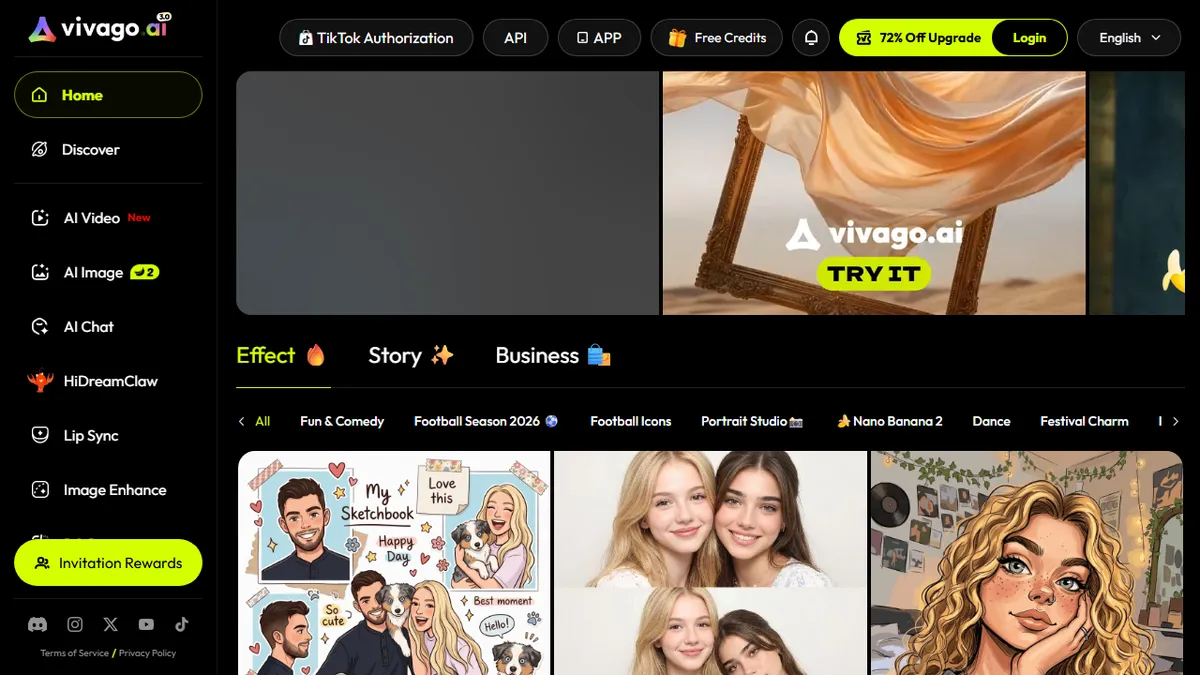
HiDream is an open-source, foundation-scale text-to-image model developed by HiDream.ai (Sparking Innovations Limited, Hong Kong) and served through the vivago.ai creative platform. The flagship release, HiDream-I1, is a 17B-parameter diffusion transformer released under the permissive MIT license, which makes it one of the very few frontier-quality image generators that can be self-hosted and used commercially without royalty or content-usage restrictions. It ships in three variants tuned for a quality-versus-speed trade-off: 'Full' targets maximum fidelity at around 50 denoising steps, 'Dev' balances quality and throughput at ~30 steps, and 'Fast' produces usable images in ~16 steps for interactive or high-volume workflows. In independent evaluations HiDream-I1 has posted top-tier GenEval and DPG-Bench scores, beating open-source peers like FLUX, AuraFlow and SD 3.5 and matching or exceeding several closed models such as Midjourney v7, Ideogram v3 and Reve. On vivago.ai, the model powers a browser-based creator suite with prompt-to-image generation, style presets, image editing, upscaling and a community feed; the same account also gives access to third-party video and image models Vivago aggregates. The weights and inference code are on GitHub and Hugging Face and are supported natively in the Hugging Face diffusers library, so teams that need on-prem or private-cloud deployment can run it themselves; those who don't want to manage GPUs can call it via Vivago's hosted API or through providers like Fal and Runware. Typical users are indie designers and marketers who want strong out-of-the-box results without Midjourney's guardrails, plus ML teams that need a commercially clean base model to fine-tune for product photography, concept art, editorial illustration or synthetic-data pipelines.
HiDream is the most interesting open-source image model since FLUX. Vivago's hosted app is fine but not the reason to care — the reason to care is that a genuinely competitive 17B DiT is sitting on Hugging Face under MIT, which resets the ceiling for anyone building on top of open weights. If you want a curated creator UX, use Midjourney; if you want to own the model, start here.
— The AI Tool Bible editorial team
Pros
- ✅ Frontier-quality output that benchmarks above other open-source models (FLUX, SD 3.5, AuraFlow) on GenEval and DPG
- ✅ Permissive MIT license on the model weights — usable commercially and fine-tunable without royalty
- ✅ Three variants (Full / Dev / Fast) let you dial quality against latency and cost
- ✅ Runs both as a hosted service on vivago.ai and as self-hosted weights on your own GPUs
- ✅ Available through multiple API providers (Vivago, Fal, Runware) so you're not locked to one vendor
- ✅ Diffusers-library integration makes it easy to plug into existing Python pipelines
- ✅ Uncensored base model gives more prompt latitude than Midjourney or DALL-E for legitimate creative work
Cons
- ⚠️ 17B parameters means Full-quality inference wants a high-VRAM GPU (24 GB+) for local use
- ⚠️ Vivago's hosted UI is less mature and less prompt-documented than Midjourney or Ideogram
- ⚠️ Being uncensored puts safety and rights-compliance work back on the deploying team
- ⚠️ Fewer community LoRAs, ControlNets and tooling than the older SD/FLUX ecosystems
- ⚠️ Vivago's subscription model gates the highest-throughput and best editing features behind Plus/Pro tiers
Use cases
Explore related
Compare with similar tools
All in Image Generation →Midjourney
FeaturedThe gold standard for aesthetic AI image generation.
Flux
FeaturedBlack Forest Labs' open-weights image model — rivals Midjourney quality.
Stable Diffusion
Open-source image generation — run anywhere, fine-tune anything.
Nano Banana (Gemini Image)
Google DeepMind's Gemini-powered image generation and conversational editing model family
DALL·E 3
OpenAI's image model — strong on prompt adherence and text-in-image.
Canva Magic Studio
Canva's all-in-one AI creative suite for design, image, video, copy, and presentations