Habibi
Not yet source-checkedSelf-hosted generative engine optimization for tracking brand mentions across ChatGPT, Perplexity, and Gemini
Machine-drafted from the vendor's site · not yet source-checkedProfile updated Link checked Pricing captured How we rate
In short
Habibi is a self-hosted GEO tool for tracking brand mentions in ChatGPT, Perplexity, and Gemini. It offers flat-cost deployment and unlimited seats for GDPR-compliant teams.
In-house SEO teams and marketing agencies that want to monitor brand visibility across ChatGPT, Perplexity, and Gemini on their own infrastructure, at a flat cost, with GDPR-friendly data residency and unlimited seats.
Solo creators or small teams who want a zero-setup SaaS dashboard, or organizations that need coverage of Claude, Copilot, and Grok as first-class engines rather than just OpenAI, Perplexity, and Google.
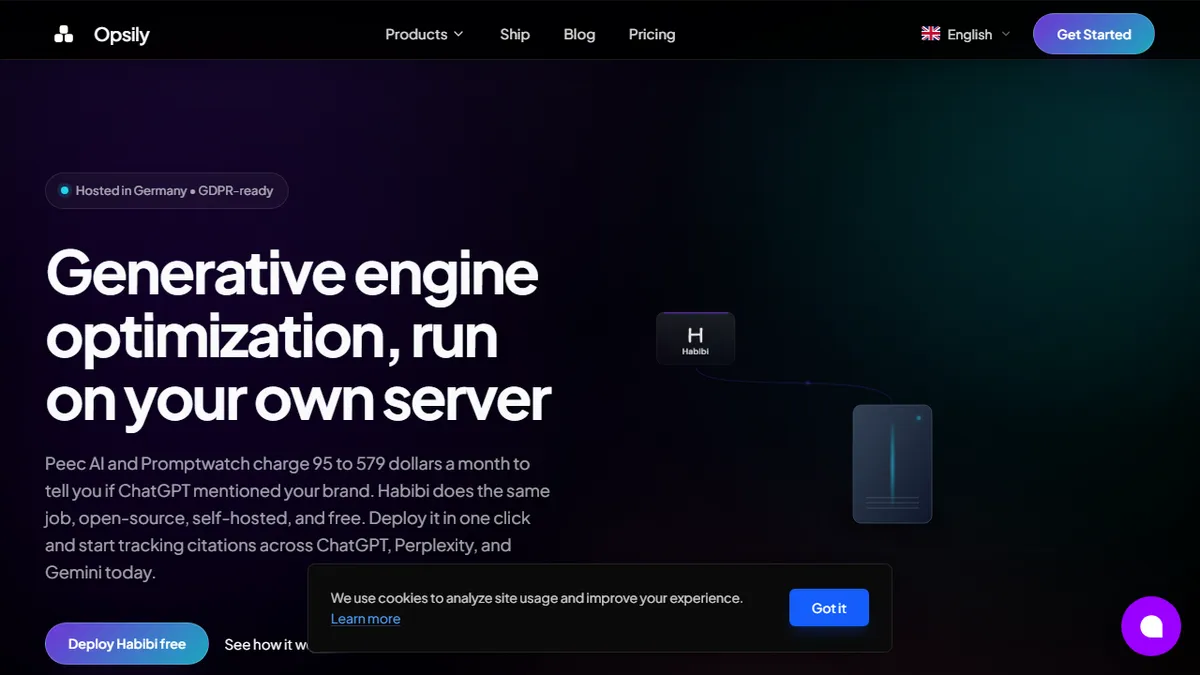
Habibi is a self-hosted Generative Engine Optimization (GEO) platform that lets marketing and SEO teams measure how their brand shows up inside answers from large language models like ChatGPT, Perplexity, and Gemini. Instead of paying per-seat SaaS pricing to tools like Peec AI or Promptwatch, teams deploy Habibi to their own server (Opsily offers a one-click deployment for around $20/month) and connect their own OpenAI, Perplexity, and Google API credentials. The tool then runs a defined library of prompts on a schedule, samples each prompt multiple times to smooth out non-determinism, and records which brands, competitors, and specific URLs the AI answer engines cite in response. Typical workflows include tracking share of voice against competitors for a set of buyer-intent prompts, mapping page-level citations to see which of your own URLs actually get picked up by AI crawlers, running experiments to see whether content or schema changes move the needle in ChatGPT results, and producing weekly or monthly visibility reports for clients. Data lives in a local SQLite database on infrastructure the team controls, which makes it a practical choice for agencies and in-house teams that need GDPR-compliant, EU-resident storage or that simply do not want their prompt library and competitor lists sitting on someone else's SaaS. Team members can be added at no extra cost, so pricing does not scale with headcount the way traditional GEO tools do.
Habibi is a smart response to the current GEO-tool land grab: rather than paying $99-$579/month for another SaaS dashboard, you self-host, bring your own API keys, and keep your prompt library private. It is not for teams who want plug-and-play, but for agencies managing many clients or enterprises with data-residency requirements, the economics and control are hard to argue with.
— The AI Tool Bible editorial team
Pros
- ✅ Self-hosted with data kept in a local SQLite database, so prompt libraries and competitor lists never leave your infrastructure
- ✅ Flat server-based pricing (from about $20/month via Opsily) instead of per-seat SaaS fees that typically run $99-$579/month
- ✅ Unlimited team seats at no extra cost, which suits agencies managing many client workspaces
- ✅ Multi-sample runs per prompt smooth out LLM non-determinism and give more trustworthy mention-rate numbers
- ✅ Page-level citation tracking shows which specific URLs answer engines actually cite, not just brand-name mentions
- ✅ Covers the three highest-traffic answer engines (ChatGPT, Perplexity, Gemini) in one dashboard
- ✅ EU (Germany) hosting option and bring-your-own-key model make GDPR and data-sovereignty stories straightforward
Cons
- ⚠️ You pay separately for OpenAI, Perplexity, and Gemini API usage, and heavy sampling can make those bills non-trivial
- ⚠️ Requires running and maintaining a server (or paying Opsily to do it), which is more setup than a pure SaaS signup
- ⚠️ Sustainable Use License is source-available but not true OSI open source, so commercial resale as a service is restricted
- ⚠️ Coverage is limited to ChatGPT, Perplexity, and Gemini today; Copilot, Claude, and Grok visibility are not first-class
- ⚠️ GEO is a young discipline and the underlying prompt-sampling methodology can still misrepresent volatile answer surfaces
Pricing (captured )
| Tier | Monthly | Key features |
|---|---|---|
| Opsily Server | €40 |
|
Prices change; we show the grid as captured on Aug 10, 2026. Check current pricing on the vendor's site →
Facts
- Free trial
- Yes
- Model used
- GPT-4o, Perplexity Sonar, Gemini (bring-your-own API keys)
- Earliest Wayback capture
- 2026-01-09 (earliest archived capture of the site, not a launch date)
Where this tool sits
Use cases
Frequently asked
- How much does Habibi cost?
- Habibi uses a freemium model. The Opsily Server deployment costs €40. You must provide your own API keys for GPT-4o, Perplexity Sonar, and Gemini. Team members can be added at no extra cost, so pricing does not scale with headcount.
- Which AI engines does Habibi support?
- Habibi tracks brand mentions across ChatGPT, Perplexity, and Gemini. It requires you to bring your own API keys for these specific models. It does not list Claude, Copilot, or Grok as first-class engines in its documentation.
- Is Habibi suitable for small teams or solo creators?
- It is best for in-house SEO teams and agencies needing self-hosted infrastructure. Solo creators or small teams wanting a zero-setup SaaS dashboard should skip it. It requires deploying to your own server and managing API credentials.
- How is data stored in Habibi?
- Data lives in a local SQLite database on infrastructure you control. This setup supports GDPR-compliant, EU-resident storage. It prevents your prompt library and competitor lists from residing on third-party SaaS platforms, offering greater data residency control.
- What are the main use cases for Habibi?
- Use cases include tracking share of voice, mapping page-level citations, and running A/B tests for content changes. Agencies can use it for client-facing GEO reporting. It helps monitor how brands appear in AI answers and which URLs are cited.