
H2O.ai
✓ Editorially verifiedEnterprise AI platform combining AutoML, generative AI, and vertical agents for regulated industries.
In short
H2O.ai is an enterprise AI platform combining AutoML and generative AI for regulated industries. It supports private, air-gapped deployments with FedRAMP-grade controls.
Pick H2O.ai if you're a regulated enterprise that needs AutoML, RAG, and agents on private or air-gapped data with FedRAMP-grade controls.
Skip it if you're an indie developer or startup looking for a self-serve API and transparent per-token pricing.
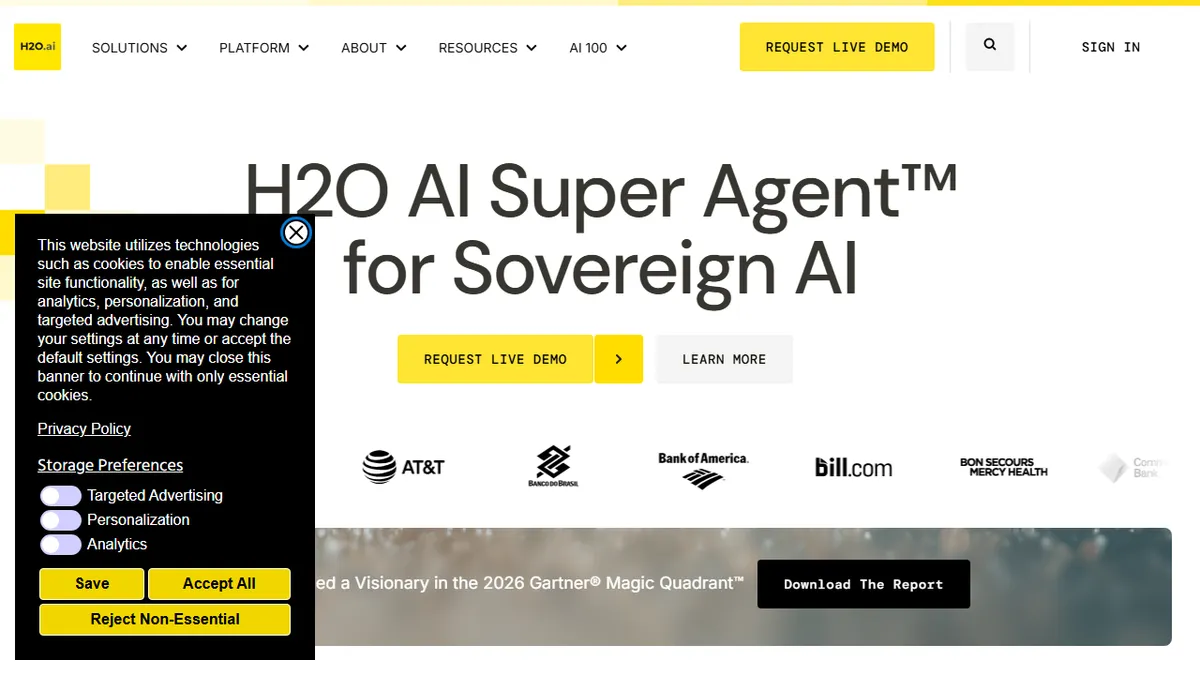
H2O.ai is an end-to-end enterprise AI platform that bundles predictive ML (Driverless AI AutoML, the open-source H2O-3 framework, the TabH2O tabular foundation model) with generative AI tooling (h2oGPTe for multi-model RAG/agents and LLM Studio for no-code fine-tuning). The pitch is convergence: train classical ML on your private data, then layer LLM-powered document AI, agents, and workflow automation on top, all deployable on-prem or in air-gapped environments.
It is squarely aimed at regulated, data-sensitive buyers - banks, telcos, healthcare, and government - rather than indie developers. Reference customers include Commonwealth Bank of Australia, AT&T, and NIH, and the platform carries FedRAMP credentials. Pricing is not published; the buying motion is sales-led with live demos. The vertical agents (banking, telecom, public sector) and the recent 75% GAIA score on deep-research tasks are H2O.ai's pitch against horizontal players like Databricks or Palantir.
The open-source H2O-3 distribution (Python/R/Spark) remains a credible reason to engage, even if everything above it is proprietary. Integrations cover Slack, Google Drive, SharePoint, and standard enterprise stacks, with APIs for embedding models into downstream apps. Expect a heavyweight sales cycle and platform commitment rather than a self-serve API key.
H2O.ai is one of the few vendors that credibly spans classical ML and modern LLM agents without forcing you to bolt two stacks together. The open-source H2O-3 lineage earns goodwill, but the real product is a sales-led enterprise platform - evaluate it against Databricks and Dataiku, not against a hosted LLM API.
— The AI Tool Bible editorial team
Pros
- ✅ Covers predictive ML and generative AI in one platform
- ✅ Air-gapped and FedRAMP-ready deployment options
- ✅ H2O-3 core is genuinely open source
- ✅ Vertical agents for banking, telecom, and public sector
- ✅ Strong AutoML pedigree with Driverless AI
Cons
- ⚠️ No public pricing; sales-led enterprise motion
- ⚠️ Overkill for individual developers or small teams
- ⚠️ Most upper-stack products are proprietary, not OSS
- ⚠️ Platform sprawl can mean a steep onboarding curve
Use cases
Frequently asked
- How much does H2O.ai cost?
- Pricing is not published. The buying motion is sales-led, requiring you to contact sales for a quote. A live demo is available on request, but there is no self-serve pricing model.
- Is H2O.ai suitable for startups or indie developers?
- No. It is aimed at regulated enterprises, not indie developers or startups seeking self-serve APIs. The platform involves a heavyweight sales cycle and platform commitment rather than transparent per-token pricing.
- Can H2O.ai run on private or air-gapped data?
- Yes. The platform is deployable on-premises or in air-gapped environments. It is designed for data-sensitive buyers in regulated industries who require FedRAMP-grade controls for their AI workloads.
- What integrations does H2O.ai support?
- It integrates with Slack, Google Drive, SharePoint, and standard enterprise stacks. APIs are available for embedding models into downstream applications, facilitating workflow automation and document AI within existing systems.
- Does H2O.ai offer open-source components?
- Yes, the H2O-3 distribution is open-source and available for Python, R, and Spark. However, the broader enterprise platform, including generative AI tools and vertical agents, is proprietary.
Explore related
Compare with similar tools
All in Agents →LangGraph
FeaturedStateful, graph-based agent orchestration from LangChain.
CrewAI
FeaturedPython framework for multi-agent orchestration.
Ernie Bot
Baidu's Mandarin-first ChatGPT rival, powered by the ERNIE model family
Moveworks
The enterprise AI assistant that searches, answers, and takes action across your business systems
AWS Bedrock
Build and scale generative AI applications with foundation models
Claude Agent SDK
Anthropic's official SDK for building autonomous Claude agents.