Graphiti
Open-source temporal knowledge graph framework for building agent memory that updates in real time.
In short
Graphiti constructs a live temporal knowledge graph that evolves as new information arrives, tracking when facts were valid. It is best for developers building production agents that require durable, queryable memory across sessions where naive RAG fails on recency.
Pick Graphiti if you are shipping agents that need durable, contradiction-aware memory and you can run a graph database alongside your LLM stack.
Skip it if you just need basic document Q&A or a hosted memory API you can call without operating any infrastructure.
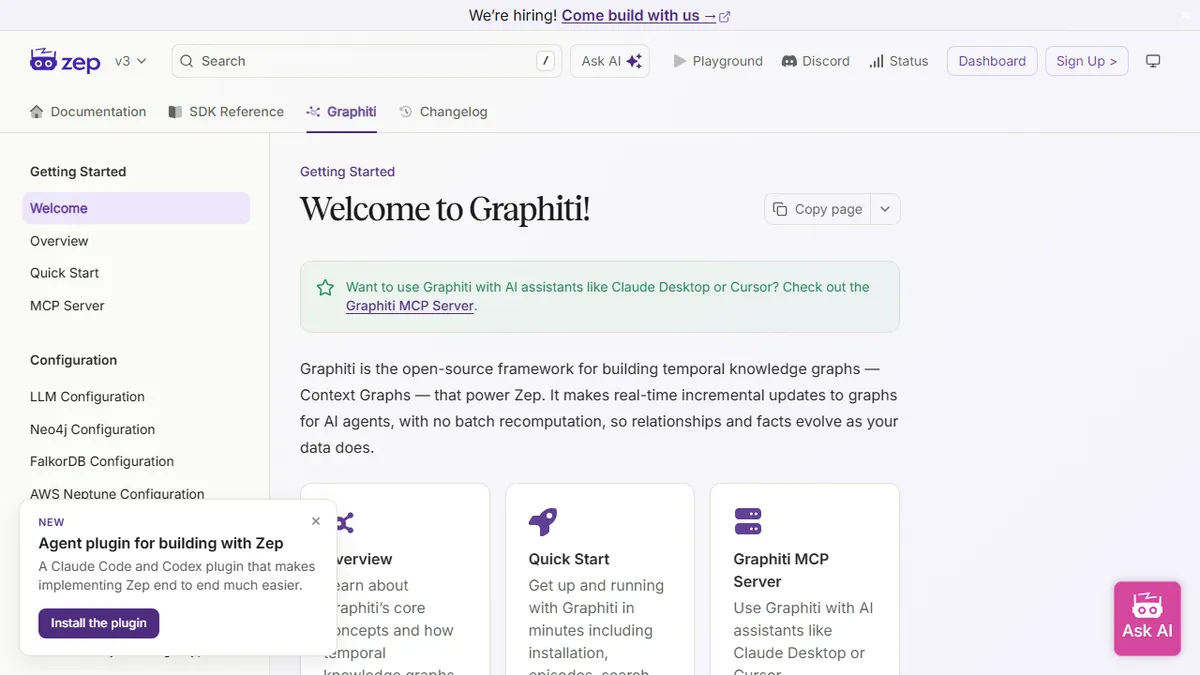
Graphiti is Zep's open-source framework for building temporal knowledge graphs, designed specifically as a memory layer for AI agents. Instead of treating retrieval as a static vector lookup, it constructs a live graph of entities and relationships that evolves as new information arrives, tracking when facts became true and when they were superseded. Retrieval is hybrid by default, combining semantic embeddings, keyword search, and graph traversal so agents can answer queries that depend on history, not just the latest snapshot.
The project targets developers building production agents that need persistent, queryable memory across sessions, particularly assistants, customer support bots, and long-running workflows where naive RAG fails on contradiction and recency. It ingests text or JSON episodes, lets you declare domain-specific entity types, and exposes an MCP server for clients like Claude Desktop and Cursor. The library is free and Apache-licensed; Zep sells a managed Context Graph service on top for teams that don't want to run their own graph DB.
Graphiti is the engine behind Zep's commercial memory product, so it's actively maintained and battle-tested rather than a research artifact. Expect to bring your own Neo4j (or compatible store) and an LLM provider for entity extraction, which adds operational complexity compared with a plain vector DB.
Graphiti is one of the more serious answers to the agent-memory problem: it treats time as a first-class citizen instead of pretending the latest embedding wins. It's not the easiest path to RAG, but for teams building stateful agents it's worth the setup over yet another vector-only pipeline.
— The AI Tool Bible editorial team
Pros
- ✅ Real-time incremental graph updates without batch recomputation
- ✅ Temporal model tracks when facts were valid, not just current state
- ✅ Hybrid semantic + keyword + graph search out of the box
- ✅ Open source with an active commercial backer in Zep
- ✅ MCP server lets Claude Desktop and Cursor read agent memory directly
Cons
- ⚠️ Requires running a graph database like Neo4j
- ⚠️ LLM calls during ingestion add cost vs plain vector RAG
- ⚠️ Steeper learning curve than drop-in RAG libraries
Use cases
Frequently asked
- How does Graphiti handle changing information?
- It constructs a live graph of entities and relationships that evolves as new information arrives. The system tracks when facts became true and when they were superseded, treating time as a first-class citizen.
- What infrastructure is required to run Graphiti?
- You must bring your own graph database, such as Neo4j, and an LLM provider for entity extraction. This adds operational complexity compared to using a plain vector database.
- How does Graphiti perform retrieval?
- Retrieval is hybrid by default, combining semantic embeddings, keyword search, and graph traversal. This allows agents to answer queries that depend on history, not just the latest snapshot.
- Is Graphiti open source?
- Yes, the library is free and Apache-licensed. It is the engine behind Zep's commercial memory product and is actively maintained.
- Can Graphiti integrate with other tools?
- It exposes an MCP server for clients like Claude Desktop and Cursor, allowing them to read agent memory directly.
Explore related
Compare with similar tools
All in RAG →Pinecone
FeaturedManaged vector database for production-scale similarity search.
LlamaIndex
FeaturedData framework for connecting LLMs to your data.
Elasticsearch Vector Search
Hybrid vector + keyword search in the enterprise-grade Elasticsearch engine
Snowflake Cortex
Generative AI and RAG built into the Snowflake data cloud
DataStax Astra DB
Serverless vector and document database for production RAG and AI agents
MongoDB Atlas Vector Search
Vector search built into the operational database you're already using.