GPT Researcher
✓ Text source-checked Oct 23, 2026Open-source agent that researches the web and local documents to write detailed reports with citations.
Source-checked against the vendor's site · rebuilt from the vendor's own pagesProfile updated Link checked How we rate
In short
GPT Researcher is a free, open-source agent that researches web and local documents to write detailed, cited reports using various LLMs.
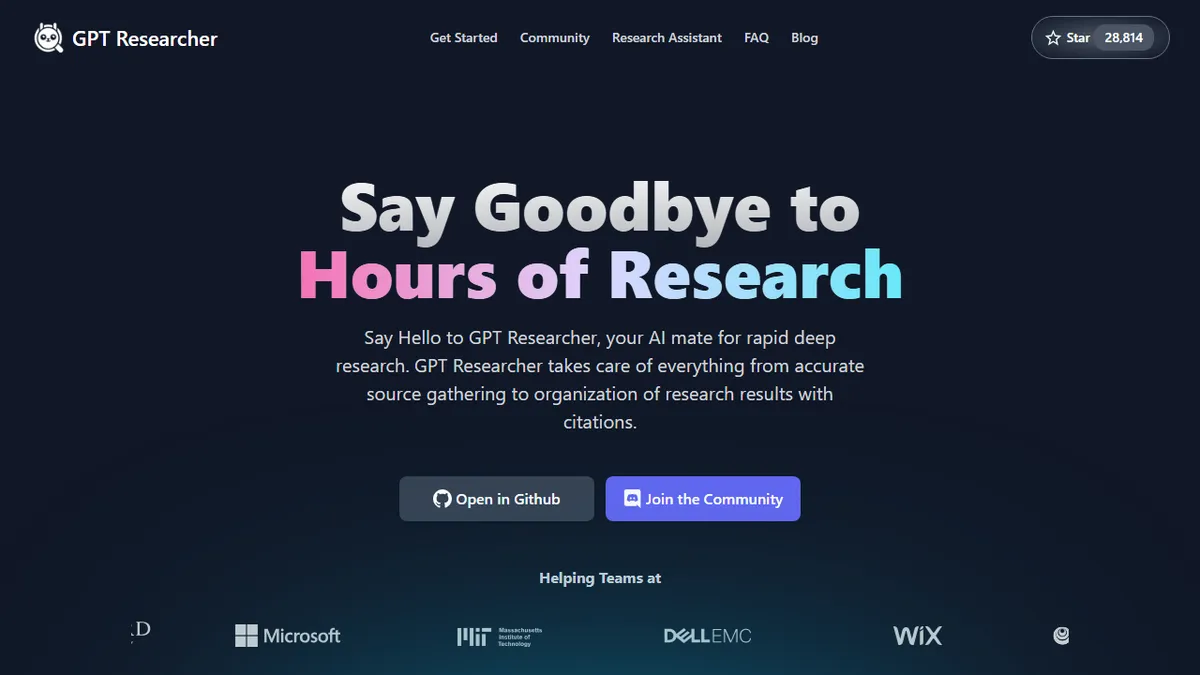
GPT Researcher is an open-source autonomous AI research agent that gathers and validates information from multiple web sources in parallel to write detailed reports with inline citations. GPT Researcher supports various LLMs including OpenAI, Anthropic, Google, Mistral, DeepSeek, and local models via Ollama, along with retrievers like Tavily, Bing, Google, DuckDuckGo, and SearXNG.
The system uses a planner to split questions and run multiple researchers in parallel for each sub-question. Context filtering using Jev, BM25, or embeddings keeps only relevant passages before they reach the LLM. Research outputs can be exported to formats including PDF, Word, Markdown, JSON, and CSV.
GPT Researcher allows users to search local documents and conduct hybrid research using both local and web sources. The tool exposes research tools to MCP clients such as Claude, Cursor, and n8n.
GPT Researcher is MIT licensed and free to use.
According to GPT Researcher: GPT Researcher is an open-source autonomous AI research agent that gathers and validates information from multiple web sources in parallel to write detailed reports with inline citations. Its pages list this strength: The tool is MIT licensed and free to use.
— The AI Tool Bible editorial team
Pros
- ✅ The tool is MIT licensed and free to use.
- ✅ Users can connect any LLM of their choice, including OpenAI, Anthropic, Groq, Llama 3, and Hugging Face.
- ✅ Research outputs can be exported to formats including PDF, Word, Markdown, JSON, and CSV.
- ✅ The system uses a planner to run multiple researchers in parallel for each sub-question.
- ✅ The tool supports hybrid research using both local documents and web sources.
Facts
- Platforms
- linux, macos, windows
- API available
- Yes
- Open source
- Yes
- Model used
- Model-agnostic (default GPT-4o; supports Anthropic Claude, Google Gemini, Groq, Ollama, and any LiteLLM-compatible provider) (not source-checked)
- Hacker News
- 1 story · top 4 points · last Aug 13, 2024 · checked Oct 12, 2026
- Earliest Wayback capture
- 2024-04-24 (earliest archived capture of the site, not a launch date)
Where this tool sits
Use cases
Frequently asked
- How much does GPT Researcher cost?
- GPT Researcher is completely free to use. It is an open-source project licensed under MIT, meaning there are no subscription fees or usage charges for the software itself.
- Which AI models can I use with GPT Researcher?
- It is model-agnostic, defaulting to GPT-4o but supporting Anthropic Claude, Google Gemini, Groq, Ollama, Mistral, DeepSeek, and any LiteLLM-compatible provider. This flexibility allows you to choose the best model for your specific research needs.
- Can GPT Researcher search my local files?
- Yes, the tool supports hybrid research. It allows users to search local documents and combine them with web sources to generate comprehensive reports that draw from both internal and external data.
- What integrations does GPT Researcher support?
- It exposes research tools to MCP clients such as Claude, Cursor, and n8n. It also supports various retrievers including Tavily, Bing, Google, DuckDuckGo, and SearXNG for gathering web information.
- What file formats can I export reports to?
- Research outputs can be exported to several formats, including PDF, Word, Markdown, JSON, and CSV. This makes it easy to share detailed reports with citations in the format that best suits your workflow.