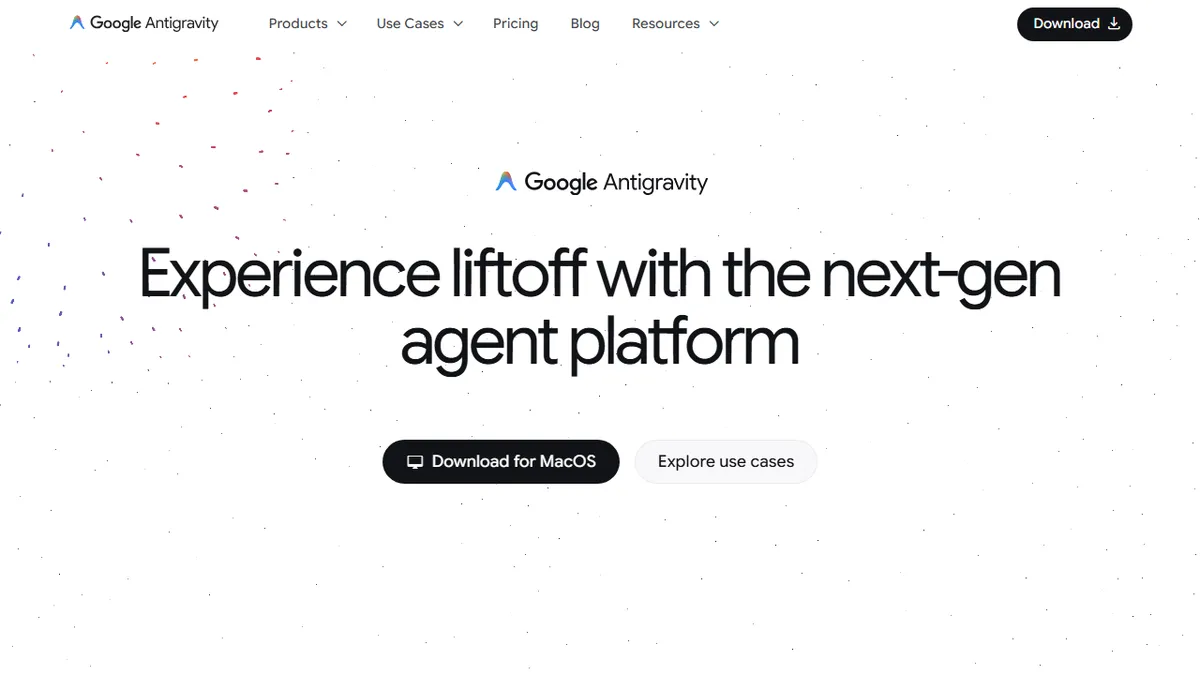
Google Antigravity
✓ Editorially verifiedGoogle's agent-first development platform for building software with autonomous coding agents.
In short
Google Antigravity is a full-stack development environment designed to manage multiple autonomous coding agents in parallel. It is best for engineering teams wanting to automate recurring tasks like refactors and dependency upgrades using Gemini models.
Developers and engineering teams that want to run several autonomous Gemini-powered coding agents in parallel across a real codebase, with a scheduler and Python SDK to automate recurring engineering work.
Non-developers, users who need a mature multi-model IDE today, or regulated teams that require detailed data-handling guarantees before adopting an agentic tool from a still-early Google product.
Google Antigravity is Google's agentic development platform aimed at software teams that want to move beyond single-turn autocomplete into orchestrating multiple autonomous coding agents. Rather than shipping only an IDE plugin, Antigravity is a stack: the Antigravity 2.0 command center (which manages parallel local agents, groups conversations into projects, and schedules recurring automation), a full IDE, a terminal-first Antigravity CLI for headless runs, and a Python SDK for prototyping custom agents and glue code. Agents can read a codebase, plan multi-step work, edit files, run commands, execute tests, and hand results back to the human via structured artifacts, letting a developer supervise several long-running jobs at once instead of pair-programming a single one. Under the hood it leans on Google's Gemini family (the site highlights Gemini 3 Flash variants) and is designed for the workflow patterns that emerged from Cursor, Windsurf, and Claude Code — repo-aware chat, agent tool use, task queues, and shell access — with Google's own default models, a scheduling layer, and first-party CLI/SDK surface. Typical users range from solo builders spinning up prototypes to enterprise engineering teams that want a controllable substrate for internal 'always-on' coding agents doing chores like dependency upgrades, refactors, migrations, test backfills, and PR triage. Downloads currently target macOS on Apple Silicon and Intel, with expected coverage of the wider desktop matrix over time. Because it is free to start and comes from Google, it is also being watched as the reference implementation of what an 'agent-first IDE' from a frontier lab looks like.
Antigravity is Google's serious answer to Cursor and Claude Code — an agent-first stack rather than an editor with a chatbox bolted on. The scheduler plus SDK is the interesting bet: it treats agents as long-running workers, not chat sessions. It's early, docs are thin, and the Gemini-centric defaults may not suit everyone, but for teams already committed to Google's model family it's the most integrated option on the market.
— The AI Tool Bible editorial team
Pros
- ✅ Ships as a full stack — desktop command center, IDE, CLI, and Python SDK — not just an editor plugin
- ✅ Designed from the ground up to supervise multiple autonomous agents running in parallel on the same repo
- ✅ Built-in scheduling turns recurring engineering chores (upgrades, sweeps, backfills) into cron-like agent tasks
- ✅ Free for individual developers, lowering the barrier vs paid seats on Cursor / Copilot Business
- ✅ First-party access to Google's Gemini 3 family with the model tuning and quota that come from being Google
- ✅ Python SDK makes it straightforward to prototype custom agents and wire them into existing internal tooling
Cons
- ⚠️ Very new — expect churn in APIs, agent behavior, and pricing before it stabilizes
- ⚠️ Public docs are thin on model routing, per-tier limits, data handling, and exactly what runs locally vs in Google cloud
- ⚠️ Downloads highlighted on the site are macOS-first; Windows and Linux coverage is less clearly advertised
- ⚠️ Ties you to Google's Gemini defaults; multi-provider model choice is less front-and-center than in Cursor or Cline
- ⚠️ 'Free' tier without published quotas makes it hard to plan around future paid gating
- ⚠️ Autonomous multi-agent workflows still need careful human review — hallucinated edits and runaway commands are a real risk
Use cases
Frequently asked
- What components are included in the Google Antigravity platform?
- The platform includes the Antigravity 2.0 command center, a full IDE, a terminal-first CLI for headless runs, and a Python SDK for prototyping custom agents.
- How does Antigravity differ from standard IDE plugins?
- It is designed to orchestrate multiple autonomous agents that can plan multi-step work, edit files, and run commands in parallel, rather than just providing single-turn autocomplete.
- What is the pricing model for Google Antigravity?
- The tool operates on a freemium model, with a free tier for individuals at $0/month. Paid options include Google AI Pro, Google AI Ultra, and organization plans via Google Cloud.
- Which operating systems are currently supported?
- Downloads currently target macOS on Apple Silicon and Intel, with expected coverage of the wider desktop matrix over time.
- What AI models power the agents in Antigravity?
- The platform relies on Google's Gemini family, specifically highlighting Gemini 3 Flash variants, as its default models for agent operations.
Explore related
Compare with similar tools
All in Agents →LangGraph
FeaturedStateful, graph-based agent orchestration from LangChain.
CrewAI
FeaturedPython framework for multi-agent orchestration.
Ernie Bot
Baidu's Mandarin-first ChatGPT rival, powered by the ERNIE model family
Moveworks
The enterprise AI assistant that searches, answers, and takes action across your business systems
AWS Bedrock
Build and scale generative AI applications with foundation models
Claude Agent SDK
Anthropic's official SDK for building autonomous Claude agents.