Google Agent Development Kit (ADK)
✓ Editorially verifiedGoogle's open-source framework for building, evaluating, and deploying production AI agents
In short
Google Agent Development Kit (ADK) is an open-source framework for creating production-scale AI agents with built-in evaluation and deployment tools. It supports Python, Java, and Go, offering a structured alternative to LangGraph for teams using Google Cloud or multi-model setups.
Developers and platform teams building production multi-agent systems on Google Cloud who want an opinionated open-source framework with real deployment, evaluation, and observability tooling.
Solo hobbyists who just want a single prompt-loop chatbot, teams fully committed to a non-Google stack that already have LangGraph/CrewAI in production, or anyone who needs a no-code visual builder.
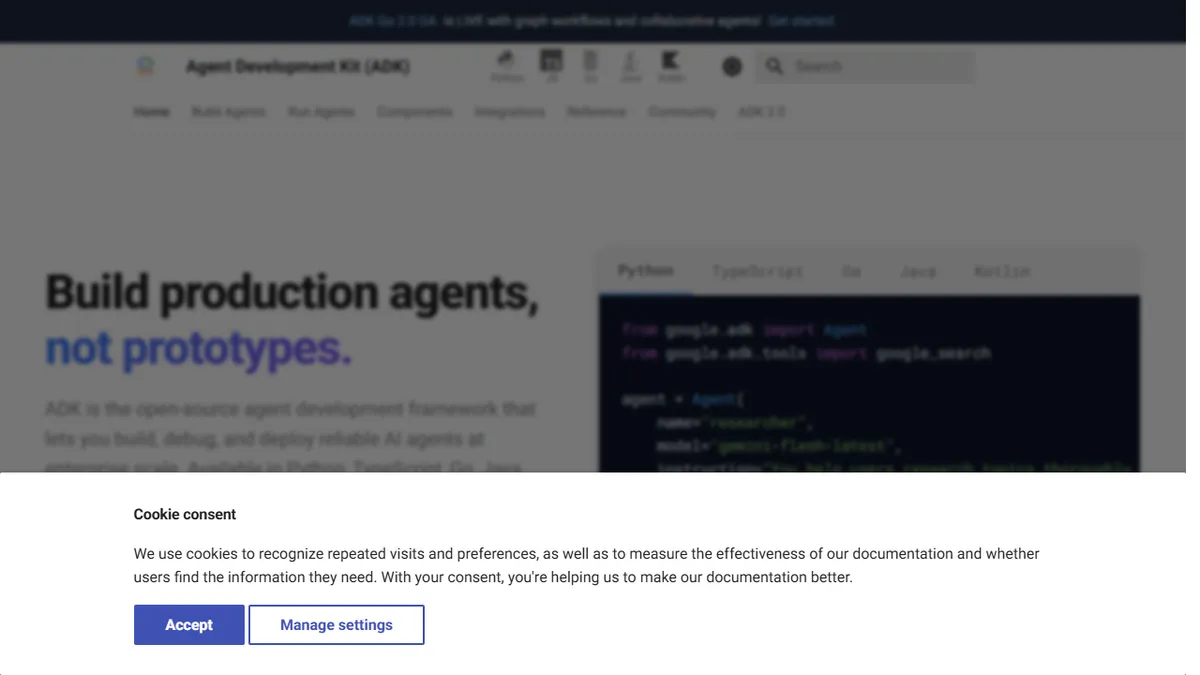
Google's Agent Development Kit (ADK) is an open-source framework for building, debugging, evaluating, and deploying AI agents at production scale. Originally released alongside the Gemini agent stack, it has grown into a multi-language toolkit — official SDKs cover Python, Java, and Go, with community/experimental support for TypeScript and Kotlin — that lets a developer describe an agent as code (tools, prompts, sub-agents, state) and then run it locally, in a hosted dev UI, on Cloud Run, on Kubernetes, or on Google's managed Agent Engine. The design point is production plumbing that hand-rolled LangChain-style scripts tend to skimp on: structured session/state management, a graph-based workflow model that mixes deterministic control flow with LLM reasoning, first-class multi-agent orchestration (sequential, parallel, hierarchical, loop patterns), streaming, tracing, evaluation harnesses, and safety/guardrail hooks. ADK is model-agnostic despite the Google branding — Gemini is the default via Vertex or the Gemini API, but LiteLLM adapters unlock Anthropic Claude, OpenAI, local Ollama models, and most other providers. Tools can be Python/Go/Java functions, MCP servers, OpenAPI specs, LangChain tools, or Google Cloud services (BigQuery, Vertex AI Search, Apigee). Typical workflows: a solo developer prototypes a single agent in `adk web`, iterates against the built-in evaluator with a golden-set of trajectories, then wraps that agent as a sub-agent inside a larger multi-agent system deployed to Agent Engine with tracing piped into Cloud Trace. It is a natural fit for teams already on Google Cloud who want an opinionated, batteries-included alternative to LangGraph, CrewAI, or writing bespoke orchestration on top of the raw Gemini SDK.
ADK is Google's most credible answer to LangGraph — and unlike a lot of Google developer launches it feels like it was built by people who actually deploy agents. If you're already on Vertex/Gemini, it is now the default choice; if you're not, the multi-language SDKs and clean MCP support still make it worth a serious look, provided you can stomach the API churn.
— The AI Tool Bible editorial team
Pros
- ✅ Genuinely open-source (Apache 2.0) with active Google engineering behind it, not a hosted-only product
- ✅ Multi-language: first-class Python, Java, and Go SDKs — rare among agent frameworks that are usually Python-only
- ✅ Built-in dev UI (`adk web`) with trace inspection, event stream, and session replay speeds up debugging enormously
- ✅ Model-agnostic via LiteLLM — Gemini is default but Claude, GPT, and local models plug in cleanly
- ✅ Rich multi-agent primitives out of the box: SequentialAgent, ParallelAgent, LoopAgent, and hierarchical sub-agents
- ✅ Tight Google Cloud integration for deployment (Cloud Run, GKE, Agent Engine) plus native BigQuery/Vertex Search tools
- ✅ Evaluation harness with trajectory-level scoring is included, not a separate paid add-on
- ✅ First-class MCP (Model Context Protocol) client and server support
Cons
- ⚠️ Documentation and examples lean heavily on Gemini + Google Cloud; non-Google paths work but feel like second-class citizens
- ⚠️ API surface is still evolving — breaking changes between minor versions have been common through 2025-2026
- ⚠️ Multi-agent orchestration primitives are powerful but the graph/callback model has a real learning curve compared to a plain prompt loop
- ⚠️ Agent Engine deployment is convenient but locks you into GCP billing and quotas
- ⚠️ TypeScript/Kotlin support lags the Python SDK in features and community examples
Use cases
Frequently asked
- Is Google ADK free to use?
- The framework itself is free and open-source under the Apache 2.0 license. Costs are incurred only from underlying model providers like Gemini API or Vertex AI, and any hosting infrastructure used.
- Which programming languages does ADK support?
- ADK provides official SDKs for Python, Java, and Go. It also includes community or experimental support for TypeScript and Kotlin, though these may lag behind the primary languages in features.
- Can I use models other than Gemini with ADK?
- Yes, ADK is model-agnostic. While Gemini is the default, LiteLLM adapters allow integration with Anthropic Claude, OpenAI models, local Ollama models, and other providers.
- What deployment options are available for ADK agents?
- Agents can run locally, in a hosted dev UI, or be deployed to Cloud Run, Kubernetes (GKE), or Google's managed Agent Engine. The framework includes tools for tracing and observability in these environments.
- Is ADK suitable for simple single-prompt chatbots?
- ADK is best for production multi-agent systems and complex workflows. It is not recommended for solo hobbyists who only need a simple single prompt-loop chatbot or those requiring a no-code visual builder.
Explore related
Compare with similar tools
All in Agents →LangGraph
FeaturedStateful, graph-based agent orchestration from LangChain.
CrewAI
FeaturedPython framework for multi-agent orchestration.
Ernie Bot
Baidu's Mandarin-first ChatGPT rival, powered by the ERNIE model family
Moveworks
The enterprise AI assistant that searches, answers, and takes action across your business systems
AWS Bedrock
Build and scale generative AI applications with foundation models
Claude Agent SDK
Anthropic's official SDK for building autonomous Claude agents.