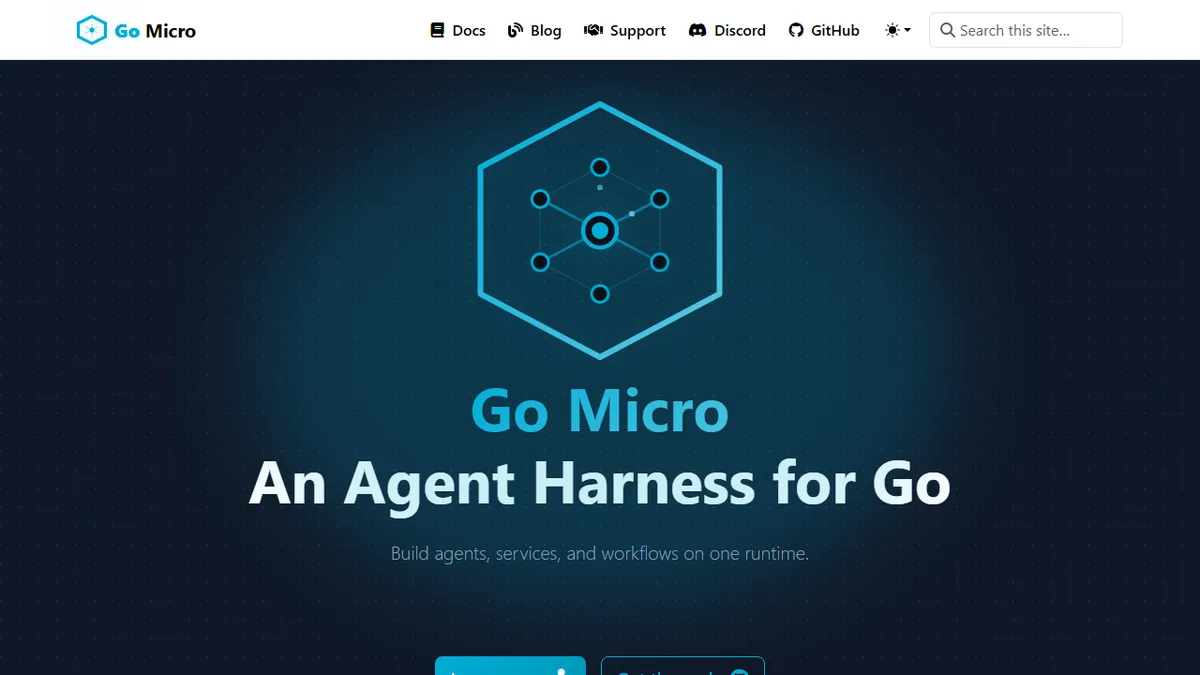
Go Micro
Agent harness and microservice framework, in one Go runtime.
In short
Go Micro combines an AI agent runtime with a full microservices framework in a single Go binary. It is best for Go teams building production agents that need to call internal services or expose endpoints as MCP tools without manual adapters.
Go teams building production agent systems that need to coexist with — or expose — real microservices, and want durable workflows plus MCP tool integration without stitching five libraries together.
Python or TypeScript shops, prototype notebooks, or teams that just need a thin LLM wrapper without a service framework attached.
Go Micro is an Apache-2.0 licensed Go framework that fuses two things that usually live in separate stacks: an AI agent harness (memory, tools, guardrails, middleware, durable workflows) and a full microservices runtime (service discovery, RPC, pluggable transports, config, brokers). The pitch is that in a real production system your agents need to call services, and your services increasingly need to be callable by agents — so Go Micro treats every service endpoint as an MCP-exposable tool automatically, and gives agents first-class discovery of other agents and services on the same mesh.
Developers scaffold with `micro new`, run everything locally with hot reload via `micro run`, and can talk to a running agent from the terminal with `micro chat`. Under the hood the abstractions are Go interfaces, so registry, broker, transport, store, and model backend are all swappable. It plugs into Claude, OpenAI, and roughly 300 additional models through Atlas Cloud, but you can point it at any provider with a client.
The durable-workflow layer is the piece that matters for long-running agents: code paths are checkpointed, so a tool call that takes minutes, a human-in-the-loop wait, or a crash mid-run resumes from the last committed step instead of re-executing side effects. That, plus the built-in service mesh, is what separates it from the more common 'agent SDK stapled to a REST server' pattern. Common workflows include: standing up an agent that fronts an existing gRPC/HTTP service estate; building agent-to-agent systems where specialized agents coordinate over the registry; and shipping self-hostable agent products where the same binary handles both the agent loop and the surrounding services.
The interesting bet here is that agents and microservices are converging, and Go Micro is one of the few frameworks built on that premise instead of bolting an agent loop onto a web server. If you're already in Go and you're tired of writing MCP adapters by hand, it's worth an afternoon. If you're not in Go, it isn't for you.
— The AI Tool Bible editorial team
Pros
- ✅ Unifies agent runtime and microservice framework — one binary handles both the LLM loop and the surrounding services.
- ✅ Automatically exposes service endpoints as MCP tools, so agents can call your existing services without hand-written adapters.
- ✅ Durable, checkpointed workflows survive restarts and long tool calls without re-running side effects.
- ✅ Every abstraction (registry, broker, transport, store, model) is a Go interface — genuinely pluggable.
- ✅ Apache 2.0 with a large existing Go Micro community (23k+ GitHub stars) and no vendor lock-in on models.
- ✅ Local dev loop is tight: `micro new`, `micro run` with hot reload, and `micro chat` to talk to the agent from the terminal.
Cons
- ⚠️ Go-only — if your team's stack is Python or TypeScript, most of the surrounding ecosystem (LangChain, LlamaIndex, DSPy) doesn't apply.
- ⚠️ The framework is opinionated about services; teams that just want a thin agent library will find it heavier than they need.
- ⚠️ Documentation and examples for the newer AI-agent surface are thinner than the mature microservice docs.
- ⚠️ Model routing through Atlas Cloud is convenient but adds a hosted dependency and its own billing if you use it.
- ⚠️ Durable workflows require you to think about idempotency and checkpoint boundaries — not a drop-in for casual scripts.
Use cases
Frequently asked
- What is the primary benefit of using Go Micro for AI agents?
- It unifies the agent runtime and microservice framework, allowing service endpoints to be automatically exposed as MCP tools. This eliminates the need for hand-written adapters when agents call existing services.
- How does Go Micro handle long-running agent workflows?
- It features a durable-workflow layer that checkpoints code paths. This allows workflows to resume from the last committed step after a crash or long tool call, preventing the re-execution of side effects.
- Which AI models are supported by Go Micro?
- The framework is model-agnostic and supports Claude, OpenAI, and over 300 additional models via Atlas Cloud. Developers can also point it at any provider using a custom client.
- Is Go Micro suitable for Python or TypeScript developers?
- No, Go Micro is Go-only. It is not recommended for Python or TypeScript shops, as the surrounding ecosystem like LangChain or LlamaIndex does not apply to this framework.
- What is the licensing model for Go Micro?
- Go Micro is open source under the Apache 2.0 license. Commercial support is available separately, and hosted model access via Atlas Cloud is billed by that provider.
Explore related
Compare with similar tools
All in Agents →LangGraph
FeaturedStateful, graph-based agent orchestration from LangChain.
CrewAI
FeaturedPython framework for multi-agent orchestration.
Ernie Bot
Baidu's Mandarin-first ChatGPT rival, powered by the ERNIE model family
Moveworks
The enterprise AI assistant that searches, answers, and takes action across your business systems
AWS Bedrock
Build and scale generative AI applications with foundation models
Claude Agent SDK
Anthropic's official SDK for building autonomous Claude agents.