GG Translator
Turns aggressive gaming chat into constructive callouts in real time
Tilt-prone ranked players, coaches, and small clans who want an automatic tone-filter on their in-game voice and text chat to avoid behavior penalties.
Pro-level competitive teams who need zero-latency callouts, privacy-strict users unwilling to route mic audio through a third-party LLM, or anyone wanting a self-hostable or API-accessible moderation layer.
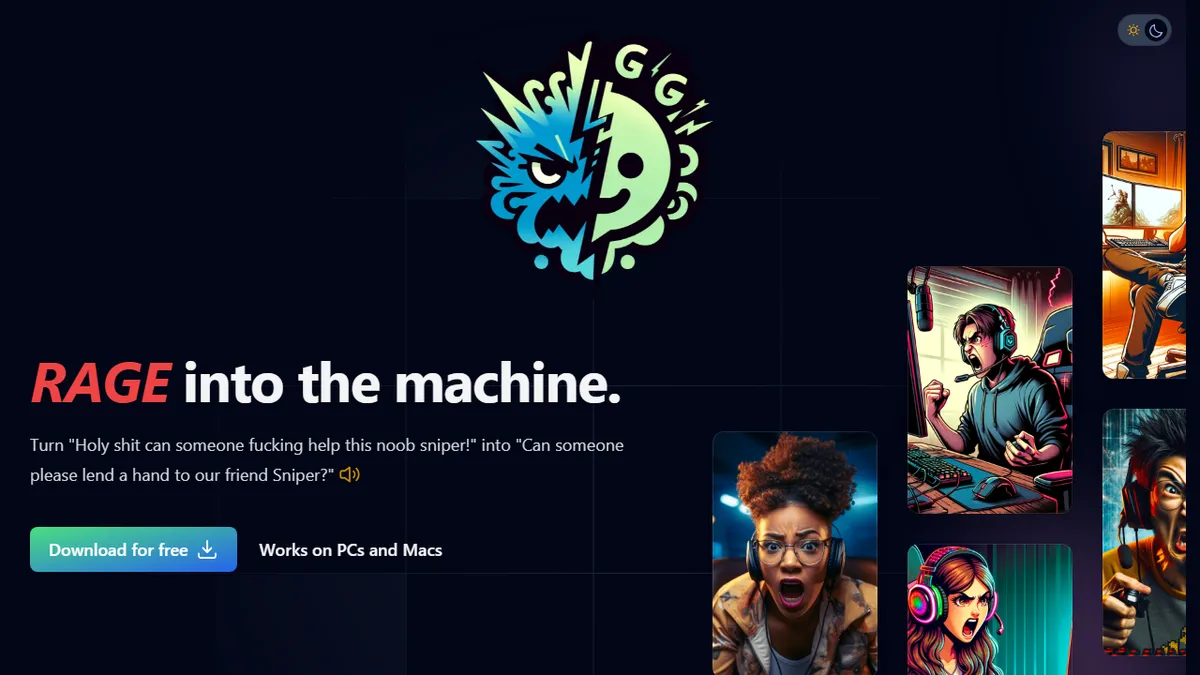
GG Translator is a narrow-purpose AI communication tool aimed at competitive multiplayer gamers who want to keep the intent of their in-game callouts but strip out the hostility, slurs and flame that get teammates to mute them or match-report them. It sits between the player's mic (or keyboard) and the game's voice/text chat: press a hotkey, speak or type the raw thought, and the tool passes it through OpenAI's API with a system prompt that rewrites it as constructive, teammate-friendly language before it goes out. The classic demo turns "Holy shit can someone fucking help this noob sniper!" into "Can someone please lend a hand to our friend Sniper?" The app is game-agnostic because it hooks into the OS audio and text layer rather than any specific title, so it works alongside Dota 2, Overwatch, League of Legends, Fortnite, Counter-Strike, and voice platforms like Discord and TeamSpeak. Free-tier users bring their own OpenAI key and pay OpenAI directly for token usage; paid lifetime licenses unlock extra TTS voices for voice-out playback and let you rewrite the underlying system prompt so the tone can be tuned from "polite coach" to "deadpan" or any other register. Typical workflows: tilt-prone ranked players using it as an anger buffer, coaches trying to model better shot-calling, streamers wanting cleaner audio for broadcast, and clans that want to keep behavior scores clean to avoid low-priority queues.
A charming niche use of an LLM: instead of another writing assistant, it's a real-time civility buffer for gamer rage. The lifetime price is fair and the free BYO-key tier is honest, but the added latency and undisclosed model mean it's more a personal behavior tool than something a serious team should route callouts through.
— The AI Tool Bible editorial team
Pros
- ✅ Solves a real, specific problem (toxicity and communication penalties) that generic chat tools ignore
- ✅ Game-agnostic: hooks into voice/text at the OS layer instead of per-title integrations
- ✅ One-time lifetime pricing ($5-$7) rather than a subscription
- ✅ Bring-your-own-key free tier keeps entry cost at zero for casual users
- ✅ Prompt customization on paid tiers lets teams tune the tone rather than accept a fixed persona
- ✅ Works with Discord and TeamSpeak, so it covers out-of-game party chat too
Cons
- ⚠️ Rewriting adds latency, which is awkward in split-second callouts where timing matters more than tone
- ⚠️ Requires users to create and fund an OpenAI account for the free tier, which is a real friction step
- ⚠️ Underlying model is undisclosed and can change under the user without notice
- ⚠️ No documented API, SDK, or open-source components — you cannot self-host or extend it
- ⚠️ Small indie product with limited public track record on reliability, updates, or support
- ⚠️ Rewritten TTS voice can sound off-tempo or robotic compared to a player's own voice
Use cases
Explore related
Compare with similar tools
All in Writing →Claude
FeaturedAnthropic's flagship assistant for long-form writing, analysis, and coding.
GPT-4o
FeaturedOpenAI's multimodal flagship behind ChatGPT.
Gemini Advanced
Google's flagship — strong at math, long context, and Workspace integration.
Llama 3
Meta's open-weights LLM family that put serious frontier-adjacent models in everyone's hands.
Qwen
Alibaba's open-weight foundation model family covering chat, vision, image generation, translation, and safety classification.
Jan
Open-source desktop ChatGPT alternative that runs local LLMs and routes to cloud providers from one app.