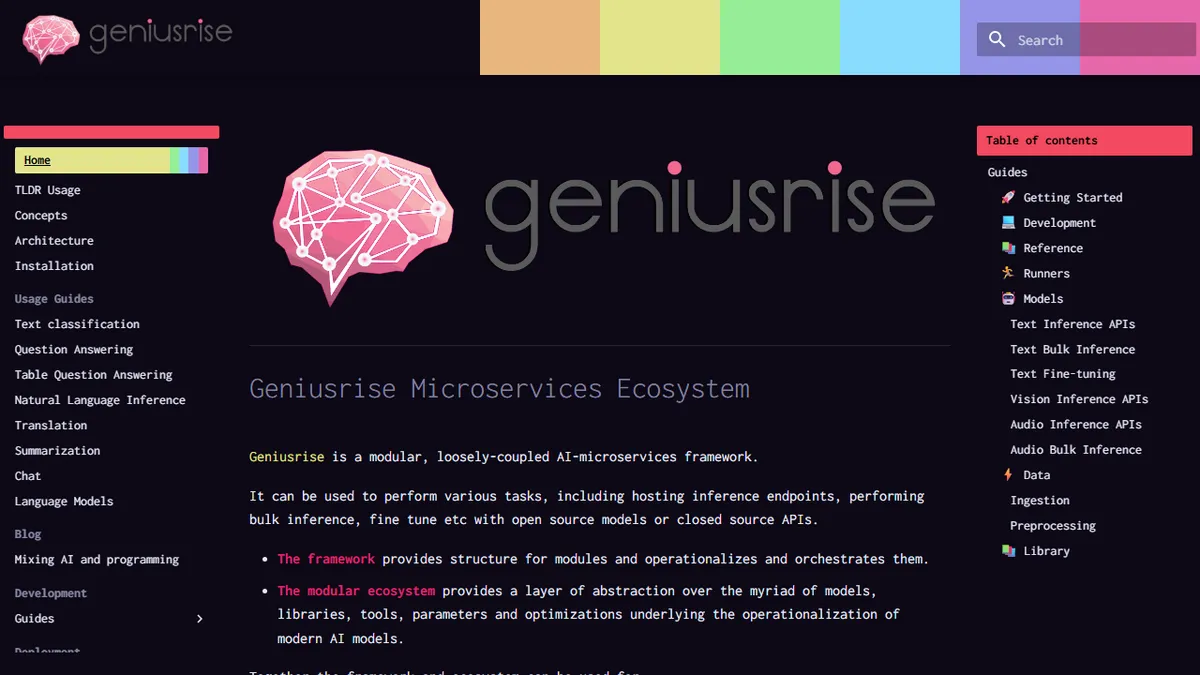

Geniusrise
Open-source framework for building, deploying, and scaling AI microservices across text, vision, and audio.
In short
Geniusrise is a free, open-source framework for deploying multi-modal AI microservices. It provides an opinionated scaffold for inference and fine-tuning on your own infrastructure.
Pick Geniusrise if you are an ML platform team that wants an opinionated open-source scaffold for shipping multi-modal inference and fine-tuning microservices on your own infra.
Skip it if you want a hosted endpoint, a no-code UI, or a single-model API and have no appetite for running Kubernetes or Airflow yourself.
Geniusrise is a modular, loosely-coupled framework for operationalizing AI models as microservices. It exposes REST endpoints and a CLI for hosting inference on open-source or closed-source models, running bulk inference jobs, fine-tuning, and wiring together multi-model pipelines. It ships runners for Kubernetes, Docker, Docker Swarm, and Apache Airflow, so the same pipeline can run on a laptop or a production cluster.
It is aimed at ML engineers and platform teams who want an opinionated scaffold for shipping inference services without gluing together FastAPI, Hugging Face, queue runners, and storage adapters by hand. The framework includes 40+ data-source connectors (databases and streaming), document preprocessing, and OCR, which makes it more practical than a bare model server for real ingestion-heavy workloads. The project is open source and self-hosted; there is no SaaS tier or published pricing.
Because it leans on the underlying model ecosystem (transformers, audio/vision models, optional closed APIs), Geniusrise functions as a control plane rather than a model provider. The trade-off is the usual self-hosted reality: you own the infra, the GPU bill, and the upgrade path.
Geniusrise occupies the same niche as BentoML and Ray Serve but pushes harder on multi-modal inference and built-in data ingestion. It is a serious framework, not a toy, and that means the setup cost is real. Worth a look if you are already comfortable on Kubernetes and want one mental model across text, vision, and audio.
— The AI Tool Bible editorial team
Pros
- ✅ Open source and self-hostable with no vendor lock-in
- ✅ Unified abstraction across text, vision, and audio inference
- ✅ Ships runners for Kubernetes, Docker, Swarm, and Airflow
- ✅ 40+ data connectors plus OCR and document preprocessing
- ✅ CLI plus REST API for both local prototyping and production
Cons
- ⚠️ Documentation-heavy; steep learning curve vs hosted alternatives
- ⚠️ You manage all GPU and cluster infrastructure yourself
- ⚠️ Community is small compared to BentoML, Ray Serve, or vLLM
- ⚠️ No managed SaaS, support, or SLA option
Use cases
Frequently asked
- How much does Geniusrise cost?
- Geniusrise is free and open source. It is self-hosted, meaning there is no SaaS tier or published pricing. You are responsible for your own infrastructure and GPU costs.
- What infrastructure is required to run Geniusrise?
- You must self-host the framework. It ships runners for Kubernetes, Docker, Docker Swarm, and Apache Airflow. You own the infrastructure, GPU bill, and upgrade path, so it is not a hosted endpoint.
- Does Geniusrise support multiple AI models?
- Yes, it is a multi-model framework. It supports open-source and closed-source models for text, vision, and audio. It functions as a control plane for wiring together multi-model pipelines rather than a single-model provider.
- Can Geniusrise handle data ingestion and preprocessing?
- Yes, it includes 40+ data-source connectors for databases and streaming. It also features document preprocessing and OCR, making it practical for ingestion-heavy workloads beyond simple model serving.
- Who is Geniusrise best suited for?
- It is best for ML platform teams wanting an opinionated open-source scaffold for shipping multi-modal inference and fine-tuning microservices. Skip it if you want a no-code UI, a hosted endpoint, or lack appetite for running Kubernetes or Airflow.
Explore related
Compare with similar tools
All in Agents →LangGraph
FeaturedStateful, graph-based agent orchestration from LangChain.
CrewAI
FeaturedPython framework for multi-agent orchestration.
Ernie Bot
Baidu's Mandarin-first ChatGPT rival, powered by the ERNIE model family
Moveworks
The enterprise AI assistant that searches, answers, and takes action across your business systems
AWS Bedrock
Build and scale generative AI applications with foundation models
Claude Agent SDK
Anthropic's official SDK for building autonomous Claude agents.