Generative MUI React
Render LLM-emitted A2UI as real Material UI components, with streaming, two-way binding, and charts.
React teams already on Material UI who want to add an agent-driven or chat-driven surface that renders real, themed components instead of markdown or bespoke JSON.
Teams not using MUI, projects that need a full agent framework with model + tools included, or anyone wanting a drag-and-drop no-code UI builder.
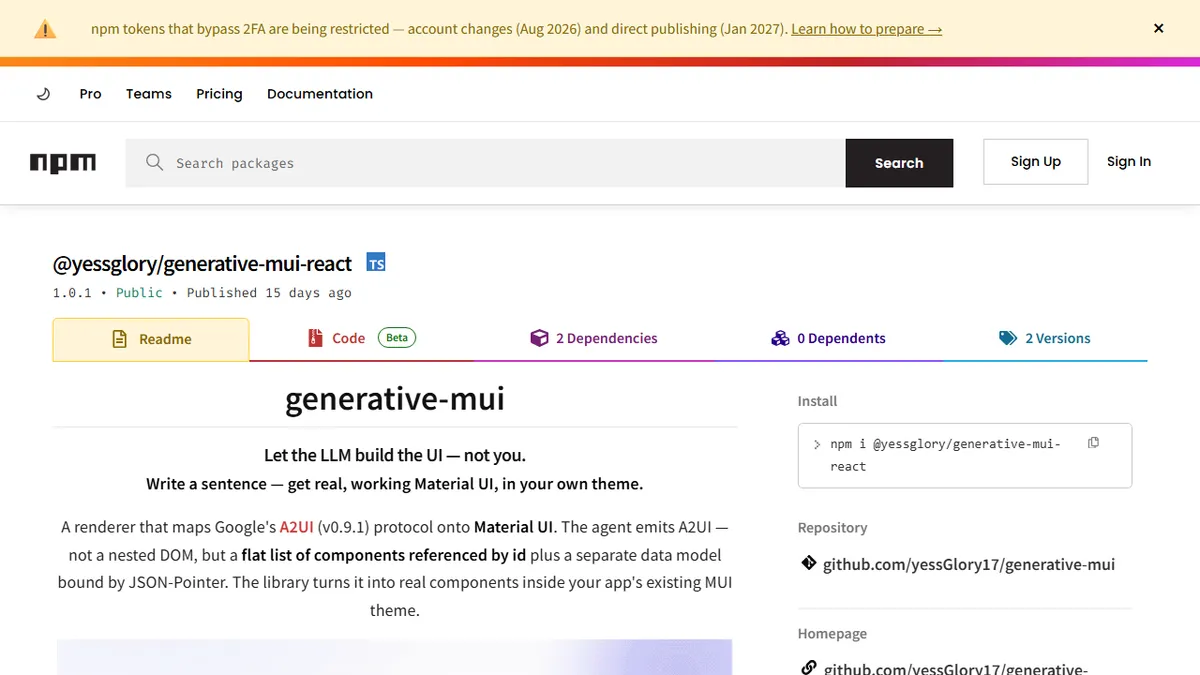
Generative MUI React (`@yessglory/generative-mui-react`) is an open-source React library that turns LLM output into live Material UI interfaces. Instead of asking a model to emit raw HTML, JSX, or Tailwind classes (which is unsafe and inconsistent), it implements Google's A2UI v0.9.1 protocol: the model produces a flat list of typed components referenced by id, plus a separate JSON data model bound via JSON-Pointer. The library parses that stream and renders real MUI components inside your existing ThemeProvider, so generative surfaces look identical to the rest of your app.
The package ships as two layers: a framework-agnostic core (`generative-mui-core`) that handles A2UI parsing, JSON-Pointer utilities, a deterministic store, and an agent tool schema; and this React adapter, which maps A2UI nodes to MUI widgets. Out of the box you get 18 basic components (Text, Button, Image, TextField, Row/Column, Checkbox, List, ChoicePicker, Card, Slider, Tabs, DateTimeInput, Divider, Modal) plus an opt-in extended catalog covering charts (Line, Bar, Pie, Scatter, SparkLine, Gauge via MUI X Charts), Table, Alert, Chip, Badge, Accordion, Progress, Stepper, Switch, Rating, and Autocomplete. You can also register your own component types with schema validation so custom widgets are as safe as built-ins.
A few design choices make it production-viable rather than a demo. Two-way binding wires input fields to a live store, so typing updates the data model without a server round-trip and enables conditional rendering. Streaming is fault-tolerant: missing components show skeletons, cycles or depth violations degrade to safe placeholders, and invalid schemas skip rather than crash. The security model refuses arbitrary CSS, class names, or unsafe attributes from the model, caps regex lengths against ReDoS, and falls back safely on unknown types. Example integrations cover a Vite SPA with browser-side Gemini calls, a Next.js app with server-side LLM calls, and MUI X Chat.
A clean, opinionated take on generative UI: adopt Google's A2UI protocol, stay strictly inside MUI, and hand back safe fallbacks when the stream is ugly. If you're already on Material UI and want an LLM to drive real forms and dashboards — not just spit markdown — this is one of the more honest implementations we've seen. The catch is the tight MUI coupling and the fact that A2UI is still finding its footing.
— The AI Tool Bible editorial team
Pros
- ✅ Implements Google's A2UI v0.9.1 spec, so any A2UI-emitting model works — not locked to one vendor.
- ✅ Renders inside your existing MUI ThemeProvider, so generated UI matches the rest of the app.
- ✅ Strong safety posture: no arbitrary CSS, safe fallbacks for unknown types, ReDoS-capped regex.
- ✅ Streaming-aware — partial JSONL from the agent renders skeletons instead of blowing up.
- ✅ Two-way data binding via JSON-Pointer means forms and conditional UI work without extra plumbing.
- ✅ Extended catalog covers MUI X Charts (line, bar, pie, gauge, sparkline) for real dashboards.
- ✅ Registerable custom components with schema validation — extensible without forking.
- ✅ MIT licensed, tiny surface, framework-agnostic core reusable outside React.
Cons
- ⚠️ Locked to Material UI v7+ — no use if your app is Tailwind, Chakra, shadcn, or Ant Design.
- ⚠️ You still have to wire your own LLM and prompt it to emit valid A2UI; no built-in model or tool-calling glue.
- ⚠️ A2UI itself is young (v0.9.x) and not yet a broadly adopted standard, so the spec may still churn.
- ⚠️ Version 1.0.x with minimal community footprint on npm; production battle-testing is limited.
- ⚠️ Charts require the optional `@mui/x-charts` peer dep, which has its own license considerations for pro features.
Use cases
Explore related
Compare with similar tools
All in Coding →Cursor
FeaturedAI-first VS Code fork — chat, edit, and agentic coding in one IDE.
GitHub Copilot
FeaturedThe original AI pair programmer, now with chat and agents.
Replit Agent
FeaturedBuild & deploy a full app from a single prompt.
Warp
The agentic development environment, from the terminal up
Cline
Open-source agentic coding assistant that plans, edits, and runs code inside your IDE
Aider
Terminal-based AI pair programmer that writes commits.