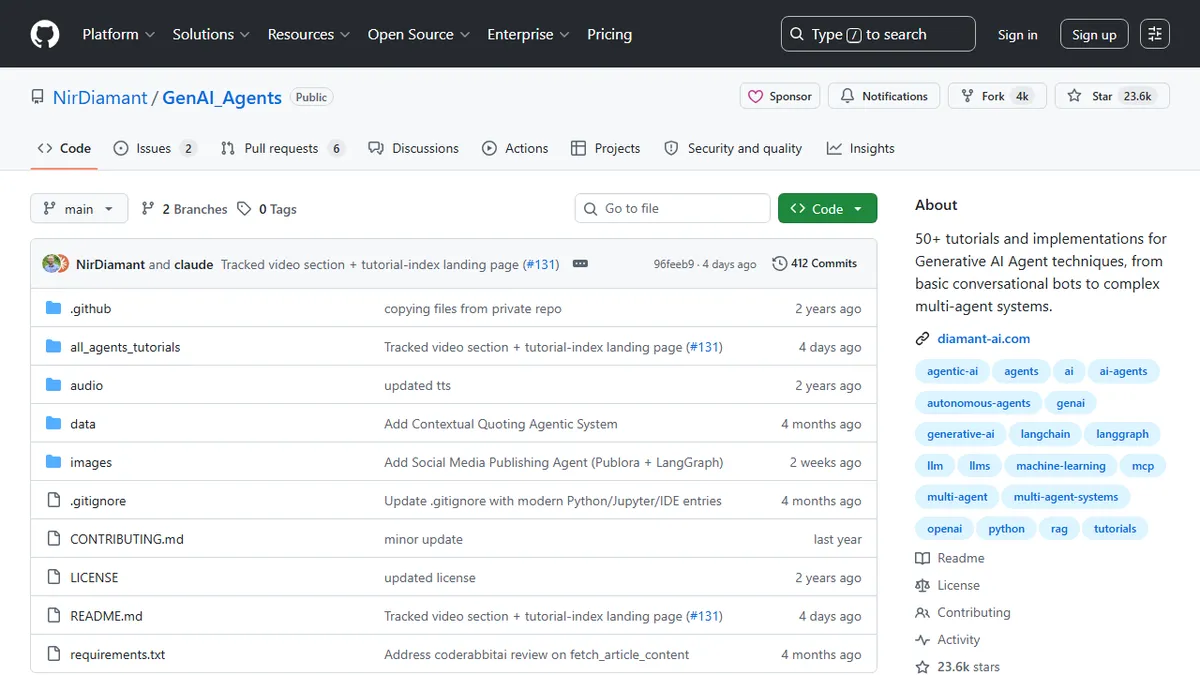
GenAI Agents (NirDiamant)
Not yet source-checked50+ Jupyter tutorials for building GenAI agents, from a simple chatbot to multi-agent systems.
Machine-drafted from the vendor's site · not yet source-checkedProfile updated Link checked How we rate
In short
GenAI Agents offers 50+ free Jupyter tutorials for building GenAI agents using frameworks like LangGraph and CrewAI, ideal for developers seeking fork-ready reference implementations.
Developers, ML engineers, and technical founders who want fork-ready reference implementations of agent patterns across LangGraph, LangChain, CrewAI, AutoGen, MCP, and PydanticAI.
Non-technical users looking for a hosted no-code agent builder, or teams that need a supported product with SLAs rather than tutorial code.
GenAI Agents is a large open-source GitHub repository maintained by Nir Diamant that collects 50+ hands-on Jupyter notebook tutorials for building Generative AI agents, ranging from a simple conversational bot to complex multi-agent systems. Each notebook is a self-contained walkthrough that covers the concept, the code, and the reasoning behind it, using popular Python frameworks including LangChain, LangGraph, PydanticAI, AutoGen, OpenAI Swarm, CrewAI, and the Model Context Protocol (MCP).
The catalogue is organised by difficulty and domain: beginner (conversational agents, question answering, data analysis), framework introductions (LangGraph, MCP), educational and research agents (literature review, Feynman-style tutoring), business agents (customer support, contract analysis, HR assistant, project management, E2E testing, quoting systems), creative agents (music composition, meme generation, murder-mystery game master), analysis agents (self-healing code, memory-enhanced email, sales-call analyser, DataScribe database explorer), news and content agents (podcast generator, journalism assistant, blog-writer swarm), shopping and task-management agents, and QA and advanced patterns such as a controllable RAG agent.
Workflows are consistent across notebooks: install dependencies, wire an LLM (usually OpenAI, occasionally Ollama for local models or LightRAG for knowledge-graph RAG), define agent nodes and state, then run the compiled graph on sample inputs. It is aimed at developers, ML engineers, students, and technical founders who want a working reference implementation to fork rather than starting from a blank file. With more than 23,000 GitHub stars and 3,900 forks it is one of the most-referenced open GenAI agent learning resources.
One of the most useful free learning resources for anyone actually building agents in Python. The value is in the breadth of worked examples across frameworks; treat it as a cookbook you steal patterns from, not a library you import.
— The AI Tool Bible editorial team
Pros
- ✅ 50+ working notebooks covering an unusually broad range of agent patterns and business use cases
- ✅ Multiple frameworks side by side (LangChain, LangGraph, PydanticAI, AutoGen, CrewAI, MCP, OpenAI Swarm) rather than being tied to one
- ✅ MIT-style openness and free to fork, with a permissive contribution workflow
- ✅ Actively maintained with regular additions such as MCP, LightRAG, and document-intake tutorials
- ✅ Sits alongside sibling repos (RAG_Techniques, Agent_Memory_Techniques, Agents Towards Production) that share the same didactic style
- ✅ Large community around it: 23k+ stars, Discord, subreddit, and newsletter feedback loop
Cons
- ⚠️ It is a tutorial collection, not a runnable product; you have to read code and wire your own keys
- ⚠️ Notebooks assume Python fluency and comfort with LLM API costs (mostly OpenAI)
- ⚠️ Heavy LangGraph bias means non-LangGraph users must translate patterns themselves
- ⚠️ Quality varies across contributed notebooks; some are polished, others are proof-of-concept
- ⚠️ README is cluttered with course, newsletter, and YouTube CTAs that can drown out the tutorial index
Facts
- Open source
- Yes (license: NOASSERTION)
- GitHub stars
- 24,721 (checked Oct 29, 2026)
- Last GitHub push
- Oct 27, 2026
- First commit
- Sep 2024
- Model used
- Framework-agnostic; most notebooks default to OpenAI GPT-4 class models, with Ollama and local model examples included.
Where this tool sits
Use cases
Frequently asked
- Is GenAI Agents free to use?
- Yes, the repository is free and open source with no paywall. While the author sells an optional paid course, the Jupyter notebooks themselves are accessible without cost.
- Which AI frameworks are covered in the tutorials?
- The tutorials cover LangChain, LangGraph, PydanticAI, AutoGen, OpenAI Swarm, CrewAI, and the Model Context Protocol (MCP). Most notebooks default to OpenAI GPT-4 class models but include local options.
- Who is this resource best suited for?
- It is best for developers, ML engineers, and technical founders who want fork-ready reference implementations. It is not recommended for non-technical users seeking hosted no-code builders or teams needing SLAs.
- What types of agent projects can I build?
- You can build conversational bots, customer support agents, contract analyzers, HR assistants, self-healing code agents, podcast generators, and multi-agent systems. The catalogue ranges from beginner to advanced patterns.
- Does it support local or open-source models?
- Yes, while most examples use OpenAI, the repository includes examples using Ollama for local models and LightRAG for knowledge-graph RAG, making it framework-agnostic regarding model providers.