
FedML
Distributed training, fine-tuning, and serving platform with federated learning roots.
In short
FedML is an open-source MLOps platform for distributed fine-tuning and federated learning. It offers managed GPU clusters and serving APIs for teams needing privacy-preserving training.
Pick FedML if you need federated learning or distributed fine-tuning across heterogeneous GPUs and want an open-source foundation under your MLOps stack.
Skip it if you just want a hosted API to fine-tune one LLM on a single dataset — a simpler service like Together or OpenAI's fine-tuning will be faster.
FedML (now operating under the TensorOpera AI umbrella) is a full-stack MLOps platform for training, fine-tuning, and deploying machine-learning models across distributed GPU infrastructure. It originated as one of the leading open-source frameworks for federated learning, and has since expanded into a managed cloud offering with experiment tracking, distributed orchestration, on-demand GPU clusters (A100, H100, RTX 4090), and low-latency model serving APIs.
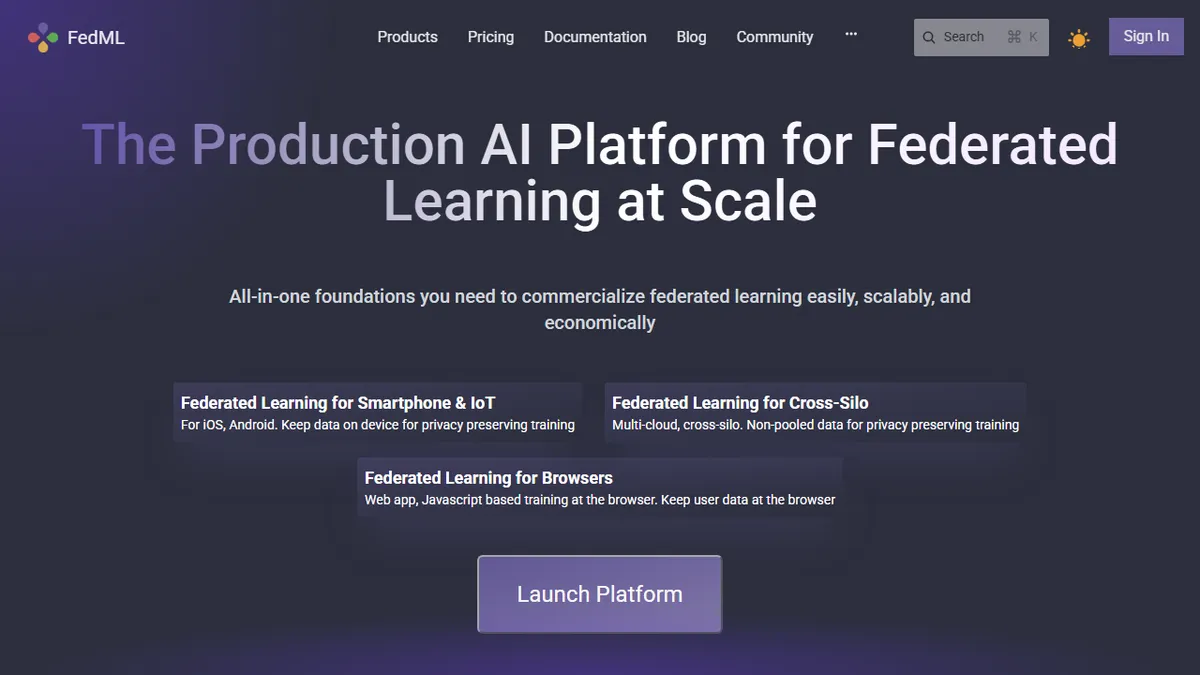
It targets ML engineers and research teams who need to fine-tune custom models without owning hardware, plus enterprises with privacy-sensitive workloads where cross-device or cross-silo federated training matters. The federated learning support — covering edge devices, browsers, and siloed datacenters — is the genuine differentiator versus generic GPU clouds like RunPod or Together. The open-source FedML library remains free; the managed TensorOpera platform uses pay-as-you-go GPU pricing, and self-hosting is possible for teams with their own clusters.
The broader TensorOpera stack now includes AgentOpera Studio for agent orchestration and Teamily AI on the consumer end, but FedML's core appeal remains the training and fine-tuning layer. Integrations span PyTorch, Hugging Face, and major cloud GPUs, with hooks for experiment tracking and model registry.
FedML is one of the few credible federated-learning platforms that grew into a full MLOps suite, and the open-source library still carries real research weight. The TensorOpera rebrand and agent-platform pivot dilute the message, but for distributed-training teams it remains a serious option.
— The AI Tool Bible editorial team
Pros
- ✅ Strong open-source heritage in federated learning
- ✅ Distributed training orchestration across multi-cloud GPUs
- ✅ On-demand A100/H100/RTX 4090 clusters
- ✅ Covers full lifecycle: train, fine-tune, serve
- ✅ Privacy-preserving cross-device and cross-silo training
Cons
- ⚠️ Managed platform pricing not transparent on landing page
- ⚠️ Rebrand to TensorOpera muddies the product identity
- ⚠️ Steeper learning curve than single-purpose fine-tuning APIs
- ⚠️ Federated learning niche may be overkill for most teams
Use cases
Frequently asked
- How much does FedML cost?
- The open-source library is free. The managed TensorOpera platform uses pay-as-you-go pricing for GPU usage. Self-hosting is also possible for teams with their own clusters.
- What models can I fine-tune with FedML?
- FedML supports bring-your-own models, specifically integrating with PyTorch and Hugging Face. It is designed for custom model fine-tuning rather than providing a fixed set of pre-trained LLMs.
- Is FedML better than Together or OpenAI for fine-tuning?
- Skip FedML if you just need a hosted API for a single LLM on one dataset; Together or OpenAI are faster for that. Choose FedML for federated learning or distributed training across heterogeneous GPUs.
- What hardware does FedML support?
- The managed platform offers on-demand GPU clusters including A100, H100, and RTX 4090. It also supports distributed training across heterogeneous GPUs and self-hosted clusters for teams with existing infrastructure.
- Does FedML support federated learning?
- Yes, federated learning is its core differentiator. It supports cross-device, browser, and siloed datacenter training, making it suitable for enterprises with privacy-sensitive workloads where data cannot be centralized.
Explore related
Compare with similar tools
All in Fine-tuning →Together AI
FeaturedFine-tune & serve open-weight models (Llama, Mistral, DeepSeek).
Modal
Serverless GPUs and infra for training & serving ML.
Replicate
One-API platform for running and fine-tuning open-source models.
OpenAI Fine-tuning
Fine-tune GPT-4o-mini and friends on your own data.
Llama
Meta's open-weight LLM family covering 1B mobile models up to 405B frontier and natively multimodal 10M-context Llama 4 variants.
RunPod
On-demand GPU cloud and serverless inference platform built specifically for AI workloads.