Factory AI (Droids)
✓ Editorially verifiedAgent-native platform that runs the whole software development lifecycle with autonomous Droids.
In short
Factory AI deploys autonomous Droids to handle the entire software development lifecycle, from ticket triage to PR validation and release. It is best for mid-to-large engineering organizations seeking supervised autonomous agents with enterprise-grade security and deployment flexibility.
Mid-to-large engineering teams that want supervised autonomous agents across the full SDLC — planning, coding, PR review, release and incident response — with enterprise controls like SSO, ZDR and on-prem deployment.
Solo developers on a tight budget or hobbyists who just want inline autocomplete in their editor — a cheaper IDE assistant like Copilot or Cursor is a better fit.
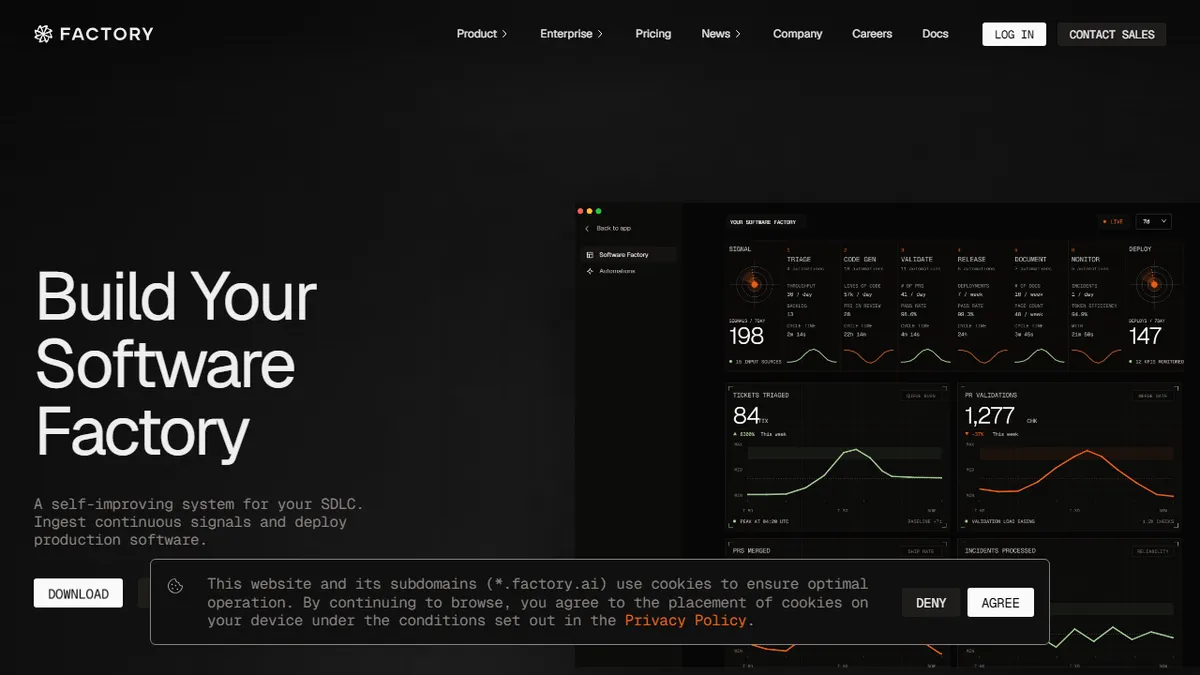
Factory is an agent-native software development platform built around 'Droids' — long-running AI coding agents that work across the full SDLC rather than just autocompleting inside an editor. Engineers interact with Droids through a desktop app, CLI, and SDK, and can dispatch work to cloud or local background agents that ingest context from repositories, tickets, docs, incidents, and observability signals. A Droid can be pointed at a Jira/Linear ticket, planned, coded, self-reviewed, opened as a PR, validated against tests, and shipped, with the platform tracking cycle time, deployment frequency, token efficiency and incident metrics on an analytics dashboard. Factory is deliberately model-agnostic and routes work across GPT-5, Claude Opus/Sonnet, Gemini and open-weight models depending on the task, with a 'Best of all' selection layer. It ships as SaaS, hybrid cloud, on-prem, or fully air-gapped, and offers Droid Computers — Factory-managed sandboxed cloud environments for the agent to execute in. Typical workflows include large-scale refactors, framework/version upgrades, backlog burn-down, on-call triage of production incidents, spec-to-PR feature work, and documentation drift. Target customers are mid-to-large engineering orgs that want to move beyond IDE autocomplete into supervised autonomous agents — Factory publicly cites Blackstone, Adyen, Wipro, Groq, You.com and Chainguard among users. Business and Enterprise tiers add SSO/SAML, zero data retention, audit logging, customer-managed encryption, data residency, dedicated compute with partitioned inference, and sub-organizations for platform teams that need to govern multiple product groups.
Factory is one of the more credible attempts to move AI coding beyond autocomplete into a governed, agent-run SDLC. The multi-surface story (desktop, CLI, SDK, cloud agents) and the on-prem/air-gapped options make it a rare option for regulated shops. Pricing and setup only pay off if you actually let the Droids run work end-to-end; treated as a fancy autocomplete, it's overpriced.
— The AI Tool Bible editorial team
Pros
- ✅ Covers the whole SDLC — triage, planning, coding, validation, release, docs, monitoring — not just inline code completion
- ✅ Model-agnostic routing across GPT-5, Claude Opus/Sonnet, Gemini and open-weight models, with BYOK on higher tiers
- ✅ Multiple surfaces: desktop app, CLI, and SDK, plus cloud or local background agents
- ✅ Deployment flexibility including SaaS, hybrid, on-premise and air-gapped installs suitable for regulated enterprises
- ✅ Droid Computers provide managed sandboxed environments so agents can actually execute, test and iterate
- ✅ Enterprise-grade controls: SSO/SAML, ZDR, audit logs, customer-managed encryption, sub-organizations, priority SLAs
- ✅ Analytics dashboard exposes cycle time, deployment frequency, MTTR and token efficiency for governance
Cons
- ⚠️ No free tier — paid subscription starts at $20/user/mo and higher tiers jump quickly to $100 and $200
- ⚠️ Positioned for engineering orgs; solo hobbyists get less value than from a plain IDE assistant
- ⚠️ Autonomous multi-step agents still require human review for non-trivial changes and can burn tokens on wrong paths
- ⚠️ Underlying model behaviour depends on external providers, so quality and latency shift as those models change
- ⚠️ Newer platform relative to Copilot/Cursor, so ecosystem of third-party integrations and community recipes is smaller
Use cases
Frequently asked
- What is the primary function of Factory AI Droids?
- Droids are long-running AI coding agents that work across the full SDLC, including planning, coding, self-reviewing, opening PRs, and validating against tests, rather than just providing inline autocomplete.
- Which AI models does Factory AI support?
- The platform is model-agnostic and routes work across GPT-5, Claude Opus/Sonnet, Gemini, and open-weight models depending on the task, with a 'Best of all' selection layer.
- What deployment options are available for Factory AI?
- Factory AI ships as SaaS, hybrid cloud, on-prem, or fully air-gapped, and offers Droid Computers, which are Factory-managed sandboxed cloud environments for agent execution.
- Who is the target customer for Factory AI?
- It is designed for mid-to-large engineering organizations that want to move beyond IDE autocomplete into supervised autonomous agents, with cited users including Blackstone, Adyen, and Wipro.
- What enterprise controls are included in higher tiers?
- Business and Enterprise tiers add SSO/SAML, zero data retention, audit logging, customer-managed encryption, data residency, and sub-organizations for governing multiple product groups.
Explore related
Compare with similar tools
All in Coding →Cursor
FeaturedAI-first VS Code fork — chat, edit, and agentic coding in one IDE.
GitHub Copilot
FeaturedThe original AI pair programmer, now with chat and agents.
Replit Agent
FeaturedBuild & deploy a full app from a single prompt.
Warp
The agentic development environment, from the terminal up
Cline
Open-source agentic coding assistant that plans, edits, and runs code inside your IDE
Aider
Terminal-based AI pair programmer that writes commits.