.svg)
Edge Impulse
✓ Editorially verifiedEnd-to-end platform for training and deploying ML models on microcontrollers, sensors, and other edge hardware.
In short
Edge Impulse is a freemium platform for training and deploying ML models on microcontrollers and edge hardware, simplifying the TF Lite Micro pipeline for firmware engineers.
Pick Edge Impulse if you're shipping ML on a microcontroller, wearable, or industrial sensor and don't want to hand-build a TF Lite Micro pipeline.
Skip it if your inference runs in the cloud or on a beefy GPU server, since you'd be paying for embedded tooling you'll never use.
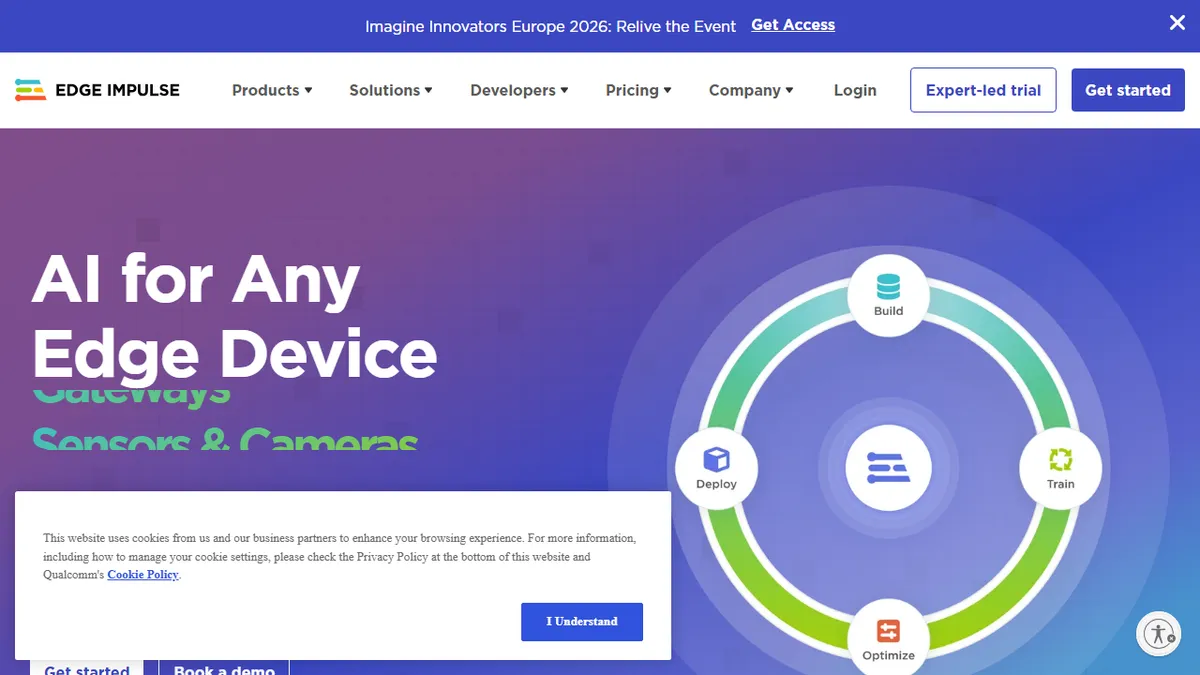
Edge Impulse is a development platform purpose-built for edge AI: it walks you from raw sensor data through DSP, model training, and on-device optimization, then spits out a library that runs on a microcontroller, NPU, gateway, or Docker container. The Visual Inspection Suite handles computer-vision pipelines, while the core studio targets time-series and audio workloads typical of IoT and embedded products.
The differentiator is hardware breadth and embedded-friendliness rather than novel model architectures. It's aimed at firmware engineers who don't want to hand-roll TensorFlow Lite Micro toolchains, and at hardware companies (Arduino, Nordic, NXP, Qualcomm, NVIDIA partners) shipping production fleets. Pricing follows a typical freemium-to-enterprise ladder: a free developer tier for prototyping, paid Professional plans, and Enterprise contracts with SLA and on-prem options.
Deployments tend to be tightly coupled to specific silicon partners, which is the trade-off for getting models that actually fit in 256 KB of RAM. Now owned by Qualcomm, which has accelerated NPU/HTP integration but raised eyebrows about long-term openness for non-Qualcomm targets.
The most credible turnkey TinyML platform on the market, and the Qualcomm acquisition has only sharpened its hardware story. The catch is gravitational pull toward partner silicon and quote-only pricing once you outgrow the free tier, but for embedded teams the alternative is months of bespoke toolchain work.
— The AI Tool Bible editorial team
Pros
- ✅ Real end-to-end pipeline from data ingest to flashable firmware
- ✅ Broad hardware support across MCUs, NPUs, and gateways
- ✅ Strong DSP + ML workflow for time-series and audio
- ✅ Free tier is usable for serious prototyping
- ✅ Backed by Qualcomm with deep silicon partnerships
Cons
- ⚠️ Pricing for Professional/Enterprise tiers is opaque without a sales call
- ⚠️ Best-tuned outputs lean toward partner silicon
- ⚠️ Less useful if you're not targeting constrained devices
Use cases
Frequently asked
- How much does Edge Impulse cost?
- Edge Impulse uses a freemium model. The Developer tier is free for prototyping. Paid Professional plans and Enterprise contracts with SLA and on-prem options are available for production use.
- What hardware does Edge Impulse support?
- It supports microcontrollers, NPUs, gateways, and Docker containers. It is designed for embedded hardware partners like Arduino, Nordic, NXP, Qualcomm, and NVIDIA, optimizing models for limited RAM.
- Is Edge Impulse suitable for cloud-based AI?
- No. It is purpose-built for edge AI. If your inference runs in the cloud or on beefy GPU servers, you would be paying for embedded tooling you will never use.
- What types of data can I process?
- The core studio targets time-series and audio workloads typical of IoT. The Visual Inspection Suite handles computer-vision pipelines, allowing you to process raw sensor data through DSP and model training.
- Who owns Edge Impulse now?
- Edge Impulse is owned by Qualcomm. This acquisition has accelerated NPU/HTP integration, though it has raised concerns about long-term openness for non-Qualcomm targets.
Explore related
Compare with similar tools
All in Fine-tuning →Together AI
FeaturedFine-tune & serve open-weight models (Llama, Mistral, DeepSeek).
Modal
Serverless GPUs and infra for training & serving ML.
Replicate
One-API platform for running and fine-tuning open-source models.
OpenAI Fine-tuning
Fine-tune GPT-4o-mini and friends on your own data.
Llama
Meta's open-weight LLM family covering 1B mobile models up to 405B frontier and natively multimodal 10M-context Llama 4 variants.
RunPod
On-demand GPU cloud and serverless inference platform built specifically for AI workloads.