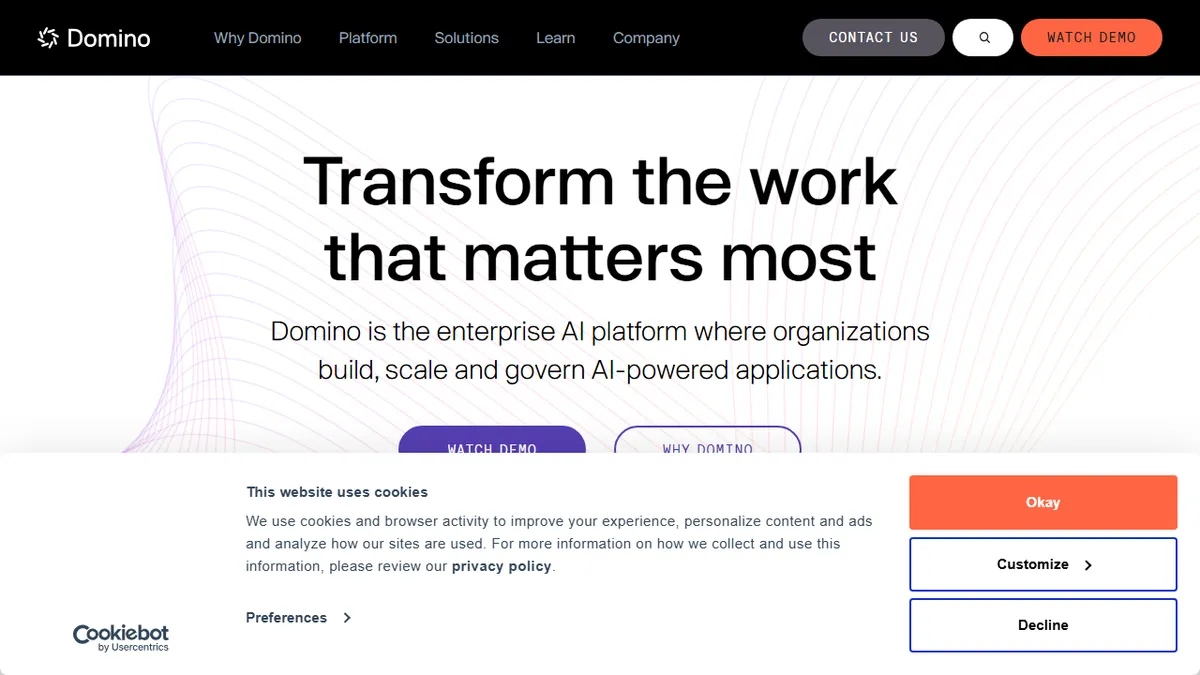

Domino Data Lab
Enterprise AI platform for building, deploying, and governing models and agents at scale.
In short
Domino Data Lab unifies data science, MLOps, and agentic AI development for large enterprises. It is best for organizations in regulated sectors requiring strong governance, audit trails, and support for mixed Python, R, and SAS workloads.
Pick Domino if you are a large enterprise data-science org that needs governed, reproducible model and agent development across mixed Python/R/SAS workloads.
Skip it if you are an individual developer or small startup just shipping an LLM app - the governance overhead and enterprise pricing will not pay off.
Domino Data Lab is an enterprise-grade platform that unifies data science, MLOps, and agentic AI development for regulated industries. Its stack is split into three layers: a Model Factory for building models and agents across Python, R, SAS and modern LLM frameworks; an App Hub for deploying AI applications to thousands of internal users; and a Governance Center for policy enforcement, audit trails, and cost tracking across the entire AI lifecycle.
The target buyer is unmistakably the Fortune 500 - life sciences, financial services, public sector, retail, and manufacturing teams that need reproducibility, lineage, and SOC-grade controls more than they need a slick consumer UI. Domino claims meaningful lifecycle wins (roughly 6x faster model development and 40% lower infrastructure costs by their numbers), and it has been a fixture of the Gartner Magic Quadrant for years, most recently named a 2026 Visionary. Pricing is not published; this is a sales-led enterprise contract.
It runs across major clouds and hybrid/on-prem environments and integrates with NVIDIA, Snowflake, and the broader Python/R ecosystem. Strength is breadth and governance; weakness is that small teams and individual developers will find it heavyweight compared to lighter MLOps tooling like Weights & Biases or open-source MLflow.
Domino has quietly been one of the most serious enterprise AI platforms for over a decade, and the pivot toward agentic AI and an App Hub keeps it relevant against newer entrants. It is the right answer when compliance, reproducibility, and SAS-era workloads matter; it is the wrong answer if you just want to prototype an agent over a weekend.
— The AI Tool Bible editorial team
Pros
- ✅ End-to-end coverage: build, deploy, and govern in one platform
- ✅ Strong reproducibility and audit trails for regulated industries
- ✅ Supports SAS, R, Python, and modern LLM/agent frameworks
- ✅ Runs across cloud, hybrid, and on-prem environments
- ✅ Established vendor with major enterprise references
Cons
- ⚠️ No public pricing; sales-led procurement only
- ⚠️ Overkill for solo developers or small teams
- ⚠️ Heavyweight setup compared to lightweight MLOps tools
- ⚠️ Less buzz than newer pure-play LLM agent platforms
Use cases
Frequently asked
- What industries is Domino Data Lab designed for?
- It targets Fortune 500 companies in life sciences, financial services, public sector, retail, and manufacturing that require reproducibility, lineage, and SOC-grade controls.
- What are the main components of the Domino platform?
- The platform consists of a Model Factory for building models and agents, an App Hub for deploying AI applications, and a Governance Center for policy enforcement and audit trails.
- Does Domino support legacy programming languages?
- Yes, the platform supports Python, R, SAS, and modern LLM frameworks, making it suitable for organizations with mixed workloads.
- Is Domino Data Lab suitable for small teams or individual developers?
- No, it is considered heavyweight for solo developers or small startups due to its governance overhead and enterprise-focused pricing model.
- How is Domino Data Lab priced?
- Pricing is not published and is sales-led, with options for Domino Cloud, Premium, and Enterprise contracts requiring contact with sales.
Explore related
Compare with similar tools
All in Agents →LangGraph
FeaturedStateful, graph-based agent orchestration from LangChain.
CrewAI
FeaturedPython framework for multi-agent orchestration.
Ernie Bot
Baidu's Mandarin-first ChatGPT rival, powered by the ERNIE model family
Moveworks
The enterprise AI assistant that searches, answers, and takes action across your business systems
AWS Bedrock
Build and scale generative AI applications with foundation models
Claude Agent SDK
Anthropic's official SDK for building autonomous Claude agents.