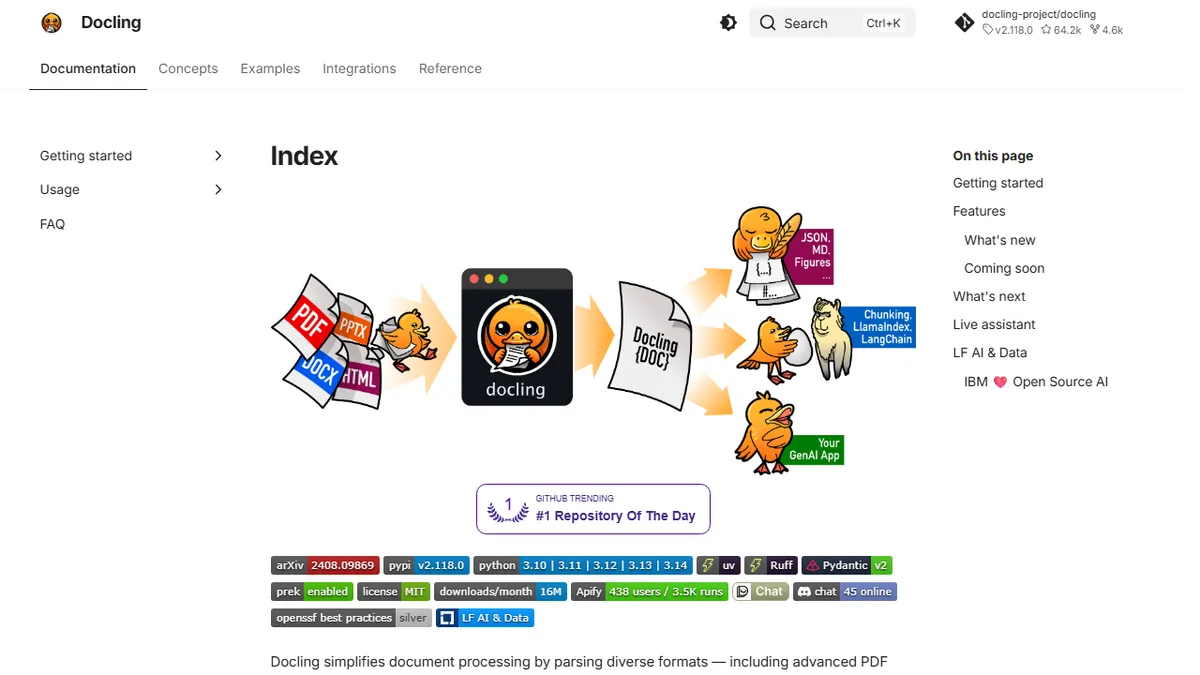
Docling
Open-source document parsing for AI: PDFs, Office files, audio and video into clean, structured Markdown/JSON
ML and platform engineers building RAG systems, doc-QA copilots, or agent pipelines that must ingest heterogeneous documents on their own infrastructure.
Non-technical users who want a point-and-click PDF-to-Word converter, or teams unwilling to self-host and manage a Python service.
Docling is an open-source document processing toolkit that turns messy real-world files into clean, structured representations that RAG pipelines and LLM agents can actually reason over. Originally started at IBM Research Zurich and now hosted by the LF AI & Data Foundation, it handles PDF, DOCX, PPTX, XLSX, HTML, EPUB, images, LaTeX, email, and even audio (WAV/MP3) and video, exporting to Markdown, HTML, JSON, WebVTT, DocLang, or its own DocTags format. Its headline capability is advanced PDF understanding: page layout analysis, reading-order recovery, table structure extraction, code and formula recognition, and image classification, driven by purpose-built vision-language models like GraniteDocling (258M). OCR is built in for scanned documents with a choice of engines, and audio is transcribed via ASR. Docling is designed to be dropped straight into modern AI stacks: it ships first-class integrations for LangChain, LlamaIndex, CrewAI, and Haystack, and exposes itself as a Python library, a CLI, an HTTP API server, and an MCP server for use inside agent frameworks. Because everything can run locally, teams handling sensitive, regulated, or air-gapped data can process documents without shipping bytes to a third-party API. Typical workflows include preparing enterprise document corpora for retrieval, converting technical PDFs (research papers, manuals, financial filings in XBRL/JATS) into structured chunks, powering doc-QA copilots, extracting tables from scanned reports, and normalising heterogeneous knowledge bases before embedding. It targets engineers and ML/AI teams building on top of LLMs rather than end users who just want a converter UI.
Docling is the strongest open-source answer we have found to the boring-but-critical problem of turning real PDFs into RAG-ready text. The combination of a small purpose-built VLM, MIT licensing, and drop-in LangChain/LlamaIndex/MCP hooks makes it a default recommendation for anyone building document AI in-house rather than paying per page to a hosted extractor.
— The AI Tool Bible editorial team
Pros
- ✅ Broad format coverage: PDF, Office, HTML, EPUB, images, LaTeX, email, plus audio and video
- ✅ Genuinely strong PDF parsing: layout, reading order, tables, formulas, and code blocks preserved
- ✅ Runs fully local, so sensitive or air-gapped document processing stays on your own infrastructure
- ✅ Native integrations with LangChain, LlamaIndex, CrewAI, and Haystack shorten the path to a working RAG pipeline
- ✅ Multiple delivery modes: Python library, CLI, HTTP API server, and MCP server for agents
- ✅ Purpose-built small VLMs (GraniteDocling 258M) keep GPU/CPU costs modest compared to calling frontier models per page
- ✅ Permissive MIT license and Linux Foundation governance make it safe for commercial adoption
Cons
- ⚠️ Python-only public library; non-Python stacks must go through the HTTP or MCP server
- ⚠️ High-fidelity parsing of complex PDFs benefits from a GPU, which raises the bar for self-hosting
- ⚠️ No hosted SaaS or managed service: teams must run and maintain their own deployment
- ⚠️ Documentation and examples assume engineering fluency; there is no non-technical UI
- ⚠️ Extraction quality on unusual layouts (multi-column scans, handwriting) still varies and may need post-processing
Use cases
Explore related
Compare with similar tools
All in RAG →Pinecone
FeaturedManaged vector database for production-scale similarity search.
LlamaIndex
FeaturedData framework for connecting LLMs to your data.
Elasticsearch Vector Search
Hybrid vector + keyword search in the enterprise-grade Elasticsearch engine
Snowflake Cortex
Generative AI and RAG built into the Snowflake data cloud
DataStax Astra DB
Serverless vector and document database for production RAG and AI agents
MongoDB Atlas Vector Search
Vector search built into the operational database you're already using.