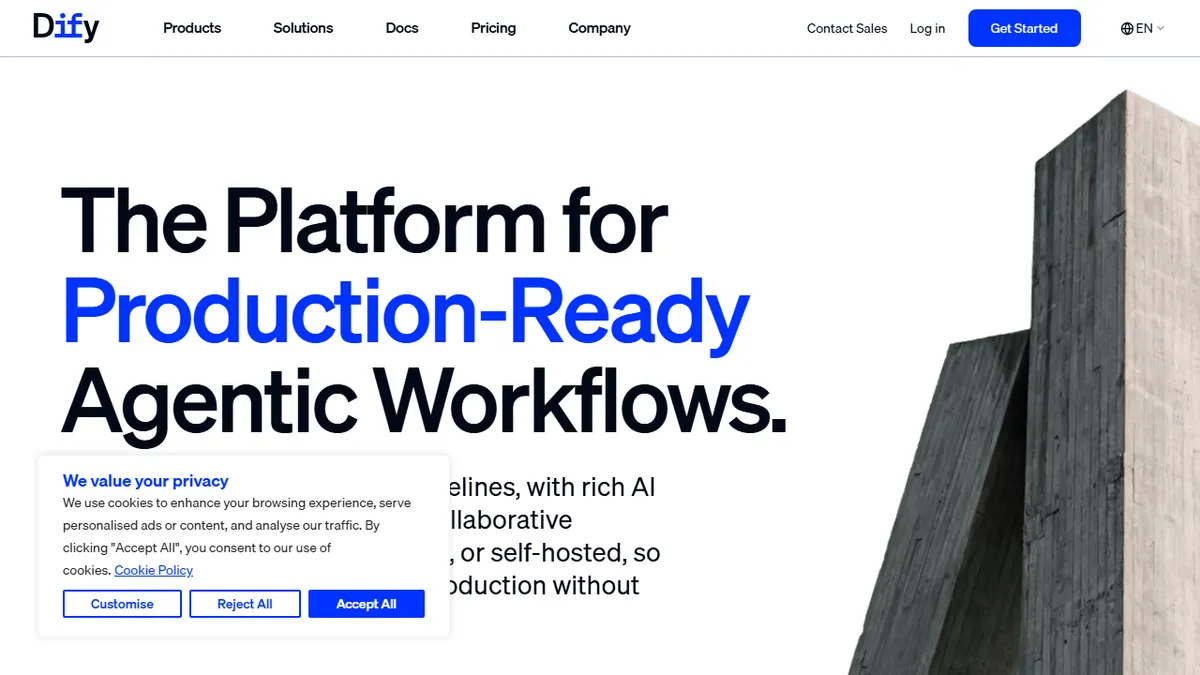
Dify
Open-source LLMOps platform for building agentic workflows, RAG pipelines, and AI applications
In short
Dify is an open-source LLMOps platform that bundles visual workflow design, RAG pipelines, and agent building into one suite. It is best for product teams wanting to deploy model-agnostic AI applications via UI, API, or MCP without custom code.
Product and platform teams that want an open-source, model-agnostic way to build RAG chatbots, internal copilots, and multi-step agent workflows with a visual editor plus a real API to call from their app.
Engineers who prefer a pure code-first framework (LangChain, LlamaIndex, Pydantic AI) or teams that need heavyweight offline evaluation, fine-tuning pipelines, or strict SOC2-in-a-box out of the SaaS tier.
Dify is an open-source LLMOps platform for designing, deploying, and operating LLM-powered applications without stitching together a bespoke stack. It bundles four layers that most teams end up building themselves: a visual Workflow Studio for chaining prompts, tools, branches, and agents; a Knowledge Pipeline that handles chunking, embedding, and retrieval for RAG; an Agent builder with tools, memory, and guardrails; and a Marketplace of model providers and integrations so you can swap OpenAI, Anthropic, Gemini, Mistral, local Ollama models, or any OpenAI-compatible endpoint behind the same workflow. Finished apps ship as hosted chat UIs, embeddable widgets, REST APIs, or MCP tools, and every run is logged with token and latency traces for evaluation and iteration. The cloud service at cloud.dify.ai is the fastest way to try it, but the Community Edition (151k+ GitHub stars) runs on your own Docker host, VPC, or Kubernetes cluster, which is why it has become a common self-hosted alternative to LangChain-plus-glue and to closed platforms like Vertex AI Agent Builder. Typical users are product teams building internal copilots, support-automation bots, and document-Q&A tools, plus solo builders who want a UI over their prompts instead of a Python project. Because the workflow graph and knowledge base are first-class objects, non-engineers can iterate on prompts and retrieval while engineers focus on tool wiring and deployment.
Dify is the platform I reach for when a client wants a working RAG chatbot or internal agent this week rather than a six-month build. The workflow canvas is expressive enough for real products and the self-host path means you are not renting your prompts back from a vendor. It is not a replacement for a hand-rolled agent framework once you need fine control, but for the 80% case of 'chat over these docs, call these tools, expose an API', it is one of the best open-source options in 2026.
— The AI Tool Bible editorial team
Pros
- ✅ Genuinely open-source (Apache-2.0-derivative) with a mature self-hosted Docker/Kubernetes deployment path
- ✅ Visual workflow builder covers branching, tool use, agents, and human-in-the-loop without dropping to code
- ✅ Model-agnostic: swap OpenAI, Anthropic, Gemini, Mistral, Ollama, or any OpenAI-compatible endpoint per node
- ✅ Built-in RAG pipeline handles chunking, embeddings, reranking, and multiple vector stores out of the box
- ✅ Publishes any app as a hosted UI, embed, REST API, or MCP tool with logs and analytics attached
- ✅ Large plugin/marketplace ecosystem and one of the most active LLM-framework communities on GitHub
- ✅ Cloud tier has a real free sandbox so you can prototype before choosing self-host vs SaaS
Cons
- ⚠️ Self-hosting the full stack (API, worker, sandbox, vector DB, Redis, Postgres) is heavier than it looks and version upgrades occasionally break workflows
- ⚠️ Cloud message-credit limits are tight on the Professional tier and overages push teams to Team or self-host quickly
- ⚠️ Workflow debugging is weaker than code-first frameworks: complex agent loops can be hard to trace step-by-step
- ⚠️ Commercial use of the Community Edition has licence caveats (multi-tenant SaaS resale, logo/branding) that need reading before shipping
- ⚠️ Evaluation and offline testing tooling is thinner than dedicated eval platforms like Langfuse or Braintrust
Use cases
Frequently asked
- Is Dify open source and can it be self-hosted?
- Yes, Dify is open-source with a Community Edition that runs on your own Docker host, VPC, or Kubernetes cluster. It is a common self-hosted alternative to closed platforms or custom LangChain stacks.
- Which AI models does Dify support?
- Dify is model-agnostic, supporting OpenAI, Anthropic, Google Gemini, Mistral, Cohere, local Ollama models, and any OpenAI-compatible endpoint. You can swap providers per node within the same workflow.
- What types of applications can be built with Dify?
- Users can build RAG chatbots, customer support automation, multi-step agent workflows, and internal copilots. Finished apps can be published as hosted chat UIs, embeddable widgets, REST APIs, or MCP tools.
- Who is Dify not suitable for?
- It is not ideal for engineers who prefer pure code-first frameworks like LangChain or LlamaIndex, or teams requiring heavyweight offline evaluation and fine-tuning pipelines that are better served by dedicated tools.
Explore related
Compare with similar tools
All in Agents →LangGraph
FeaturedStateful, graph-based agent orchestration from LangChain.
CrewAI
FeaturedPython framework for multi-agent orchestration.
Ernie Bot
Baidu's Mandarin-first ChatGPT rival, powered by the ERNIE model family
Moveworks
The enterprise AI assistant that searches, answers, and takes action across your business systems
AWS Bedrock
Build and scale generative AI applications with foundation models
Claude Agent SDK
Anthropic's official SDK for building autonomous Claude agents.