Dataiku
✓ Editorially verifiedEnterprise AI platform unifying data, ML, LLMs, and agents under one governed workflow.
In short
Dataiku provides an end-to-end enterprise AI platform where analysts and engineers collaborate on analytics, ML, and agentic systems. It is best for large organizations seeking a governed layer over existing data infrastructure to manage AI workflows with strict controls.
Pick Dataiku if you're a large org that wants one governed platform for ML, analytics, LLMs, and agents instead of stitching five vendors together.
Skip it if you're an indie dev or startup looking for a self-serve agent builder with transparent monthly pricing.
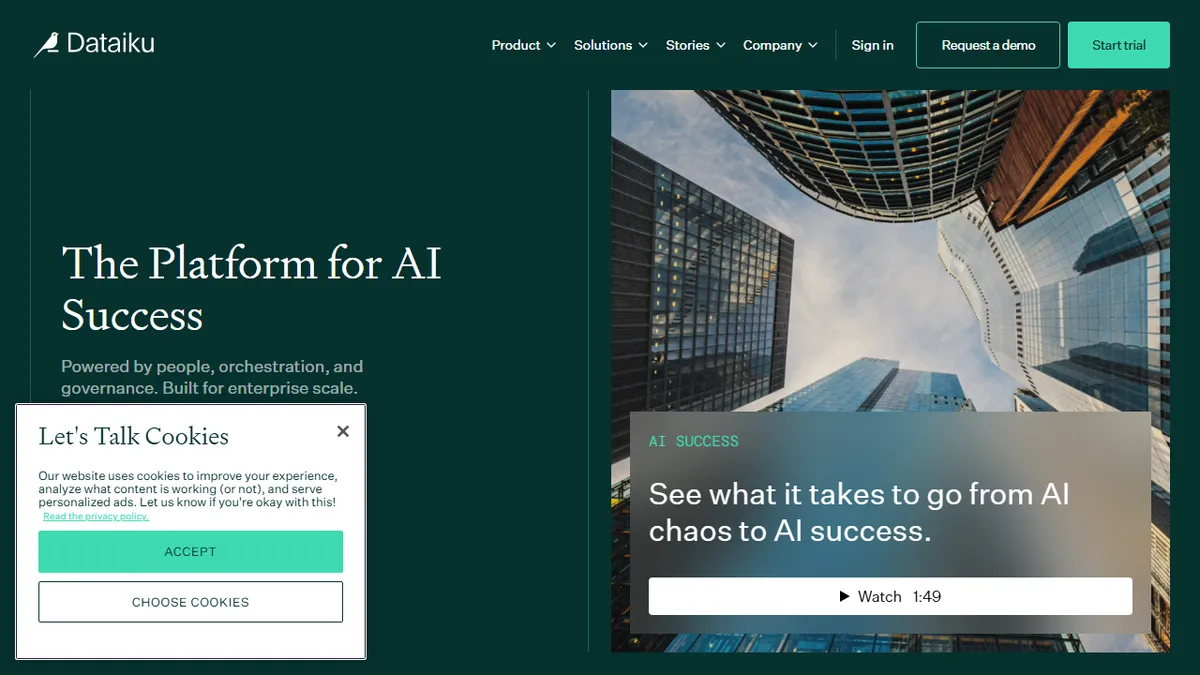
Dataiku is an end-to-end enterprise AI platform that lets business analysts, data scientists, and ML engineers collaborate on the same projects, spanning classical analytics, machine learning pipelines, generative AI, and now agentic systems. The core selling point is breadth: a single visual + code workbench (Python, R, SQL, notebooks) on top of governed data connections, plus an 'LLM Mesh' abstraction that routes prompts across providers (OpenAI, Anthropic, Bedrock, Vertex, open models) with cost, audit, and PII controls layered on top.
It is firmly an enterprise tool: pricing isn't published, deals are quoted per environment, and the typical buyer is a Fortune 2000 data team that already has Snowflake, Databricks, or a cloud data warehouse and wants a governed layer to ship AI on top. Differentiation versus Databricks or SageMaker is the low-code surface for non-engineers and a mature governance/MLOps story; differentiation versus pure agent frameworks is that agents sit inside the same lineage, monitoring, and approval workflows as the rest of the org's models.
A free Cloud trial and a perpetually-free Community edition exist for evaluation, but anything production-grade is sales-led. Deploys on AWS, Azure, GCP, Kubernetes, or on-prem; integrates with most major data, BI, and model providers. Not the right pick if you want a slick consumer agent builder or a self-serve SaaS price tag.
Dataiku is one of the few platforms that genuinely covers the full AI lifecycle for a regulated enterprise, and the LLM Mesh is a smart abstraction as model choice multiplies. It's not glamorous, but for a bank or pharma that has to ship and audit dozens of AI workflows, it's a credible Databricks/SageMaker alternative with a friendlier surface for analysts.
— The AI Tool Bible editorial team
Pros
- ✅ Unifies analytics, ML, LLMs, and agents in one governed platform
- ✅ Strong low-code surface so non-engineers can ship
- ✅ Mature MLOps, lineage, audit, and cost controls
- ✅ Multi-cloud and on-prem deploys; broad data connector library
- ✅ LLM Mesh abstracts vendors with PII and policy guardrails
Cons
- ⚠️ Enterprise-only pricing; no public price list
- ⚠️ Heavy platform that's overkill for small teams
- ⚠️ Learning curve across the visual + code surface
- ⚠️ Agent tooling is newer than its ML/analytics core
Use cases
Frequently asked
- Who is Dataiku designed for?
- It is designed for large organizations, such as Fortune 2000 data teams, that need a governed platform for ML, analytics, LLMs, and agents. It is not suitable for indie developers or startups looking for self-serve pricing.
- What is the LLM Mesh feature?
- The LLM Mesh is an abstraction that routes prompts across providers like OpenAI, Anthropic, Bedrock, and Vertex. It includes cost, audit, and PII controls to manage model usage within the platform.
- How does Dataiku handle deployment and integration?
- Dataiku deploys on AWS, Azure, GCP, Kubernetes, or on-premises. It integrates with major data, BI, and model providers, including Snowflake and Databricks, to serve as a governed layer for AI.
- Is there a free version of Dataiku?
- Yes, a free Cloud trial and a perpetually-free Community edition are available for evaluation. However, production-grade usage requires a sales-led enterprise deal.
Explore related
Compare with similar tools
All in Agents →LangGraph
FeaturedStateful, graph-based agent orchestration from LangChain.
CrewAI
FeaturedPython framework for multi-agent orchestration.
Ernie Bot
Baidu's Mandarin-first ChatGPT rival, powered by the ERNIE model family
Moveworks
The enterprise AI assistant that searches, answers, and takes action across your business systems
AWS Bedrock
Build and scale generative AI applications with foundation models
Claude Agent SDK
Anthropic's official SDK for building autonomous Claude agents.