
Cube
✓ Editorially verifiedSemantic layer that grounds LLM agents in your real business metrics instead of letting them hallucinate SQL.
In short
Cube provides a universal semantic layer that allows LLM agents to answer quantitative questions using defined business metrics rather than guessing SQL. It is best for data teams and SaaS companies needing governed analytics and embedded multi-tenant solutions. The platform requires initial modeling work to define the semantic graph before AI features become effective.
Pick Cube if you need LLM agents or embedded analytics to answer quantitative questions against your warehouse without inventing metric definitions.
Skip it if you just want a chat-with-your-CSV toy or a turnkey BI dashboard without modeling work.
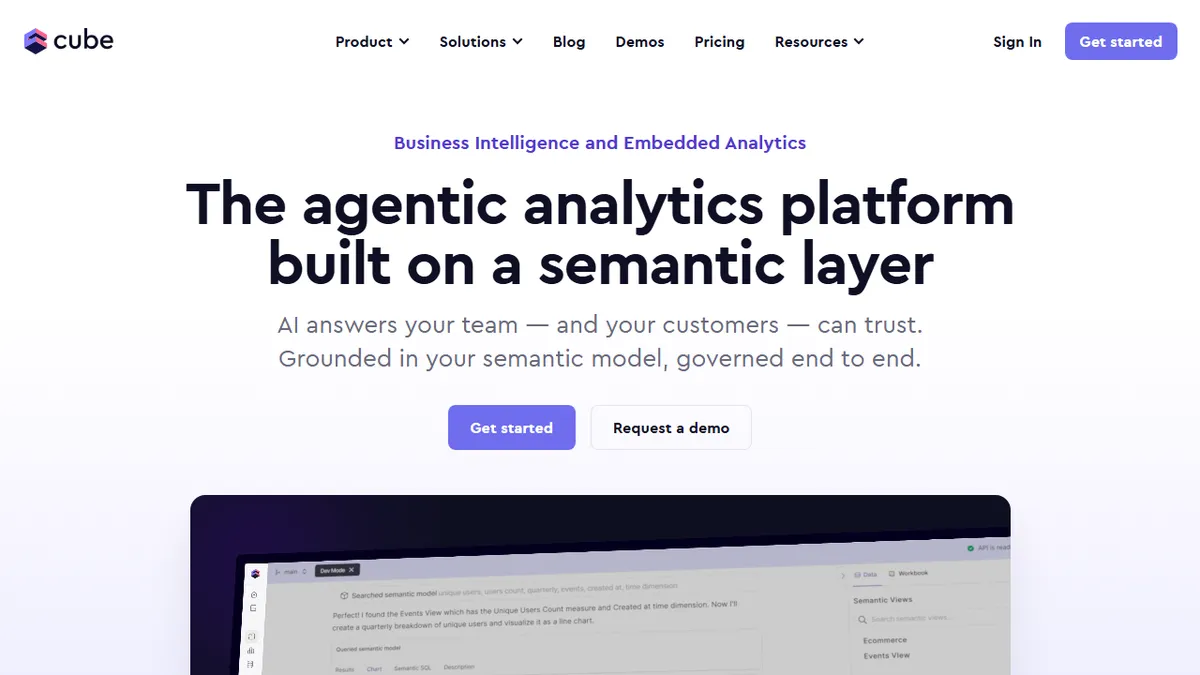
Cube is an agentic analytics platform built around a universal semantic layer. You model your metrics, dimensions, and joins once in Cube, then expose them to dashboards, embedded analytics, and increasingly to LLM agents through MCP connectors, Claude, ChatGPT, and Slack. The pitch, borrowed from a Brex quote on the homepage, is that 'the LLM is the engine, but the semantic layer is the map' — without that map, natural-language analytics tools tend to invent metric definitions and return numbers that don't reconcile with the finance team's.
It's aimed at two audiences: data teams who want governed Analytics Chat and workbooks for internal use, and SaaS companies (Brex, Webflow, Drata, Wix and 100+ others) embedding multi-tenant analytics into their own products. Cube Core is open source with ~18k GitHub stars; Cube Cloud is the managed, paid tier with embedded analytics, Creator Mode, and SSO — pricing is gated behind a sales conversation. If you're building a RAG or agent stack that needs to answer quantitative questions over a warehouse, this is the layer that stops the model from guessing.
Integrations span ClickHouse, Snowflake, BigQuery, Databricks, Postgres and most warehouses on the read side, with SQL, REST, GraphQL, and MCP on the serving side. The caveat: Cube is infrastructure, not a finished BI app — you still model the semantic graph yourself, and the AI features shine brightest once that modeling work is done.
Cube is one of the few serious answers to the 'LLMs hallucinate numbers' problem in analytics — the semantic layer becomes the contract the model is forced to obey. The open-source core keeps it honest, and the MCP push means it slots cleanly into Claude or ChatGPT agent stacks. Expect to invest real modeling time before the magic appears.
— The AI Tool Bible editorial team
Pros
- ✅ Open-source core with a mature 18k-star community
- ✅ Governs LLM answers via a semantic layer, cutting metric hallucinations
- ✅ First-class MCP, Claude, ChatGPT, and Slack endpoints
- ✅ Battle-tested in embedded analytics at Brex, Webflow, Wix
Cons
- ⚠️ Cloud pricing not public — requires a sales call
- ⚠️ You must model the semantic graph before the AI features pay off
- ⚠️ Overkill for small projects without a warehouse or multi-tenant needs
Use cases
Frequently asked
- How does Cube prevent LLMs from hallucinating data?
- Cube uses a semantic layer to ground LLM agents in real business metrics. By modeling metrics, dimensions, and joins once, the system ensures that natural-language analytics tools return numbers that reconcile with finance teams instead of inventing definitions.
- Who is the primary target audience for Cube?
- Cube is aimed at data teams seeking governed Analytics Chat and workbooks, as well as SaaS companies embedding multi-tenant analytics into their products. It is not suitable for users who only need a simple chat-with-CSV tool or a turnkey BI dashboard without modeling.
- What are the pricing options for Cube?
- Cube Core is open source and free. Cube Cloud is a paid, managed tier that includes features like embedded analytics, Creator Mode, and SSO. Pricing for the cloud version is not public and requires contacting sales.
- Which data sources and integrations does Cube support?
- On the read side, Cube integrates with ClickHouse, Snowflake, BigQuery, Databricks, Postgres, and most other warehouses. On the serving side, it supports SQL, REST, GraphQL, and MCP connectors for tools like Claude, ChatGPT, and Slack.
- Is Cube a complete BI application?
- No, Cube is infrastructure rather than a finished BI app. Users must model the semantic graph themselves before the AI features provide value. It is considered overkill for small projects that lack a warehouse or multi-tenant needs.
Explore related
Compare with similar tools
All in RAG →Pinecone
FeaturedManaged vector database for production-scale similarity search.
LlamaIndex
FeaturedData framework for connecting LLMs to your data.
Elasticsearch Vector Search
Hybrid vector + keyword search in the enterprise-grade Elasticsearch engine
Snowflake Cortex
Generative AI and RAG built into the Snowflake data cloud
DataStax Astra DB
Serverless vector and document database for production RAG and AI agents
MongoDB Atlas Vector Search
Vector search built into the operational database you're already using.