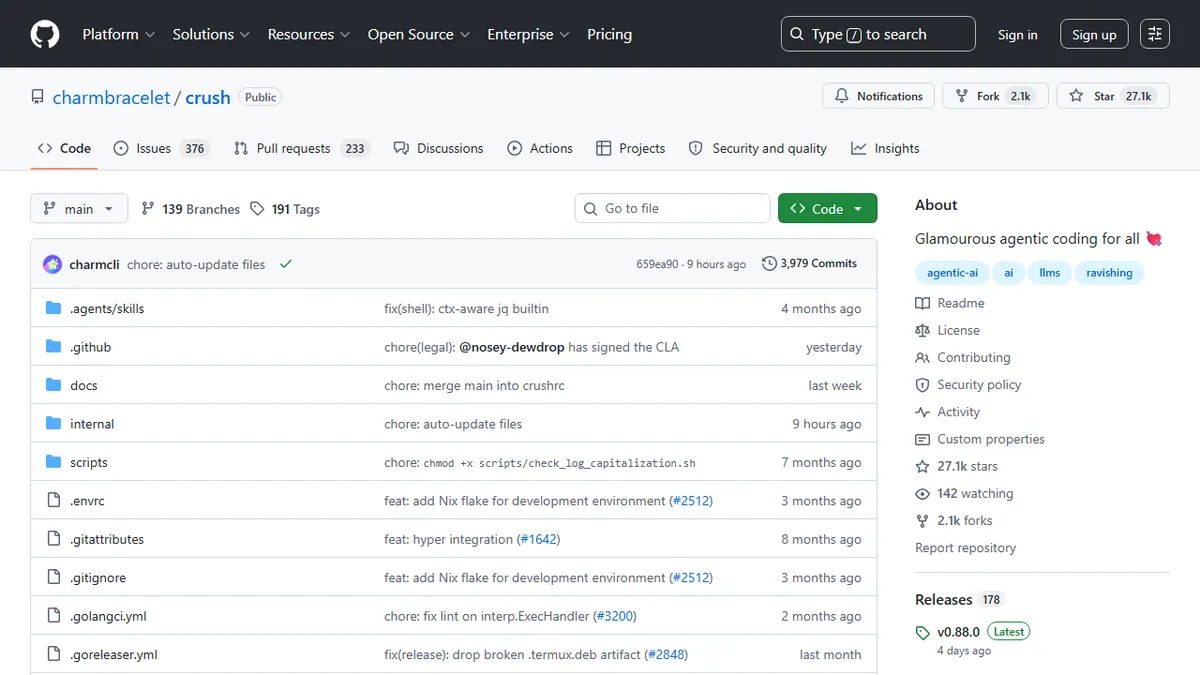
Crush
Not yet source-checkedGlamourous agentic coding for your terminal
Machine-drafted from the vendor's site · not yet source-checkedProfile updated Link checked Pricing captured How we rate
In short
Crush is a terminal-based agentic coding tool that integrates with multiple LLM providers, LSP, and MCP. It is best for developers who want a flexible, cross-platform CLI that supports mid-session model switching and headless workflows.
Terminal-native developers and platform engineers who want one agentic coding CLI that speaks every LLM provider, integrates MCP and LSP, and runs the same on macOS, Linux, Windows, and BSD.
Developers who want a zero-config, IDE-embedded assistant inside VS Code or JetBrains, or non-technical users who do not live in a terminal.
Crush is an open-source agentic coding CLI from Charm (the team behind Bubble Tea, Glow, and Gum) that puts a polished, TUI-first AI pair programmer inside your terminal. It is written in Go, ships as a single binary, and runs natively on macOS, Linux, Windows, BSDs, and Android, so the same tool works across every workstation and server you touch.
Unlike editor-locked assistants, Crush is provider-agnostic. It talks to Anthropic Claude, OpenAI, Google Gemini, Groq, Cerebras, OpenRouter, Vercel AI Gateway, Amazon Bedrock, Google VertexAI, Azure OpenAI, and any OpenAI- or Anthropic-compatible endpoint, plus local runtimes like Ollama, llama.cpp, and LM Studio. You can hot-swap the underlying model mid-session and keep the same conversation, files, and context, which makes it easy to route cheap tasks to a local model and reach for a frontier model only when the diff gets hard.
The agent loop is grounded in real tooling: it drives Language Server Protocol clients for accurate symbol context, executes shell commands and file edits with per-tool permission gating, and extends through Model Context Protocol servers over stdio, HTTP, and SSE. It also implements the Agent Skills standard, supports multiple concurrent sessions per project, generates Git commits and PR bodies, and can run headlessly as a backend via 'crush serve' for scripted or shared use.
Typical workflows include exploring an unfamiliar repo with LSP-aware questions, refactoring across files under supervised tool permissions, writing tests and running them in a loop, generating commit messages and PR descriptions, wiring MCP servers for internal APIs, and pairing a fast local model with an occasional call-out to Claude or GPT for hard reasoning steps. Configuration lives in a Bash-style .crushrc (or legacy JSON) so the same setup travels between machines through dotfiles.
Crush is the cleanest 'bring your own model' coding agent in a terminal I have used. Charm's design polish shows, and the combination of MCP, LSP, and free model-switching makes it genuinely useful for mixing a cheap local model with occasional Claude or GPT calls. If you already live in tmux, it is an easy install to justify.
— The AI Tool Bible editorial team
Pros
- ✅ Truly provider-agnostic: Claude, GPT, Gemini, Groq, Bedrock, VertexAI, Azure, OpenRouter, Ollama, llama.cpp, and any compatible endpoint
- ✅ Switch models mid-session without losing context, making mixed local/frontier routing practical
- ✅ First-class MCP support (stdio, HTTP, SSE) plus the Agent Skills standard for extensibility
- ✅ LSP integration gives the agent real symbol-level context instead of blind grep
- ✅ Single Go binary with installers for Homebrew, NPM, Arch, Nix, Winget, Scoop, and BSD pkg
- ✅ Per-tool permission model keeps shell and file writes gated by default
- ✅ Open source under FSL-1.1-MIT with an active, well-known maintainer (Charm) and 27k+ stars
- ✅ Runs headlessly via 'crush serve' for shared workspaces and scripted automations
Cons
- ⚠️ Terminal-only UX; no VS Code, JetBrains, or GUI integration if you prefer an IDE-embedded assistant
- ⚠️ Bring-your-own-key model means API costs land on you for any hosted frontier model
- ⚠️ Bash-style .crushrc and MCP wiring have a learning curve compared with zero-config IDE plugins
- ⚠️ FSL-1.1-MIT is source-available with usage restrictions before it converts to MIT, not a pure OSI license
- ⚠️ Younger project than Aider or Continue, so edge-case bugs and breaking config changes still land
- ⚠️ Quality of agentic edits depends heavily on which model you point it at; weak local models produce weak diffs
Pricing (captured )
| Tier | Monthly | Per seat | Key features |
|---|---|---|---|
| Free | $0 USD | — |
|
| Team | $4 USD per user / month | Yes |
|
| Enterprise | $21 USD per user / month | Yes |
|
Prices change; we show the grid as captured on Oct 30, 2026. Check current pricing on the vendor's site →
Facts
- API available
- Yes
- Free trial
- Yes
- Open source
- Yes (license: NOASSERTION)
- GitHub stars
- 28,855 (checked Oct 29, 2026)
- Last GitHub push
- Oct 29, 2026
- First commit
- May 2025
- Model used
- Provider-agnostic: Anthropic Claude, OpenAI GPT, Google Gemini, Groq, Cerebras, OpenRouter, Bedrock, VertexAI, Azure OpenAI, Ollama, llama.cpp, LM Studio, and any OpenAI/Anthropic-compatible endpoint
- Package downloads (30 d)
- 58,916 · npm @charmland/crush · checked Nov 10, 2026
Where this tool sits
Use cases
Frequently asked
- Which AI models does Crush support?
- Crush is provider-agnostic, supporting Anthropic Claude, OpenAI, Google Gemini, Groq, Cerebras, OpenRouter, Bedrock, VertexAI, Azure OpenAI, and local runtimes like Ollama and llama.cpp.
- Can I switch models during a coding session?
- Yes, you can hot-swap the underlying model mid-session while keeping the same conversation, files, and context, allowing you to route tasks to different models as needed.
- What is the pricing structure for Crush?
- Crush offers a free tier, a Team plan at $4 USD per user/month, and an Enterprise plan at $21 USD per user/month.
- Does Crush work on all major operating systems?
- Yes, it is written in Go and ships as a single binary that runs natively on macOS, Linux, Windows, BSDs, and Android.
- How does Crush handle code context and permissions?
- It uses Language Server Protocol clients for accurate symbol context and implements a per-tool permission model to gate shell commands and file edits.