
Count
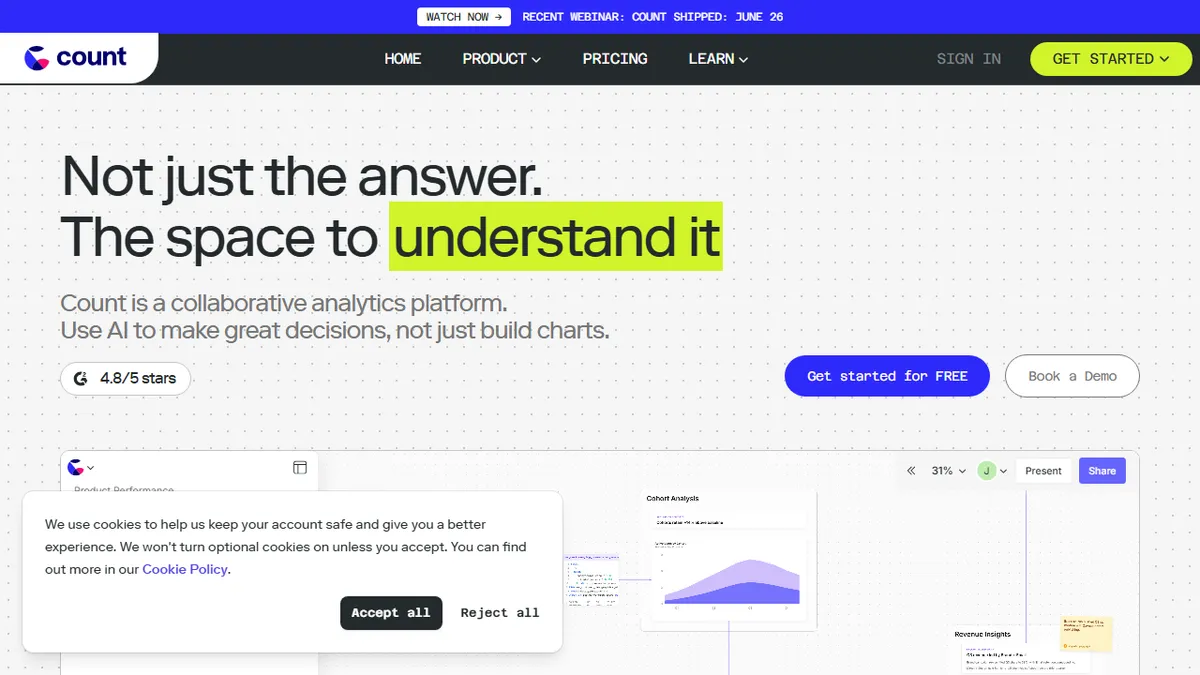
Collaborative AI-powered data canvas that blends SQL, Python, and natural-language agents for team analytics.
In short
Count provides a shared canvas where SQL, Python, and AI agents coexist for transparent data exploration. It is best for teams wanting self-serve BI with auditable AI outputs rather than black-box chat interfaces.
Pick Count if your data team wants AI agents embedded in a transparent SQL/Python canvas that business stakeholders can actually open and read.
Skip it if you need an on-prem or open-source BI stack, or if a handful of analysts already run fine in dbt plus a notebook.
Count is a collaborative analytics platform built around a shared canvas where SQL queries, Python notebooks, charts, and AI agents live side by side. The agents (backed by frontier models from Anthropic, OpenAI, and Google) let analysts and stakeholders ask questions in natural language, @-mention specific datasets or metrics, and get back auditable work that anyone on the team can inspect, fork, or tweak. It connects to warehouses, semantic layers, and BI tools via API and MCP, and surfaces results through interactive reports, metric trees, and process-flow maps.
The pitch is a self-serve BI alternative for data teams who want AI exploration without the black-box feeling of a pure chat interface. Pricing starts with a Free tier (3 editor seats, CSV only), Pro at $49 per editor/month with 75 collaborators included, Scale at $69 per editor/month with a 15-seat minimum, and an Enterprise tier with HIPAA, SSO, and row-level security. Viewer seats are unlimited across plans, which makes it cheaper to roll out across a non-technical org than seat-priced incumbents like Looker or Hex.
Integrations include Slack, an MCP client, and the standard warehouse connectors; agent context controls let you constrain what the AI is allowed to query and how it reasons. The product is proprietary and cloud-hosted, so teams that need on-prem or fully open-source tooling will need to look elsewhere.
Count is one of the more thoughtful answers to 'what does BI look like after LLMs,' favoring an inspectable canvas over a magic chat box. The unlimited-viewer pricing is the right instinct, though per-editor costs add up fast at scale. Best suited to teams that already think in metrics and want agents as collaborators, not oracles.
— The AI Tool Bible editorial team
Pros
- ✅ Canvas model keeps AI work auditable rather than locked in chat threads
- ✅ Unlimited viewer seats make org-wide rollout affordable
- ✅ MCP and API support for connecting warehouses and external tools
- ✅ Mixes SQL, Python, and agent prompts in a single workspace
Cons
- ⚠️ Closed source and cloud-only, no self-host option
- ⚠️ Per-editor pricing escalates quickly for larger analyst teams
- ⚠️ Scale tier requires a 15-seat minimum commitment
Use cases
Frequently asked
- How does Count integrate AI with traditional data tools?
- It combines SQL queries, Python notebooks, and AI agents on a single shared canvas. The agents are backed by frontier models from Anthropic, OpenAI, and Google, allowing users to ask questions in natural language while keeping work auditable.
- What are the pricing tiers for Count?
- Count offers a Free tier with 3 editor seats, Pro at $49 per editor/month, and Scale at $69 per editor/month with a 15-seat minimum. Enterprise pricing is custom and includes features like HIPAA and SSO.
- Can non-technical stakeholders use Count?
- Yes, viewer seats are unlimited across all plans, making it affordable for org-wide rollout. Stakeholders can inspect, fork, or tweak the work produced by analysts and AI agents.
- Does Count support on-premises deployment?
- No, Count is a proprietary, cloud-hosted product. Teams requiring on-prem or fully open-source tooling are advised to look elsewhere.
- What integrations does Count support?
- Count connects to warehouses, semantic layers, and BI tools via API and MCP. It also includes integrations for Slack and standard warehouse connectors.
Explore related
Compare with similar tools
All in Agents →LangGraph
FeaturedStateful, graph-based agent orchestration from LangChain.
CrewAI
FeaturedPython framework for multi-agent orchestration.
Ernie Bot
Baidu's Mandarin-first ChatGPT rival, powered by the ERNIE model family
Moveworks
The enterprise AI assistant that searches, answers, and takes action across your business systems
AWS Bedrock
Build and scale generative AI applications with foundation models
Claude Agent SDK
Anthropic's official SDK for building autonomous Claude agents.