Cookbook AI
Turn scattered recipes into a professionally designed, print-ready cookbook.
Home cooks turning handwritten family recipes into a keepsake book, private chefs assembling signature menus, and nutritionists packaging sellable meal-plan cookbooks without hiring a designer.
Publishers doing high-end commercial cookbooks who need real food photography and bespoke typography, or developers who want a recipe-parsing API to embed elsewhere.
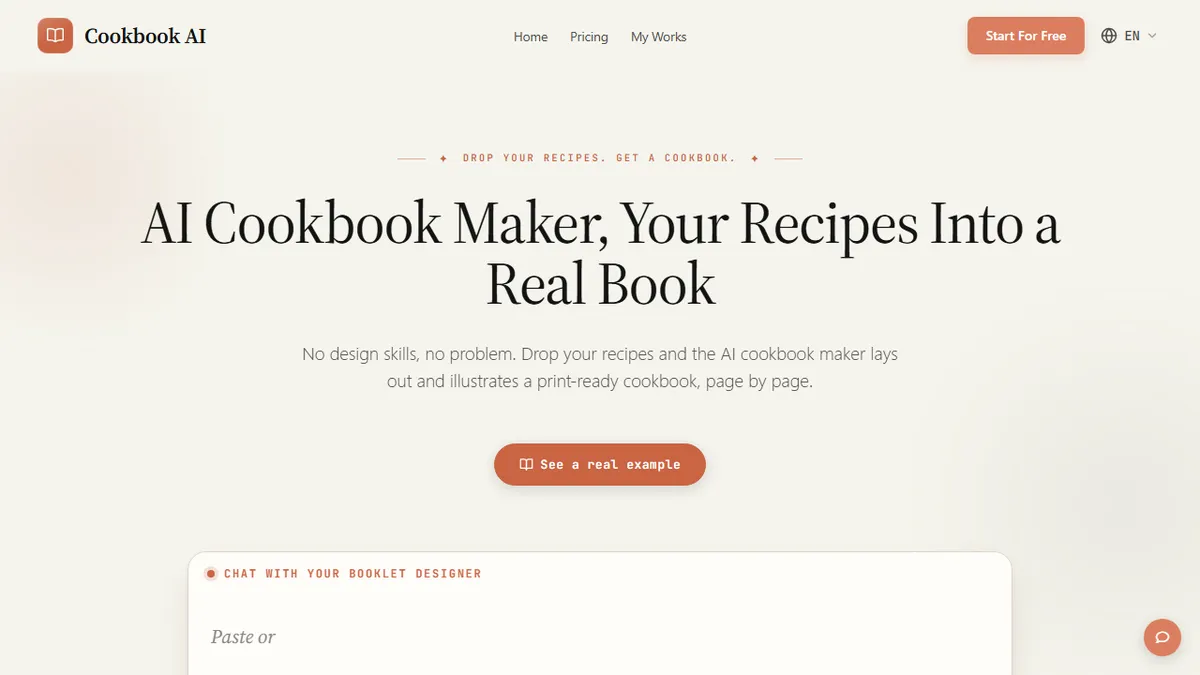
Cookbook AI (AI Cookbook Maker) is a niche generative-content tool that turns a mess of recipes — typed notes, PDFs, Word docs, photographs of index cards, screenshots of blog posts — into a single, coherently designed cookbook that is ready to print or share as a link. You feed it whatever raw material you have, and it ingests each recipe, extracts ingredients and steps, preserves the original wording and measurements rather than paraphrasing, and lays everything out on A4 pages with consistent typography, section dividers, and generated or sourced food photography for recipes that arrive image-less. Output is a downloadable print-ready PDF or a shareable web link, and users can go back into a chat-driven or visual editor to tweak individual pages before exporting.
The product is aimed at three fairly specific audiences: families collating heirloom recipes from handwritten cards into a keepsake book, private chefs and small restaurants building signature-dish collections or seasonal menus, and health professionals, nutritionists, and food creators packaging meal plans or diet cookbooks they can sell. It is not a general-purpose writing assistant or a Canva-style layout tool — the entire pipeline (parsing, categorisation into courses, image generation, page composition) is tuned specifically for recipe books. Multilingual support covers the major European and East Asian markets (English, Spanish, Portuguese, German, French, Italian, Japanese, Korean, Simplified and Traditional Chinese), which is unusual for a tool this narrow. Pricing is subscription-plus-credits with a yearly discount, but the underlying model stack is not disclosed on the marketing site.
A refreshingly focused tool: it does one thing — turn a pile of recipes into a book that looks like a book — and the workflow around photo-of-handwritten-card ingestion is genuinely useful for the family-keepsake use case. I would like to see published pricing and a named model stack before recommending it for anything commercial, and the AI-generated food shots are the obvious weak link if you plan to sell the output.
— The AI Tool Bible editorial team
Pros
- ✅ Ingests recipes from mixed sources (text, PDF, DOCX, photos of handwritten cards) without requiring you to normalise them first.
- ✅ Preserves original recipe wording and measurements instead of rewriting, which matters for family/heritage collections.
- ✅ Auto-generates or sources food photography for recipes that lack their own images.
- ✅ Outputs a genuinely print-ready A4 PDF plus a shareable web link, so the same file works for print-on-demand and for sending to relatives.
- ✅ Automatic organisation by course (appetizers, mains, desserts) removes a tedious manual step.
- ✅ Post-generation chat and visual editor let you fix layout or wording without regenerating from scratch.
- ✅ UI localised into ten languages including CJK, broader than most micro-SaaS tools in this space.
Cons
- ⚠️ Pricing is not disclosed on the public marketing page — you have to sign up to see plan costs and credit rates.
- ⚠️ Underlying models are not disclosed, so it is unclear how private or reproducible the image and layout generation is.
- ⚠️ Extremely narrow scope: only cookbooks. If you want a general recipe app, meal-planner, or cooking assistant, this is not it.
- ⚠️ AI-generated food photography can look uncanny or generic compared to real shot images, which may undercut a premium keepsake or commercial cookbook.
- ⚠️ A4-only page format is oriented at European printers; US-Letter users may need to reflow before sending to a domestic print shop.
- ⚠️ No visible API, integrations, or bulk workflow — it is a one-book-at-a-time consumer/prosumer tool.
Use cases
Explore related
Compare with similar tools
All in Writing →Claude
FeaturedAnthropic's flagship assistant for long-form writing, analysis, and coding.
GPT-4o
FeaturedOpenAI's multimodal flagship behind ChatGPT.
Gemini Advanced
Google's flagship — strong at math, long context, and Workspace integration.
Llama 3
Meta's open-weights LLM family that put serious frontier-adjacent models in everyone's hands.
Qwen
Alibaba's open-weight foundation model family covering chat, vision, image generation, translation, and safety classification.
Jan
Open-source desktop ChatGPT alternative that runs local LLMs and routes to cloud providers from one app.