
CocoIndex
✓ Text source-checked Nov 3, 2026Open-source incremental data framework for AI agents.
Source-checked against the vendor's site · rebuilt from the vendor's own pagesProfile updated Link checked How we rate
In short
CocoIndex is a free, open-source Rust-based framework that incrementally transforms diverse data into fresh context for AI agents, ensuring only changed data is processed.
CocoIndex is designed for any engineer working on AI workloads.
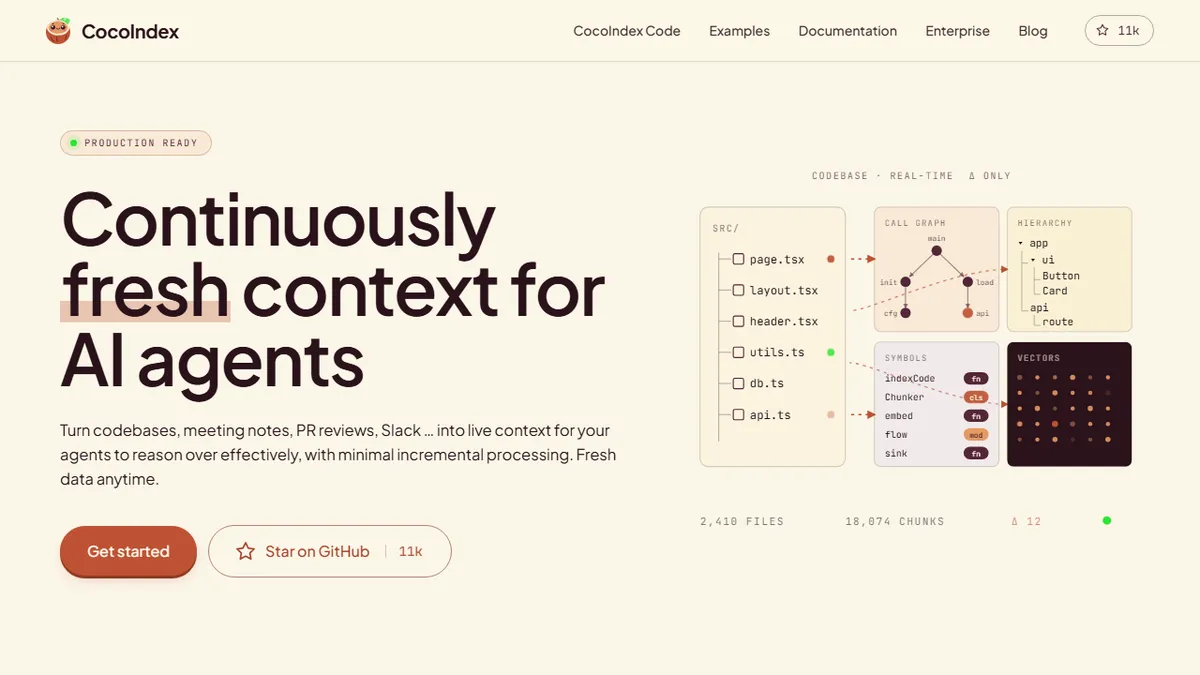
CocoIndex turns codebases, meeting notes, inboxes, Slack, PDFs, and videos into live, continuously fresh context for AI agents and LLM apps. CocoIndex functions as an incremental engine designed for long-horizon agents. The vendor says that the framework provides data transformation for engineers, designed for AI workloads with a smart incremental engine for always-fresh, explainable data.
CocoIndex reindexes only the delta, ensuring that only changed data is processed. Schemas evolve automatically within the framework without requiring manual migration meetings. The vendor says that CocoIndex provides end-to-end lineage, where every byte in the target traces back to a source. The system uses Python rather than a DAG, allowing users to write transforms while the engine derives the graph.
CocoIndex is built on a Rust engine, providing a production-grade core. The product scales from a single repository to petabyte-scale stores, operating in parallel by default and using delta-only processing by design.
CocoIndex supports macOS, Linux, and Windows operating systems with specific version and architecture requirements.
According to CocoIndex: CocoIndex turns codebases, Meeting notes, inboxes, Slack, PDFs, and videos into live, continuously fresh context for AI agents and LLM apps. Its pages list this strength: CocoIndex achieves sub-second freshness at any repository size.
— The AI Tool Bible editorial team
Pros
- ✅ CocoIndex achieves sub-second freshness at any repository size.
- ✅ The tool provides AST-based coding context including call graphs, hierarchies, symbol tables, and semantic indexes.
- ✅ The vendor says that the Rust engine features parallel chunking, zero-copy transforms where possible, and failure isolation.
- ✅ Schema evolution happens automatically without requiring index swaps or downtime.
Facts
- Platforms
- api (not source-checked)
- API available
- Yes (not source-checked)
- Open source
- Yes (license: Apache-2.0)
- GitHub stars
- 11,889 (checked Nov 13, 2026) (not source-checked)
- Last GitHub push
- Nov 12, 2026 (not source-checked)
- First commit
- Mar 2025 (not source-checked)
- Company
- CocoIndex (not source-checked)
- Model used
- Bring-your-own (embeddings + LLM) (not source-checked)
- Vendor pages
- Changelog
- Docs pages indexed
- 97 pages we found in the docs (not source-checked)
- Package downloads (30 d)
- 67,727 · pypi cocoindex · checked Nov 9, 2026 (not source-checked)
- Hacker News
- 24 stories · top 181 points · last Mar 24, 2026 · checked Nov 9, 2026
- Earliest Wayback capture
- 2024-12-20 (earliest archived capture of the site, not a launch date)
Where this tool sits
Use cases
Recent updates from CocoIndex
Frequently asked
- How much does CocoIndex cost?
- CocoIndex is free. It is an open-source framework. You must bring your own embeddings and LLM, so you will incur costs for those specific model services, but the framework itself has no listed price.
- What data sources can CocoIndex process?
- It supports codebases, meeting notes, inboxes, Slack, PDFs, and videos. It also handles call graphs, hierarchies, symbol tables, and semantic indexes, turning these into live context for AI agents and LLM applications.
- How does the incremental engine work?
- CocoIndex reindexes only the delta, ensuring only changed data is processed. This design allows it to scale from single repositories to petabyte-scale stores while operating in parallel by default, keeping data continuously fresh without full reprocessing.
- Is CocoIndex difficult to learn?
- It uses Python rather than a DAG, allowing users to write transforms while the engine derives the graph. Schemas evolve automatically without manual migration meetings, simplifying the workflow for engineers working on AI workloads.
- Which operating systems are supported?
- CocoIndex supports macOS, Linux, and Windows. Specific version and architecture requirements apply for each platform. The core is built on a Rust engine, providing a production-grade foundation for these environments.