Cloud World Model
Not yet source-checkedSimulate AWS, GCP, Azure, OCI, and DigitalOcean infrastructure without provisioning real resources.
Machine-drafted from the vendor's site · not yet source-checkedProfile updated Link checked Pricing captured How we rate
In short
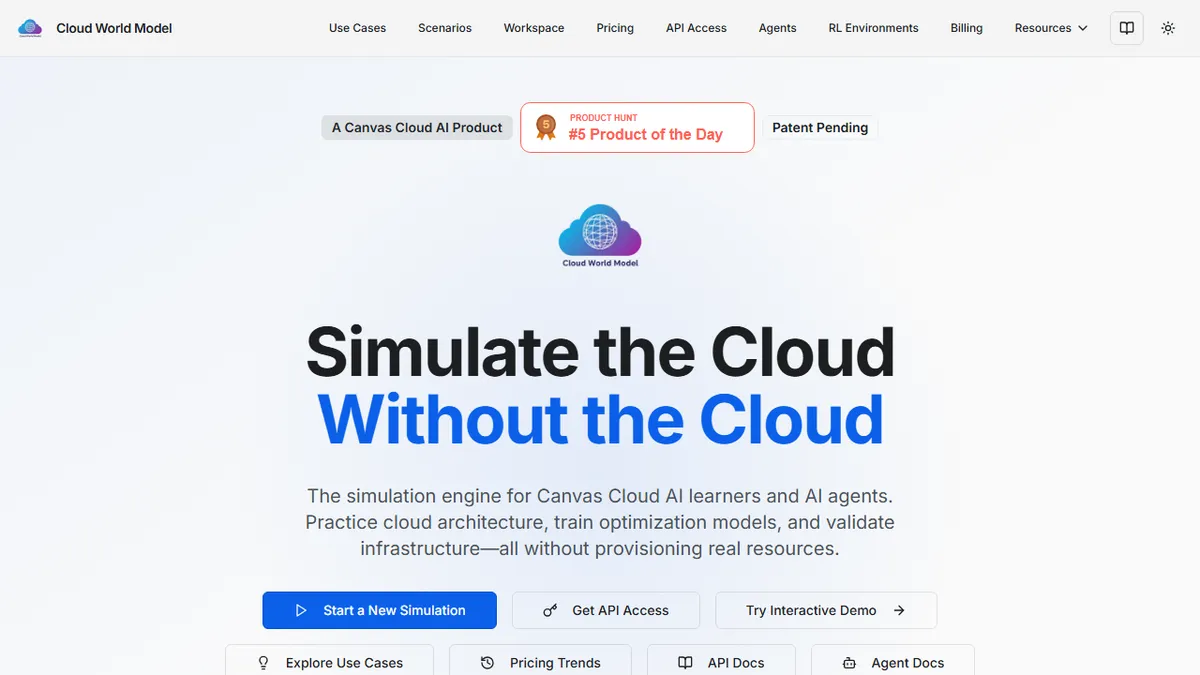
Cloud World Model simulates AWS, GCP, Azure, OCI, and DigitalOcean infrastructure for AI agents and learners. It provides a free, sandboxed environment to test architectures and chaos scenarios without real cloud costs.
Teams building LLM agents that need to reason about or plan cloud infrastructure, and learners who want a safe, billable-free sandbox to practice multi-cloud architecture and chaos scenarios.
Anyone who needs to actually provision or run production workloads, or teams requiring high-fidelity, contract-guaranteed emulation of specific cloud services for compliance testing.
Cloud World Model, built by Canvas Cloud AI, is a multi-cloud simulation platform that lets AI agents and human practitioners design, stress-test, and reason about infrastructure across AWS, GCP, Azure, Oracle Cloud, and DigitalOcean without spinning up (or paying for) real resources. Instead of a live cloud account, you get a sandboxed 'world model' that mirrors provider behaviour end-to-end: instances, networking, databases, observable metrics like CPU, latency, error rates, and running cost, plus chaos primitives such as AZ outages, added latency, and DB failures.
The product is aimed squarely at agentic workflows. It exposes a Model Context Protocol (MCP) server (listed on Smithery) and a REST API, so LLM agents can call it as a tool to plan architectures, run what-if experiments, and iterate on designs before touching production. Typical loops involve an agent proposing a topology, stepping the simulation, reading metrics, injecting a chaos event, and revising the design — all metered in cheap credits rather than real cloud bills.
Beyond agent tooling, teams use it as a training and evaluation surface for reinforcement learning on infrastructure decisions, as a low-stakes environment for cloud-architecture practice and interview prep (it slots into Canvas Cloud AI's learning material), and as a scratchpad for cross-provider cost comparison on a given workload. Documented 'Simulation Fidelity' benchmarks are used to show how closely the model tracks real provider behaviour. Credits are shared across all API keys on an account, and read-only endpoints are always free, which makes long-running agents cheap to keep polling state.
This is one of the more interesting 'world models for agents' I've seen — it treats the cloud itself as an environment an LLM can plan against, complete with metrics and chaos knobs, at credit-pack prices. The free tier is genuinely usable for wiring it into an agent loop, and the MCP-first posture matters. Just remember: it is a simulator, so trust it for exploration and RL, not as a substitute for a staging environment.
— The AI Tool Bible editorial team
Pros
- ✅ Purpose-built as an MCP tool for LLM agents, not a human-only UI, so wiring it into Claude/GPT agents is a first-class path.
- ✅ Covers five major clouds (AWS, GCP, Azure, OCI, DigitalOcean) in one simulator, which is rare for multi-cloud what-ifs.
- ✅ Chaos-engineering primitives (AZ outages, latency injection, DB failure) let agents test resilience without touching prod.
- ✅ Generous free tier (1,000 credits/month auto-refreshed, no card) makes it realistic to prototype agent loops for free.
- ✅ Paid credits never expire and are shared across API keys on the account, avoiding classic 'burn or lose' SaaS pressure.
- ✅ Read/status endpoints are always free, so idle polling by agents does not burn budget.
- ✅ Publishes a Simulation Fidelity benchmark rather than hiding accuracy claims behind marketing.
Cons
- ⚠️ It is a simulation, not real infrastructure — behaviour is approximated, so production decisions still need validation against the actual cloud.
- ⚠️ Not open source; you depend on Canvas Cloud AI to keep provider models current as AWS/GCP/Azure evolve.
- ⚠️ AI explanations cost 10 credits per call, which can add up quickly inside a chatty agent loop if not gated.
- ⚠️ Fidelity coverage across five providers is inherently uneven; edge-case services or newer offerings may be missing or shallow.
- ⚠️ Ecosystem is young — expect fewer community examples, terraform-style importers, or third-party integrations than mature cloud tools.
Pricing (captured )
| Tier | Monthly | Key features |
|---|---|---|
| Free | Free |
|
| Small | $9 |
|
| Medium | $49 |
|
| Large | $299 |
|
Prices change; we show the grid as captured on Oct 21, 2026. Check current pricing on the vendor's site →
Facts
- API available
- Yes
- Free trial
- Yes
- Hacker News
- 2 stories · top 3 points · last Jul 22, 2026 · checked Oct 9, 2026
- Earliest Wayback capture
- 2026-06-12 (earliest archived capture of the site, not a launch date)
Where this tool sits
Use cases
Frequently asked
- How much does Cloud World Model cost?
- It is freemium. The free tier includes 1,000 auto-refreshed monthly credits with no card required. Paid packs cost $9, $29, or $79. Credits never expire, and read-only endpoints are always free.
- Can I use it to run production workloads?
- No. It is a simulation platform, not a live cloud provider. You cannot provision real resources or run production workloads. It is designed for planning, testing, and learning, not for actual deployment.
- How do AI agents integrate with Cloud World Model?
- It exposes a Model Context Protocol (MCP) server and a REST API. LLM agents can call these to plan architectures, run simulations, read metrics, and inject chaos events as part of their workflow loops.
- Is it suitable for learning cloud architecture?
- Yes. It serves as a safe, billable-free sandbox for practicing multi-cloud architecture and chaos scenarios. It is used for cloud certification prep, interview practice, and reinforcement learning on infrastructure decisions.
- Which cloud providers are supported?
- Cloud World Model simulates infrastructure for AWS, GCP, Azure, Oracle Cloud (OCI), and DigitalOcean. It mirrors provider behavior including instances, networking, databases, and observable metrics like CPU and latency.