
Cleanlab TLM
Trustworthiness scoring layer that flags LLM hallucinations in real time.
In short
Cleanlab TLM adds real-time confidence scores to any LLM to flag hallucinations. It helps production teams gate risky outputs in RAG and agent workflows.
Pick Cleanlab TLM if you're shipping a RAG, agent, or chatbot product and need a numeric confidence signal to gate or escalate risky LLM outputs.
Skip it if you're a hobbyist or your app tolerates occasional hallucinations — the cost and integration overhead only pays off at production scale.
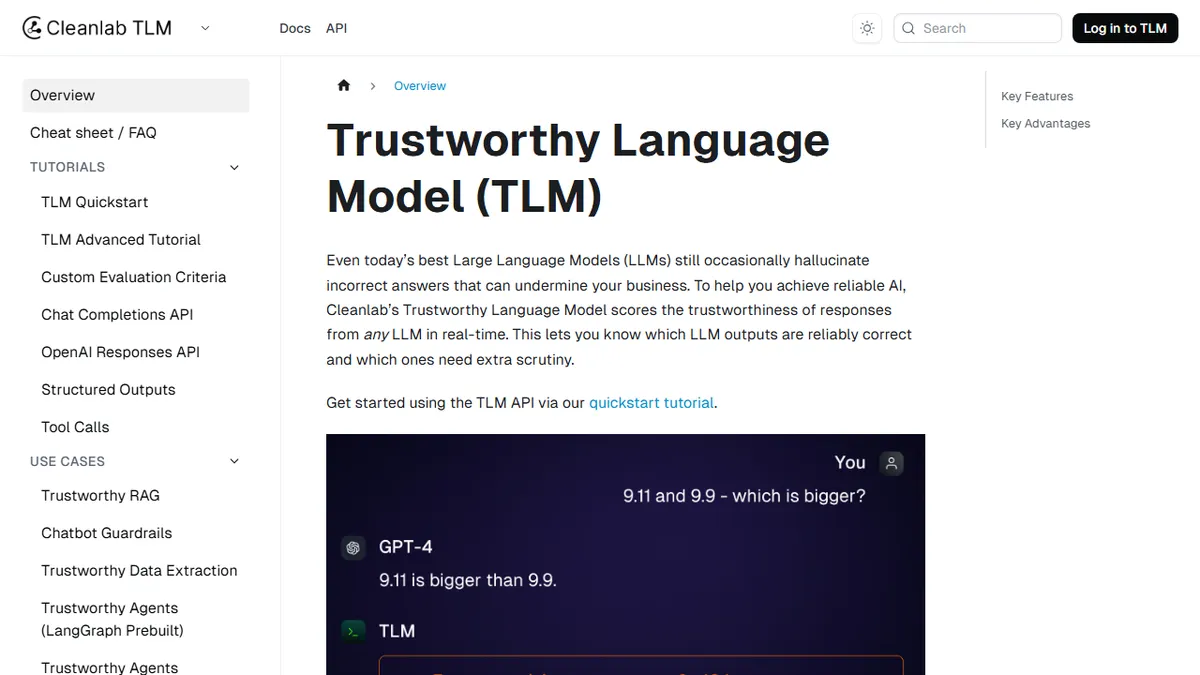
Cleanlab's Trustworthy Language Model (TLM) is a scoring service that sits alongside any LLM and assigns a real-time confidence score to each response, designed to catch hallucinations before they reach users. It can wrap an existing model (GPT, Claude, Gemini, open-weights) or act as a drop-in replacement that returns both an answer and a trustworthiness score, with configurable latency and cost tradeoffs for production use.
The target audience is engineering teams running RAG pipelines, agents, chatbots, or data-extraction workflows where wrong answers have real downstream cost. Cleanlab pitches TLM as more precise than competing hallucination detectors (they cite roughly 3x in RAG benchmarks), and it's sold primarily through a metered API plus enterprise/private-deployment contracts rather than a flat-rate consumer plan.
It integrates as a thin API call around your existing stack, so you keep your model choice and prompts; TLM just adds a numeric trust signal you can route on (block, escalate to a human, retry with a stronger model). Pricing isn't published on the TLM docs page itself; expect a free tier for evaluation and sales-led pricing for volume.
TLM is one of the more credible hallucination-scoring products on the market, built by the team behind the well-known Cleanlab data-quality library. The benchmarks are strong and the API-first design slots cleanly into existing stacks, but the lack of public pricing and the per-call overhead mean it's really an enterprise tool, not a weekend-project add-on.
— The AI Tool Bible editorial team
Pros
- ✅ Model-agnostic — works with any LLM provider or open-weights model
- ✅ Real-time trust scores enable automated routing and guardrails
- ✅ Strong published benchmarks vs other hallucination detectors
- ✅ Configurable latency/cost tradeoffs suitable for production
Cons
- ⚠️ Public pricing is opaque; serious volume needs sales contact
- ⚠️ Adds an extra API hop and latency to every LLM call
- ⚠️ Trust scores are probabilistic — not a hard correctness guarantee
Use cases
Frequently asked
- How much does Cleanlab TLM cost?
- Cleanlab TLM uses a freemium model. There is a free tier for evaluation, followed by usage-based API pricing. Enterprise and private deployment options are available through sales, with no flat-rate consumer plan published.
- Which LLM models does Cleanlab TLM support?
- It is a multi-model solution that wraps any LLM. You can use it with GPT, Claude, Gemini, or open-weights models. It acts as a thin API layer, allowing you to keep your existing model choice and prompts.
- Is Cleanlab TLM difficult to integrate?
- It integrates as a thin API call around your existing stack. You do not need to change your prompts or model selection. It simply adds a numeric trust signal that you can use to route, block, or escalate responses.
- Who should use Cleanlab TLM?
- It is best for engineering teams shipping RAG pipelines, agents, chatbots, or data-extraction workflows where wrong answers have downstream costs. Hobbyists or apps that tolerate occasional hallucinations should skip it due to integration overhead.
- How does TLM handle hallucinations?
- TLM assigns a real-time confidence score to each response to catch hallucinations before they reach users. You can configure latency and cost tradeoffs, and use the score to block, escalate to a human, or retry with a stronger model.
Explore related
Compare with similar tools
All in Evaluation →Braintrust
FeaturedEval, monitor, and improve AI products end-to-end.
LangSmith
LangChain's eval + observability platform.
Weights & Biases
The ML experiment tracker, now with LLM eval features.
Helicone
Open-source LLM observability — one-line proxy install.
Arize AI
Enterprise observability and evaluation platform for LLM agents and generative AI applications.
Giskard
Continuous AI red teaming platform that stress-tests LLM agents for vulnerabilities before they hit production.