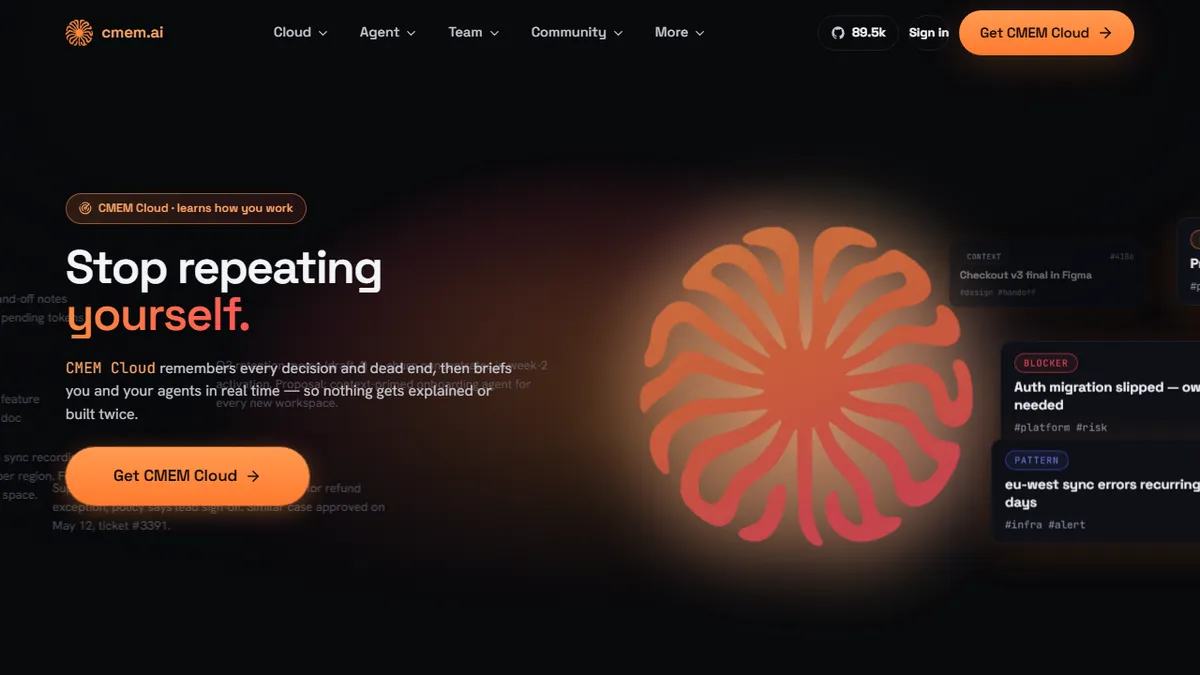
claude-mem
✓ Text source-checked Nov 4, 2026Keeps decisions, discoveries, and fixes from work ready for the next session, machine, and tool.
Source-checked against the vendor's site · rebuilt from the vendor's own pagesProfile updated Link checked Pricing captured How we rate
In short
claude-mem is an open-source memory engine that captures agent decisions and fixes into searchable local notes. Paid tiers add cloud sync and hosted observation for cross-device continuity.
claude-mem is an open-source memory engine. Supported integrations capture agent activity and turn useful decisions, discoveries, and fixes into searchable notes stored on the user's machine.
CMEM Pro adds hosted observation, cloud sync, and a private MCP connection. Cloud sync keeps captured project memory available when moving between connected computers.
The system supports recall of synced memory from MCP clients, including ChatGPT when the account supports custom connectors.
The local engine stores memory on the user's machine. If cloud sync is enabled, synced data is also stored by CMEM.
Capture functionality depends on the specific tool and integration installed. MCP connections provide recall, but connecting ChatGPT does not automatically capture ChatGPT conversations.
According to claude-mem: Claude-mem is an open-source memory engine. Its pages list this strength: The local claude-mem engine is open source. They also state this limitation: The ChatGPT connection does not automatically capture ChatGPT conversations or backfill local-only history.
— The AI Tool Bible editorial team
Pros
- ✅ The local claude-mem engine is open source.
- ✅ Progressive recall allows the agent to find a note before reading its details.
- ✅ Cloud sync keeps captured project memory available when moving between connected computers.
- ✅ Synced memory can be recalled from MCP clients, including ChatGPT when the account supports custom connectors.
Cons
- ⚠️ The ChatGPT connection does not automatically capture ChatGPT conversations or backfill local-only history.
- ⚠️ A credit or debit card is required for the trial, and prepaid cards are not eligible.
Pricing (captured )
| Tier | Monthly | Key features |
|---|---|---|
| claude-mem | Free |
|
| Pro | $30/mo |
|
| Heavy | $70/mo |
|
| CMEM Max | $100/mo |
|
Prices change; we show the grid as captured on Oct 24, 2026. Check current pricing on the vendor's site →
Facts
- Platforms
- macos, linux, windows
- API available
- Yes (not source-checked)
- Free trial
- Yes
- Open source
- Yes
- Model used
- Model-agnostic — works with the models used by the connected agent (Claude, GPT, Gemini, etc.) via MCP (not source-checked)
- Hacker News
- 1 story · top 1 points · last Jul 26, 2026 · checked Oct 9, 2026
- Earliest Wayback capture
- 2026-02-01 (earliest archived capture of the site, not a launch date)
Where this tool sits
Use cases
Frequently asked
- How much does claude-mem cost?
- The open-source version is free. Paid plans include CMEM Pro at $30/month, Heavy at $70/month, and CMEM Max at $100/month. These tiers add features like hosted observation and cloud sync.
- Which AI models does claude-mem support?
- It is model-agnostic and works with models used by connected agents, including Claude, GPT, and Gemini. It operates via MCP connections to capture activity from these supported integrations.
- Does claude-mem work with ChatGPT?
- Yes, it supports recall of synced memory from MCP clients, including ChatGPT if the account supports custom connectors. However, connecting ChatGPT does not automatically capture its conversations; capture depends on the specific integration installed.
- Where is my data stored?
- The local engine stores memory on your machine. If you enable cloud sync, synced data is also stored by CMEM. This allows captured project memory to remain available when moving between connected computers.
- What are the main use cases for claude-mem?
- It is used for searching past decisions, picking up work on another machine, and recalling history behind specific changes. It supports coding, research, and building custom tools by keeping discoveries and fixes ready for the next session.