
Chatfuel
AI messaging agents for WhatsApp, Instagram, Facebook, and TikTok built for small-business sales and bookings.
In short
Chatfuel offers LLM-powered agents for WhatsApp, Instagram, Facebook, and TikTok DMs. It targets small service businesses needing automated sales, bookings, and ad replies without complex flow building.
Pick Chatfuel if you run a service business that lives in Instagram or WhatsApp DMs and want an out-of-the-box sales and booking agent rather than a flow builder.
Skip it if you need a customizable open-source agent framework, transparent model choice, or a builder for non-Meta channels like SMS or web-only widgets.
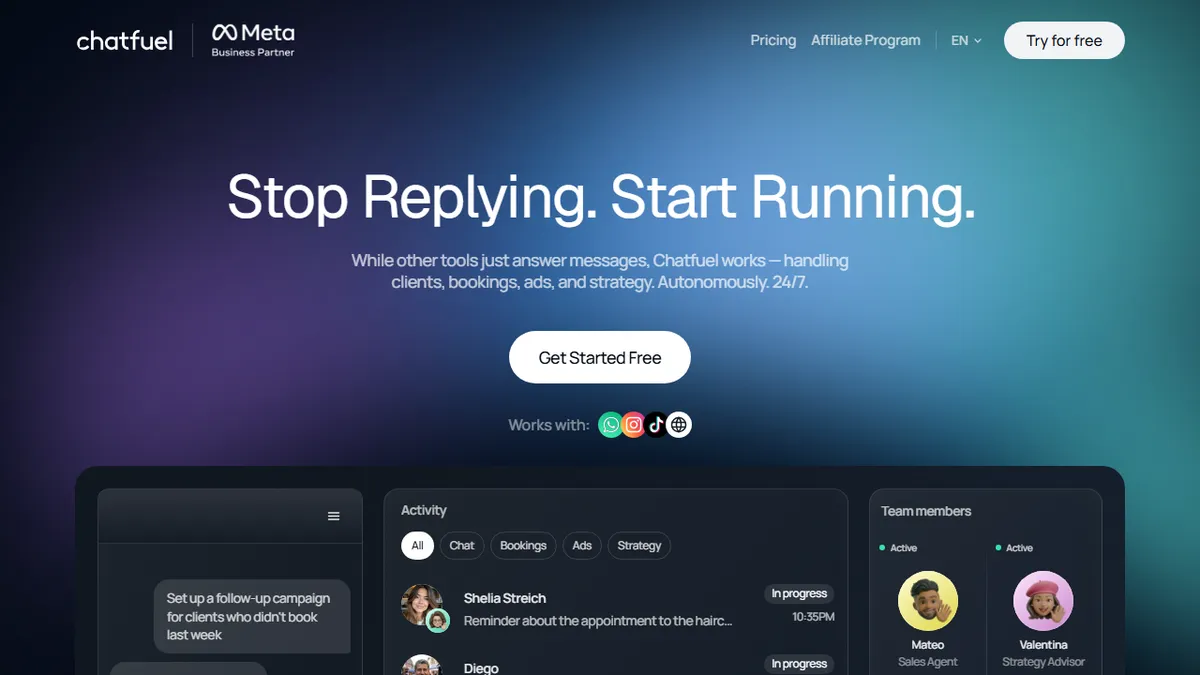
Chatfuel is a long-running chatbot platform (originally a Facebook Messenger bot builder) that has rebuilt itself around LLM-powered agents for social-commerce DMs. The product centers on four named AI agents — a sales qualifier, a marketing/ad-reply agent, a booking agent, and a strategy advisor — that handle inbound conversations across WhatsApp, Instagram, Facebook, and TikTok, plus a shared team inbox for human handoff.
The target customer is clearly a small or mid-sized service business (salons, clinics, local retailers, coaches) that lives in Instagram and WhatsApp DMs rather than email. The free Light tier covers basic automations and a shared inbox; AI PRO at $49/mo unlocks the agent stack, knowledge base, and lead-qualification funnels, with higher tiers gated by contact volume. Compared with general-purpose builders like ManyChat or Voiceflow, Chatfuel leans further into the WhatsApp Business API and into pre-built agent personas rather than a blank flow canvas.
Integrations cover Stripe, Google Sheets, Zapier, Shopify and a documented Chatfuel API for custom hooks. Caveats: it is a closed SaaS, the WhatsApp Business API relationship means per-conversation Meta fees still apply on top of the subscription, and the prebuilt agents trade depth of flow customization for setup speed.
Chatfuel has quietly survived the chatbot boom-bust cycle by going all-in on WhatsApp and Instagram commerce. The named-agent framing is a marketing skin, but the underlying product is one of the more credible options for SMBs who want DMs answered competently without hiring a flow designer. Just budget for Meta's per-conversation fees on top.
— The AI Tool Bible editorial team
Pros
- ✅ Official WhatsApp Business API partner with native Instagram and Facebook coverage
- ✅ Pre-built sales, marketing, booking, and strategy agents reduce setup time
- ✅ Free tier is generous enough to evaluate without a credit card
- ✅ Integrations with Stripe, Shopify, Google Sheets, Zapier, and a public API
Cons
- ⚠️ Underlying model is not disclosed and agent personas limit deep flow control
- ⚠️ WhatsApp conversation fees from Meta are billed on top of the subscription
- ⚠️ Closed source with no self-host option
- ⚠️ AI PRO jumps to $49/mo before contact volume add-ons kick in
Use cases
Frequently asked
- How much does Chatfuel cost?
- Chatfuel uses a freemium model. The Light tier is free, covering basic automations and a shared inbox. The AI PRO tier costs $49 per month, unlocking the agent stack, knowledge base, and lead-qualification funnels. Higher tiers are gated by contact volume.
- Which platforms does Chatfuel support?
- Chatfuel supports WhatsApp, Instagram, Facebook, and TikTok. It is specifically designed for social-commerce DMs on these channels. It does not support non-Meta channels like SMS or web-only widgets, which are noted as reasons to skip the tool.
- What integrations are available?
- Chatfuel integrates with Stripe, Google Sheets, Zapier, and Shopify. It also provides a documented Chatfuel API for custom hooks. Note that WhatsApp Business API usage incurs additional per-conversation Meta fees on top of the subscription.
- Is Chatfuel suitable for custom flow building?
- No. Chatfuel focuses on pre-built agent personas for sales, marketing, booking, and strategy. It trades depth of flow customization for setup speed. If you need a customizable open-source framework or a blank flow canvas, you should skip it.
- What AI model does Chatfuel use?
- The specific model is undisclosed, but the platform uses LLM-backed agents. It features four named agents: a sales qualifier, a marketing/ad-reply agent, a booking agent, and a strategy advisor, all handling inbound conversations.
Explore related
Compare with similar tools
All in Agents →LangGraph
FeaturedStateful, graph-based agent orchestration from LangChain.
CrewAI
FeaturedPython framework for multi-agent orchestration.
Ernie Bot
Baidu's Mandarin-first ChatGPT rival, powered by the ERNIE model family
Moveworks
The enterprise AI assistant that searches, answers, and takes action across your business systems
AWS Bedrock
Build and scale generative AI applications with foundation models
Claude Agent SDK
Anthropic's official SDK for building autonomous Claude agents.