Chassis
Not yet source-checkedOpen-source tool that auto-packages ML models into production-ready Docker containers with a prediction API.
Machine-drafted from the vendor's site · not yet source-checkedProfile updated Link checked How we rate
In short
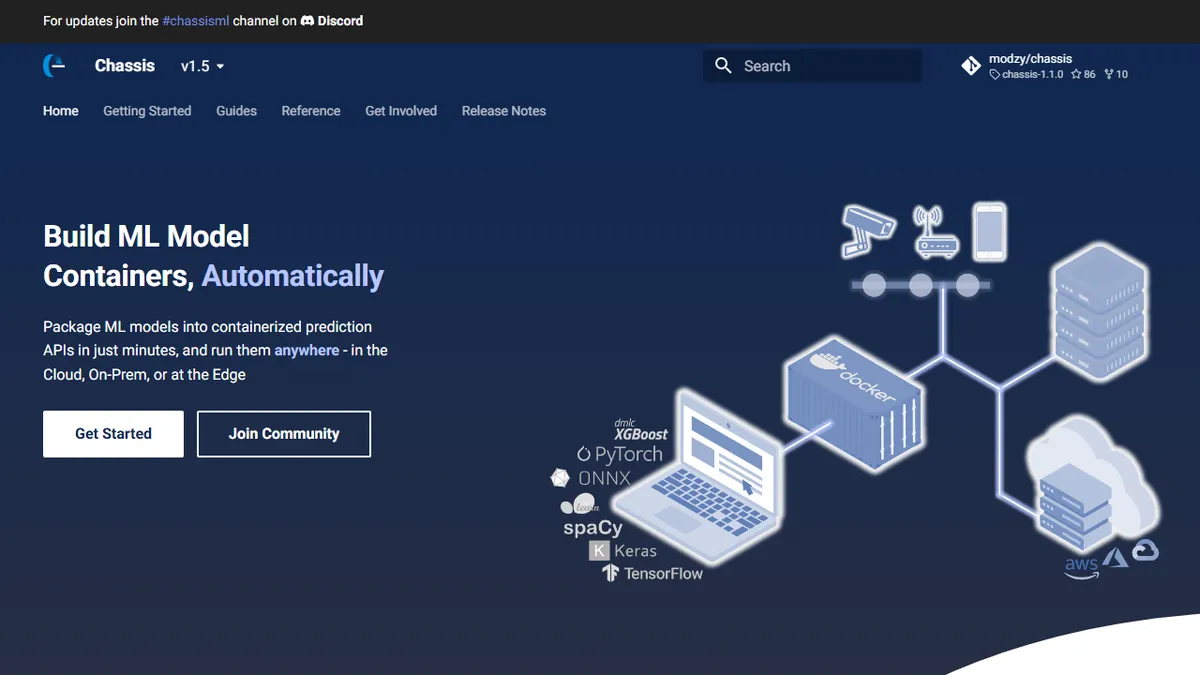
Chassis automates the packaging of trained Scikit-learn, PyTorch, or TensorFlow models into containerized prediction services. It is best for data scientists who need to deploy models to Kubernetes, Raspberry Pi, or Jetson without manually writing Dockerfiles or gRPC servers.
Pick Chassis if you have a trained Python ML model and need a reproducible container with a prediction API ready for cloud, on-prem, or edge.
Skip it if you need training, fine-tuning, or evaluation tooling, or if your stack already standardizes on KServe, BentoML, or Seldon.
Chassis is an open-source Python SDK that takes a trained ML model and emits a containerized prediction service with one function call. It supports the usual framework zoo (Scikit-learn, PyTorch, TensorFlow) and compiles for both x86 and ARM, so the same model can ship to a Kubernetes cluster, a Raspberry Pi, or an NVIDIA Jetson without re-wrapping the dependency hell each time.
The target user is the MLOps-light data scientist who can write Python and `pip install chassisml`, but doesn't want to hand-author a Dockerfile, a gRPC server, or a Kubernetes manifest just to expose a model. It is fully free and community-maintained under the modzy/chassis GitHub org, with Modzy as the original commercial sponsor; deployment to Modzy's platform is one of several supported targets (containerd, Docker, Kubernetes are all first-class).
Worth noting: Chassis is plumbing, not a model. It does not train, fine-tune, or evaluate; it solves the unglamorous packaging step. The project's release cadence has been quiet (v1.5 has been the current major for a while), so treat it as a stable utility rather than an aggressively evolving platform.
Chassis sits in a useful niche: the boring final mile between a notebook and a deployable container. The Python-only ergonomics are genuinely nice, and edge-target support is unusually thorough. Just go in knowing it's a packaging tool with modest momentum, not a competitor to BentoML's broader serving story.
— The AI Tool Bible editorial team
Pros
- ✅ One Python call turns a trained model into a Docker prediction container
- ✅ Cross-compiles for x86 and ARM, including Jetson and Raspberry Pi
- ✅ Framework-agnostic across Scikit-learn, PyTorch, TensorFlow
- ✅ Fully open source with no vendor lock-in to Modzy
Cons
- ⚠️ Not an AI model itself, just deployment glue
- ⚠️ Release activity has slowed; community support is the main channel
- ⚠️ Requires Docker installed locally and some wrapper code
Facts
- Platforms
- cli, api
- API available
- Yes
- Open source
- Yes (license: Apache-2.0)
- GitHub stars
- 87 (checked Nov 13, 2026)
- Last GitHub push
- Apr 24, 2024
- First commit
- May 2021
- Package downloads (30 d)
- 68 · pypi chassisml · checked Nov 9, 2026
Where this tool sits
Use cases
Frequently asked
- What machine learning frameworks does Chassis support?
- Chassis supports Scikit-learn, PyTorch, and TensorFlow, allowing users to package models from these frameworks into containers.
- Can Chassis deploy models to edge devices?
- Yes, Chassis compiles for both x86 and ARM architectures, enabling deployment to devices like Raspberry Pi and NVIDIA Jetson without re-wrapping dependencies.
- Does Chassis handle model training or evaluation?
- No, Chassis is strictly a packaging tool. It does not train, fine-tune, or evaluate models; it only handles the containerization step for deployment.
- Is Chassis free to use?
- Yes, Chassis is a free, open-source project maintained by the community under the modzy/chassis GitHub organization.