Caveman
The token-efficient stack for agent-native development
Platform and infra engineers running non-trivial LLM traffic across multiple providers who want measurable cost savings, per-team spend visibility, and an auditable governance layer without rewriting their agent code.
Solo hobbyists making occasional API calls, teams locked to a single provider's console, or anyone unwilling to route production LLM traffic through an additional SDK or gateway hop.
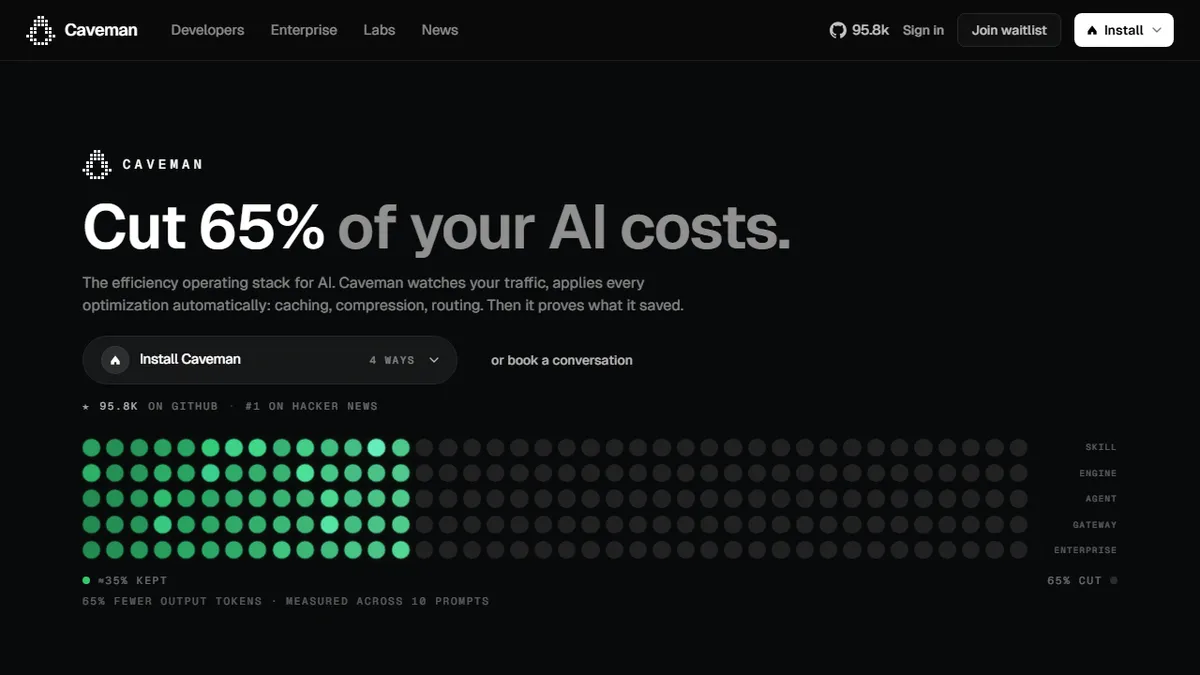
Caveman is a token-efficiency layer that sits between your application and large language model providers (Claude, GPT, Gemini, and 30+ others) and cuts inference cost — the company claims by around 65% — while preserving byte-for-byte output fidelity. It works by monitoring outbound LLM traffic and automatically applying caching, prompt/output compression, and cross-model routing so cheaper models handle the work they can and premium models are reserved for the calls that actually need them.
The product ships as a five-tier stack. Caveman Skill is a free, MIT-licensed toolkit you drop into a project. Caveman Engine is a runtime/CLI with a free single-seat tier. The Agent SDK exposes the optimizations programmatically for agent authors, the Gateway is a hosted proxy that intercepts LLM calls, and the Enterprise tier layers on governance — a visibility dashboard that breaks spend down by member, API key, model, and workflow; shadow-mode testing so you can validate optimizations against real traffic before promoting them; an Autopilot that opens pull requests with measured cost/quality deltas; and Ed25519-signed audit receipts for compliance.
Caveman also publishes CaveGemma, a fine-tuned Gemma-4 model released under MIT for teams that want to run a compression-aware model in-house. Typical workflows include shrinking system prompts that get re-sent on every turn, caching structured-extraction responses (invoice fields, form parsing), routing straightforward code generation to smaller models, and giving platform engineers a single pane of glass over multi-provider LLM spend across a whole engineering org.
It targets teams whose LLM bill has become a real line item and who are comfortable slotting a gateway or SDK into their stack — infra-minded developers building on top of foundation-model APIs rather than end users of a single chat product.
Caveman is one of the more credible entrants in the 'FinOps for LLMs' space — the open-source Skill tier, shadow-mode validation, and signed audit trail suggest the team understands that infra sitting in front of every LLM call has to earn trust before it earns budget. Whether you'll see the marketed 65% savings depends entirely on your traffic mix, but the free tier makes it cheap to find out.
— The AI Tool Bible editorial team
Pros
- ✅ Vendor-neutral: works across Claude, GPT, Gemini and 30+ agent runtimes rather than locking you to one provider
- ✅ Open-source core (MIT-licensed Skill package and CaveGemma weights) lets you audit and self-host the primitives
- ✅ Free single-seat Engine tier is enough to prove the cost savings on a real workload before committing
- ✅ Shadow-mode plus PR-driven Autopilot means optimizations land with measured deltas, not blind swaps
- ✅ Per-member/per-key/per-model spend dashboard gives platform teams the accountability layer most LLM stacks lack
- ✅ Ed25519-signed audit receipts are a genuine differentiator for regulated environments
Cons
- ⚠️ Adds a gateway or SDK dependency in the hot path of every LLM call — an extra failure surface to operate
- ⚠️ The headline '65% cost cut' is workload-dependent; savings on already-terse prompts or single-model shops will be far smaller
- ⚠️ Enterprise pricing is not published, so budgeting requires a sales conversation
- ⚠️ Value is thin for solo builders making a handful of API calls a day — this is infrastructure aimed at scaled traffic
- ⚠️ Compression and cross-model routing can subtly change model behaviour at the margins; regression testing is on you
Use cases
Explore related
Compare with similar tools
All in Agents →LangGraph
FeaturedStateful, graph-based agent orchestration from LangChain.
CrewAI
FeaturedPython framework for multi-agent orchestration.
Ernie Bot
Baidu's Mandarin-first ChatGPT rival, powered by the ERNIE model family
Moveworks
The enterprise AI assistant that searches, answers, and takes action across your business systems
AWS Bedrock
Build and scale generative AI applications with foundation models
Claude Agent SDK
Anthropic's official SDK for building autonomous Claude agents.