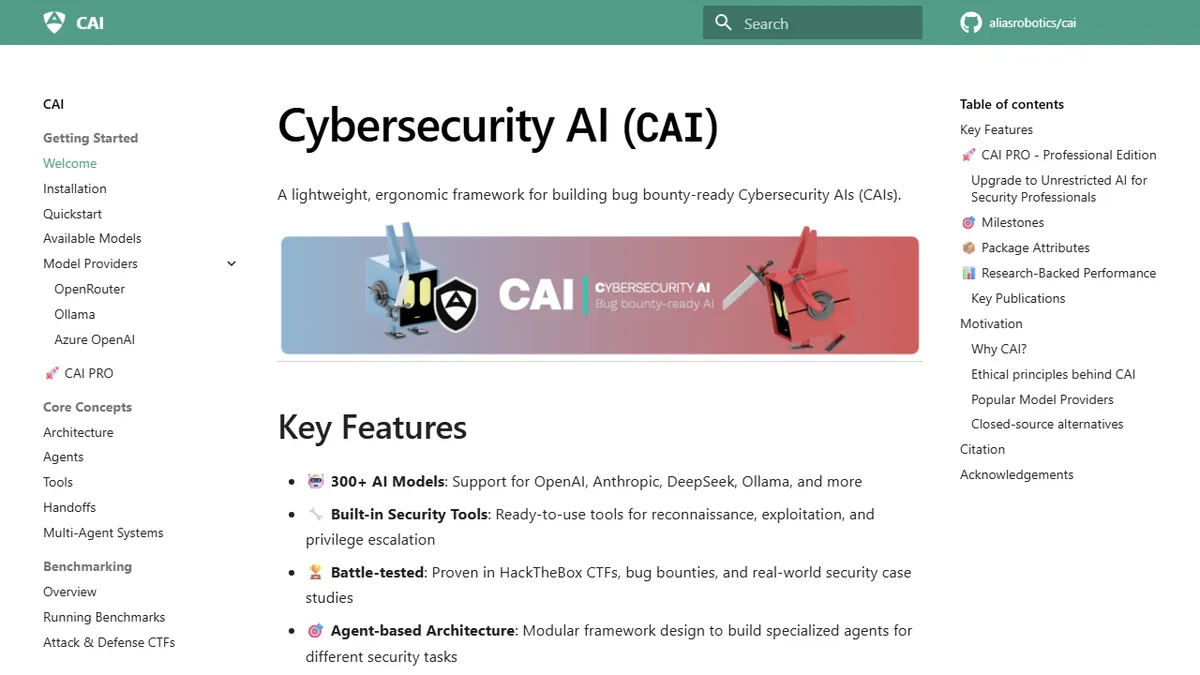

CAI
Open-source agent framework for offensive security, bug bounty automation, and AI-driven penetration testing.
In short
CAI is a code-first, open-source agent framework for autonomous penetration testing and bug bounty automation. It is best for security researchers who need a scriptable, model-agnostic stack rather than a closed SaaS dashboard.
Pick CAI if you are a security researcher or bug bounty hunter who wants a scriptable, model-agnostic agent stack tuned for offensive workflows.
Skip it if you want a no-code security scanner, a defensive SOC copilot, or a hosted SaaS pentest service.
CAI (Cybersecurity AI) is an open-source framework from Alias Robotics for building autonomous and human-in-the-loop security agents. It ships with built-in reconnaissance, exploitation, and privilege-escalation tools, a multi-agent architecture, prompt-injection guardrails, and tracing via Phoenix. The framework brokers calls across 300+ models through providers like OpenAI, Anthropic, and DeepSeek, so teams can mix general LLMs with security-specialised ones.
It is aimed at bug bounty hunters, red teamers, and security researchers who want a code-first agent stack rather than a closed SaaS dashboard. The OSS edition is free for research use; a commercial CAI PRO tier at roughly EUR 350/month adds unlimited usage of the proprietary `alias1` offensive-security model, EU-hosted GDPR/NIS2 infrastructure, an iOS TestFlight client, and vendor support. The team cites a first-place finish in HackTheBox's Human vs AI CTF and peer-reviewed benchmarks showing large speedups over manual testing.
Integration is Python-native with tooling that plugs into existing offensive workflows. The main caveats are that it is a developer framework rather than a polished product, the `alias1` model is gated behind PRO, and operators are responsible for staying within legal scope when pointing autonomous agents at live targets.
CAI is one of the few credible open-source agent frameworks aimed squarely at offensive security rather than generic chat. The benchmark results and EU-hosted PRO tier make it a serious option for bug bounty teams, though the framework-first approach means you are still writing Python and owning the legal blast radius.
— The AI Tool Bible editorial team
Pros
- ✅ Open-source framework with a permissive research path
- ✅ Model-agnostic across 300+ LLMs via standard providers
- ✅ Purpose-built offensive tooling and multi-agent orchestration
- ✅ Proven on competitive CTF benchmarks vs other AI agents
- ✅ EU-hosted PRO option for GDPR/NIS2-sensitive teams
Cons
- ⚠️ Framework, not a turnkey product - requires Python skill
- ⚠️ Proprietary alias1 model locked behind PRO tier
- ⚠️ Autonomous offensive use raises legal and scoping risk
- ⚠️ Documentation-heavy onboarding; smaller community than generic agent stacks
Use cases
Frequently asked
- What is the pricing model for CAI?
- The open-source edition is free for research use. A commercial CAI PRO tier costs approximately EUR 350 per month and includes unlimited usage of the proprietary alias1 model.
- Which AI models does CAI support?
- CAI brokers calls across more than 300 models through providers like OpenAI, Anthropic, and DeepSeek. It also features a proprietary offensive-security model called alias1, which is available in the PRO tier.
- Who is CAI designed for?
- It is aimed at bug bounty hunters, red teamers, and security researchers who prefer a code-first agent stack. It is not suitable for users seeking a no-code scanner or a defensive SOC copilot.
- Does CAI include offensive security tools?
- Yes, the framework ships with built-in reconnaissance, exploitation, and privilege-escalation tools, along with a multi-agent architecture and prompt-injection guardrails.
- What are the main limitations of using CAI?
- CAI is a developer framework requiring Python skills rather than a turnkey product. Operators are responsible for staying within legal scope when using autonomous agents on live targets.
Explore related
Compare with similar tools
All in Agents →LangGraph
FeaturedStateful, graph-based agent orchestration from LangChain.
CrewAI
FeaturedPython framework for multi-agent orchestration.
Ernie Bot
Baidu's Mandarin-first ChatGPT rival, powered by the ERNIE model family
Moveworks
The enterprise AI assistant that searches, answers, and takes action across your business systems
AWS Bedrock
Build and scale generative AI applications with foundation models
Claude Agent SDK
Anthropic's official SDK for building autonomous Claude agents.